QUESTION IMAGE
Question
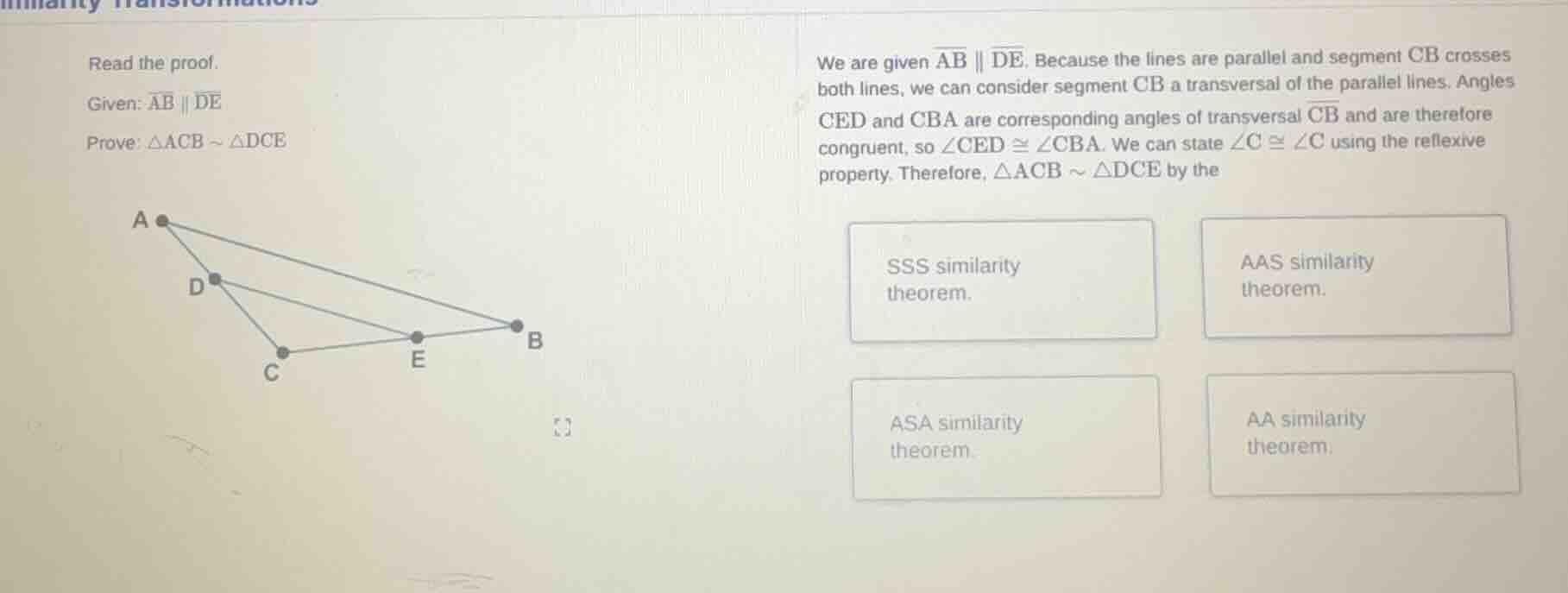
read the proof. given: \\(\overline{ab} \parallel \overline{de}\\) prove: \\(\triangle acb \sim \triangle dce\\) we are given \\(\overline{ab} \parallel \overline{de}\\). because the lines are parallel and segment cb crosses both lines, we can consider segment cb a transversal of the parallel lines. angles ced and cba are corresponding angles of transversal \\(\overline{cb}\\) and are therefore congruent, so \\(\angle ced \cong \angle cba\\). we can state \\(\angle c \cong \angle c\\) using the reflexive property. therefore, \\(\triangle acb \sim \triangle dce\\) by the \
sss similarity theorem. \
aas similarity theorem. \
asa similarity theorem. \
aa similarity theorem.
To determine the similarity theorem, we analyze the given proof:
- We have \(\angle CED \cong \angle CBA\) (corresponding angles from parallel lines).
- We have \(\angle C \cong \angle C\) (reflexive property, a common angle).
The AA (Angle - Angle) similarity theorem states that if two angles of one triangle are congruent to two angles of another triangle, then the triangles are similar. Here, we have two pairs of congruent angles (\(\angle CED \cong \angle CBA\) and \(\angle C \cong \angle C\)), so the AA similarity theorem applies.
The SSS similarity theorem requires three pairs of proportional sides, which we don't have information about. The AAS similarity theorem is for congruence (and also requires a side - angle - angle relationship for congruence, not similarity in the way we need here), and the ASA similarity theorem is also more about congruence with a specific angle - side - angle order and is not the right fit for this similarity proof with the given angle information.

Snap & solve any problem in the app
Get step-by-step solutions on Sovi AI
Photo-based solutions with guided steps
Explore more problems and detailed explanations
AA similarity theorem.