QUESTION IMAGE
Question
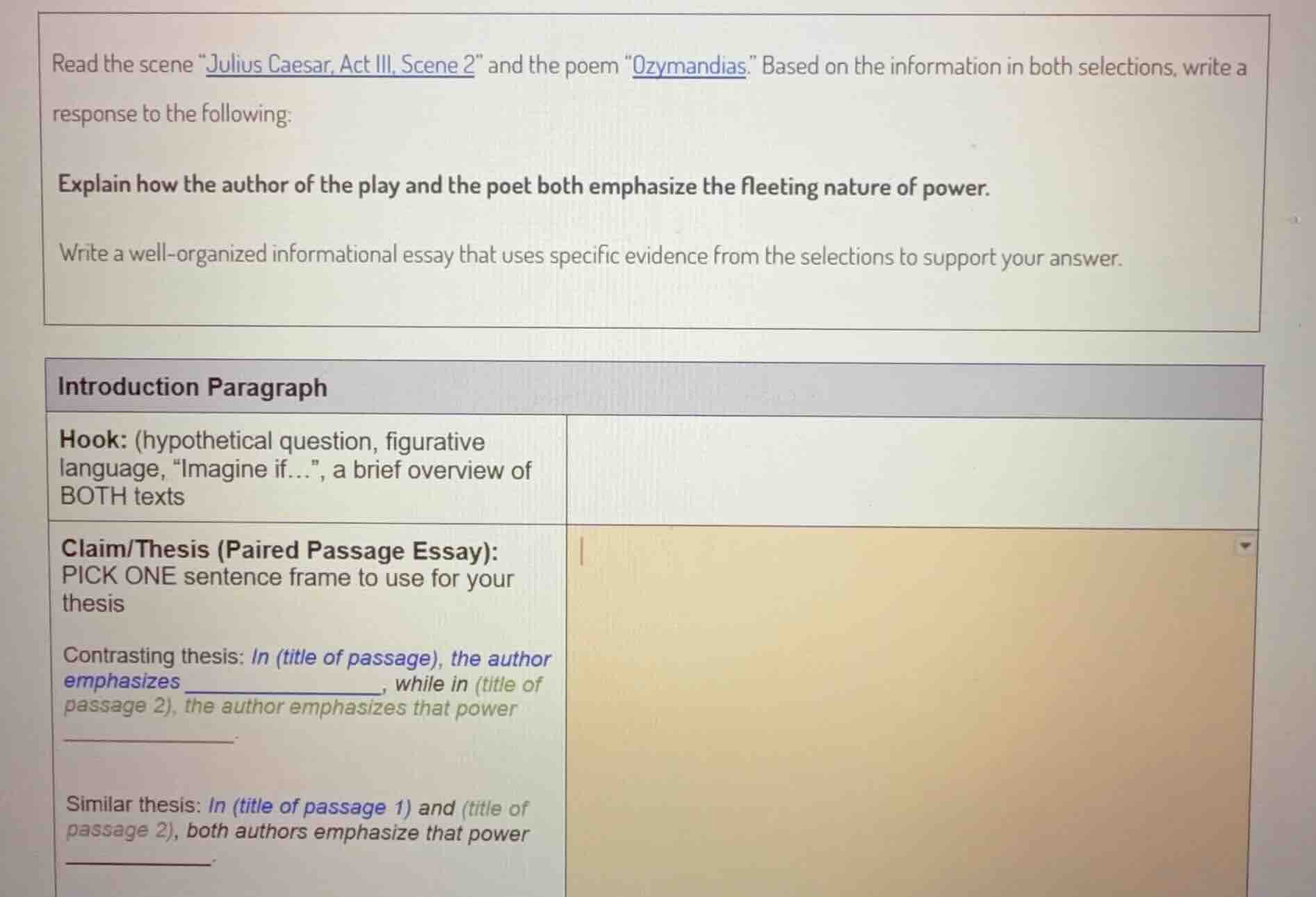
read the scene \julius caesar, act iii, scene 2\ and the poem \ozymandias.\ based on the information in both selections, write a response to the following:
explain how the author of the play and the poet both emphasize the fleeting nature of power.
write a well-organized informational essay that uses specific evidence from the selections to support your answer.
introduction paragraph
hook: (hypothetical question, figurative language, \imagine if...\, a brief overview of both texts
claim/thesis (paired passage essay):
pick one sentence frame to use for your thesis
contrasting thesis: in (title of passage), the author emphasizes _____________, while in (title of passage 2), the author emphasizes that power _____________.
similar thesis: in (title of passage 1) and (title of passage 2), both authors emphasize that power _______________.
First, craft a hook that connects the two texts. Then, use the similar thesis frame to state the core claim about power's fleeting nature, followed by body paragraphs with specific evidence: in Julius Caesar, Act III, Scene 2, Caesar's sudden assassination and the rapid shift of political control show power can vanish in an instant; in "Ozymandias," the ruined statue and the inscription "Look on my Works, ye Mighty, and despair!" contrasted with the empty desert prove even the most arrogant, absolute power crumbles over time. Finally, a conclusion ties the two texts' messages together.

Snap & solve any problem in the app
Get step-by-step solutions on Sovi AI
Photo-based solutions with guided steps
Explore more problems and detailed explanations
Introduction Paragraph
Hook:
Imagine a ruler who believes their power is eternal—until a single betrayal or the slow grind of time reduces their legacy to dust. In Shakespeare’s Julius Caesar, Act III, Scene 2, a beloved dictator falls in moments, while Percy Shelley’s "Ozymandias" reveals a once-great king’s empire as nothing but desert ruins.
Claim/Thesis (Paired Passage Essay):
In Julius Caesar, Act III, Scene 2 and "Ozymandias," both authors emphasize that power is a temporary, fragile force that cannot outlast the forces of chance or time.
Body Paragraph 1 (Julius Caesar Evidence)
Shakespeare highlights power’s fleetingness through Caesar’s abrupt assassination. Moments before his death, Caesar is a revered leader, addressed as "most high, most mighty, and most puissant Caesar" (Act III, Scene 2). But in seconds, the conspirators’ knives end his reign, and the crowd’s loyalty shifts instantly from mourning Caesar to cheering Brutus, then turning on the conspirators when Antony delivers his funeral oration. This rapid reversal shows that even the most seemingly solid political power can dissolve in an instant, dependent on the whims of others and vulnerable to sudden betrayal.
Body Paragraph 2 (Ozymandias Evidence)
Shelley uses imagery of decay to show power’s impermanence. The poem describes a broken statue in the desert: "Two vast and trunkless legs of stone / Stand in the desert... Near them, on the sand, / Half sunk a shattered visage lies." The inscription on the pedestal boasts, "My name is Ozymandias, King of Kings; / Look on my Works, ye Mighty, and despair!" but no trace of his empire remains—only "the lone and level sands stretch far away." This contrast between the king’s arrogant claim of eternal power and the empty, ruined landscape proves that even the most absolute, self-proclaimed power is erased by time, leaving no lasting mark.
Conclusion
Both Julius Caesar, Act III, Scene 2 and "Ozymandias" use specific, vivid details to argue that power is not permanent. Shakespeare shows how power can vanish in a single, violent moment, while Shelley demonstrates how it erodes slowly but completely over centuries. Together, they make clear that no amount of wealth, fear, or pride can make power last forever.