QUESTION IMAGE
Question
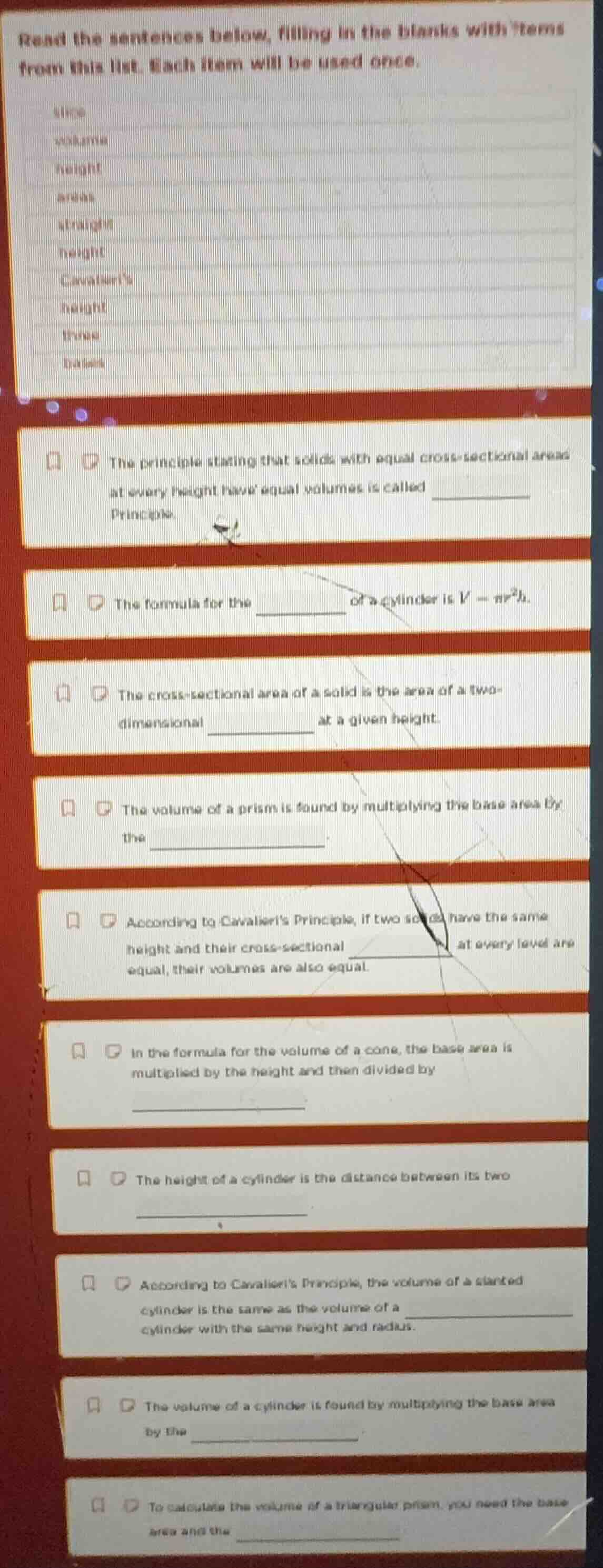
read the sentences below, filling in the blanks with items from this list. each item will be used once.
the principle stating that solids with equal cross - sectional areas at every height have equal volumes is called ________ principle.
the formula for the ________ of a cylinder is (v=pi r^{2}h).
the cross - sectional area of a solid is the area of a two - dimensional ________ at a given height.
the volume of a prism is found by multiplying the base area by the ________.
according to cavalieri’s principle, if two solids have the same height and their cross - sectional ________ at every level are equal, their volumes are also equal.
in the formula for the volume of a cone, the base area is multiplied by the height and then divided by ________.
the height of a cylinder is the distance between its two ________.
according to cavalieri’s principle, the volume of a slanted cylinder is the same as the volume of a ________ cylinder with the same height and radius.
the volume of a cylinder is found by multiplying the base area by the ________.
to calculate the volume of a triangular prism, you need the base area and the ________.
- Identified the matching term for the geometric principle described.
- Matched the formula to the correct 3D measurement term.
- Defined cross-section as a 2D slice of a solid.
- Linked prism volume calculation to the required dimension.
- Connected Cavalieri's Principle's condition to cross-sectional measurements.
- Recalled the cone volume formula's divisor.
- Identified the two flat faces of a cylinder.
- Contrasted slanted and standard cylinder types for volume equivalence.
- Linked cylinder volume calculation to the required dimension.
- Linked triangular prism volume calculation to the required dimension.

Snap & solve any problem in the app
Get step-by-step solutions on Sovi AI
Photo-based solutions with guided steps
Explore more problems and detailed explanations
- The principle stating that solids with equal cross-sectional areas at every height have equal volumes is called Cavalieri's Principle.
- The formula for the volume of a cylinder is $V = \pi r^2 h$.
- The cross-sectional area of a solid is the area of a two-dimensional slice at a given height.
- The volume of a prism is found by multiplying the base area by the height.
- According to Cavalieri's Principle, if two solids have the same height and their cross-sectional areas at every level are equal, their volumes are also equal.
- In the formula for the volume of a cone, the base area is multiplied by the height and then divided by three.
- The height of a cylinder is the distance between its two bases.
- According to Cavalieri's Principle, the volume of a slanted cylinder is the same as the volume of a straight cylinder with the same height and radius.
- The volume of a cylinder is found by multiplying the base area by the height.
- To calculate the volume of a triangular prism, you need the base area and the height.