QUESTION IMAGE
Question
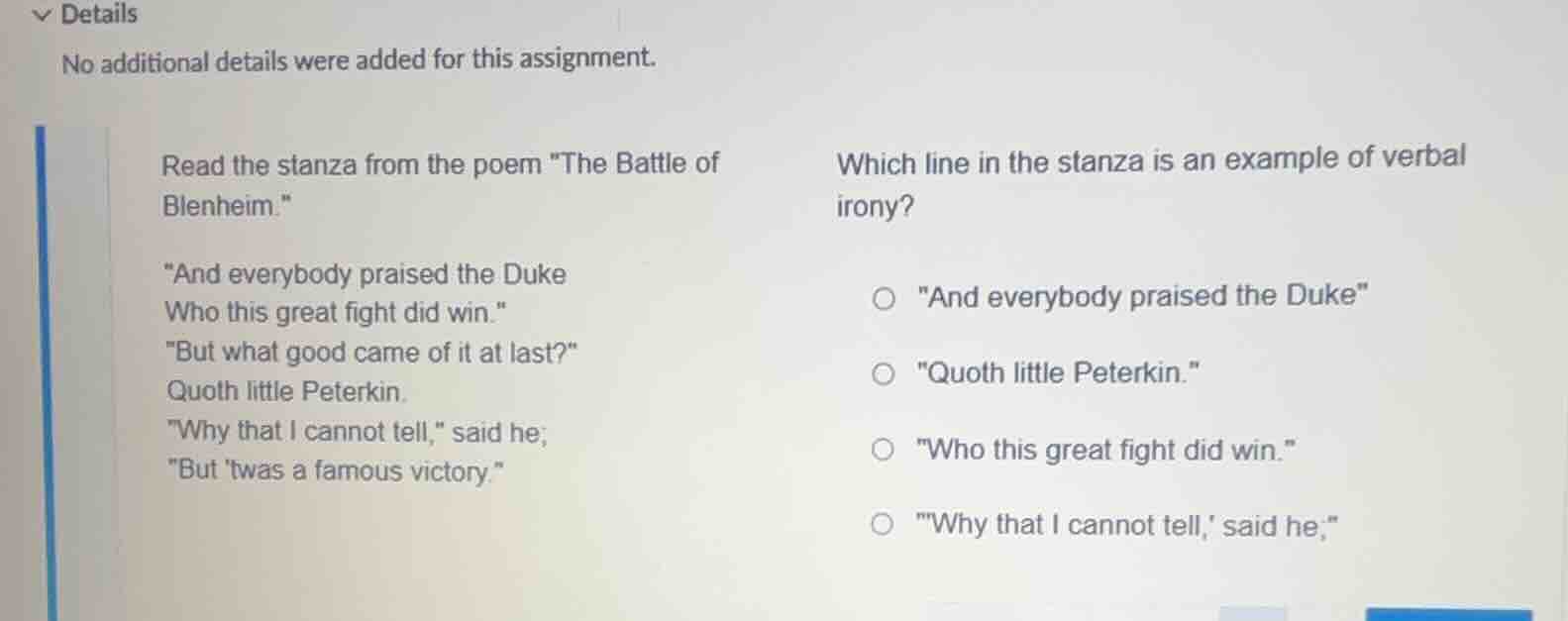
read the stanza from the poem \the battle of blenheim.\ \and everybody praised the duke who this great fight did win.\ \but what good came of it at last?\ quoth little peterkin. \why that i cannot tell,\ said he; \but twas a famous victory.\ which line in the stanza is an example of verbal irony? - \and everybody praised the duke\ - \quoth little peterkin.\ - \who this great fight did win.\ - \why that i cannot tell, said he,\
Verbal irony involves saying something that contradicts the intended meaning or the situation. In the poem, the line “But ‘twas a famous victory” is ironic because the speaker (after admitting they can't tell what good came of the fight) calls it a “famous victory,” highlighting the absurdity of glorifying a battle with no apparent positive outcome. The other lines are either statements of praise, dialogue tags, or expressions of ignorance, not ironic.

Snap & solve any problem in the app
Get step-by-step solutions on Sovi AI
Photo-based solutions with guided steps
Explore more problems and detailed explanations
"But 'twas a famous victory."