QUESTION IMAGE
Question
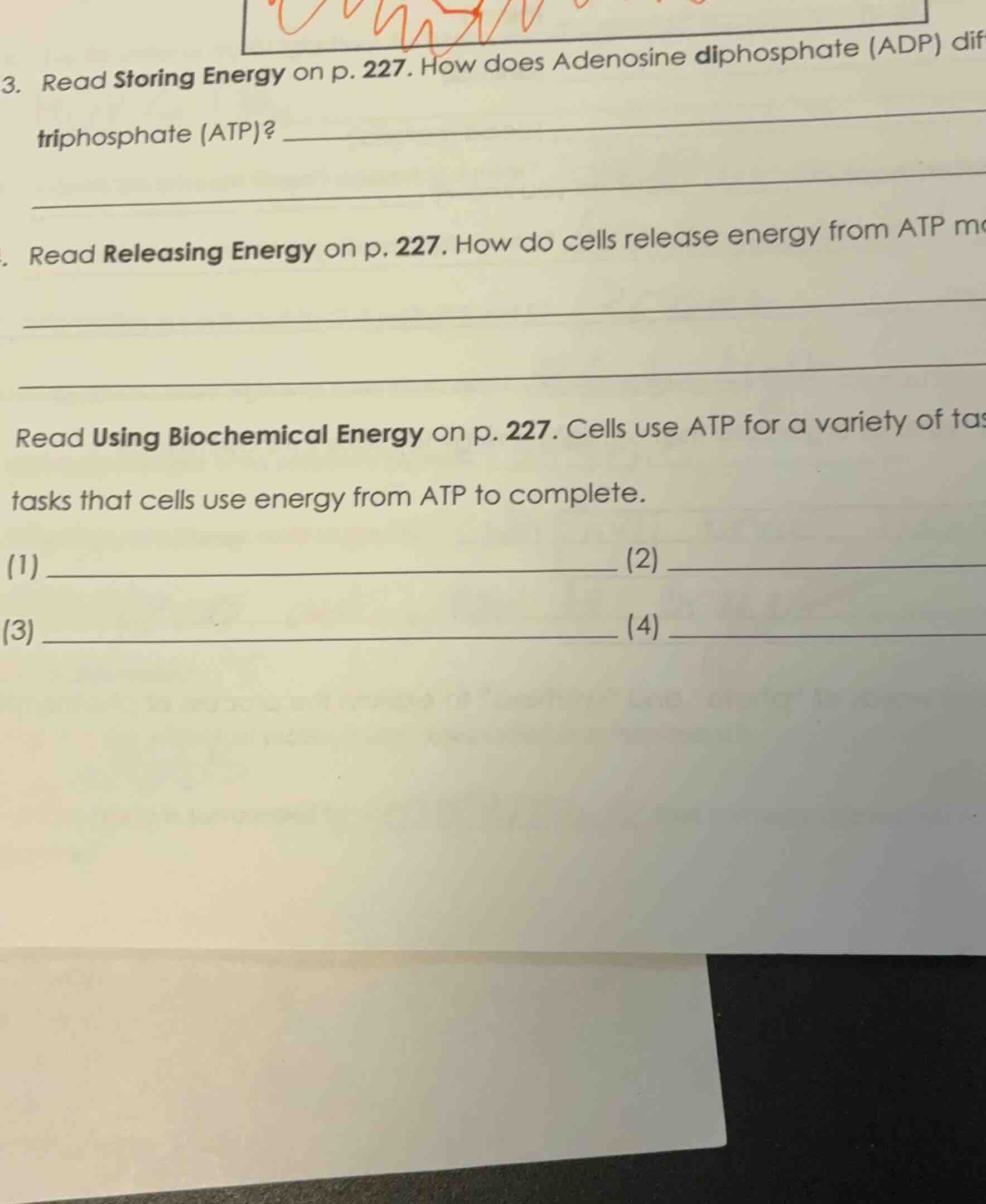
- read storing energy on p. 227. how does adenosine diphosphate (adp) dif triphosphate (atp)?
read releasing energy on p. 227. how do cells release energy from atp m
read using biochemical energy on p. 227. cells use atp for a variety of tas tasks that cells use energy from atp to complete.
(1) (2)
(3) (4)
To answer these questions, we refer to the relevant sections (Storing Energy, Releasing Energy, Using Biochemical Energy) on page 227 (assuming a typical biology textbook context):
Question 3 (ADP vs ATP - Storing Energy)
- Structure Difference: ADP has 2 phosphate groups ($\text{ADP} = \text{Adenosine} + 2\text{Pi}$), while ATP has 3 phosphate groups ($\text{ATP} = \text{Adenosine} + 3\text{Pi}$).
- Energy Storage: ATP stores energy in the high - energy bond between its second and third phosphate groups. ADP has less stored energy; when a phosphate group is added to ADP (forming ATP), energy is stored in that new bond.
Question about Releasing Energy from ATP
Cells release energy from ATP by breaking the high - energy bond between the second and third phosphate groups. This reaction (ATP $
ightarrow$ ADP + $\text{Pi}$ + energy) is catalyzed by enzymes and the released energy is used for cellular work.
Question about Using Biochemical Energy (ATP - Driven Tasks)
Typical tasks cells use ATP for include:
- Active Transport: Moving molecules against concentration gradients (e.g., sodium - potassium pump).
- Synthesis of Macromolecules: Building proteins, nucleic acids, carbohydrates, etc.
- Mechanical Work: Muscle contraction (in muscle cells) or movement of organelles within cells.
- Cellular Signaling: Phosphorylating proteins to activate signaling pathways.

Snap & solve any problem in the app
Get step-by-step solutions on Sovi AI
Photo-based solutions with guided steps
Explore more problems and detailed explanations
s (Filling the Blanks)
- For the ADP vs ATP question (Q3): ADP has 2 phosphate groups and less stored energy; ATP has 3 phosphate groups and stores energy in the bond between the second and third phosphate. When a phosphate is added to ADP, ATP is formed and energy is stored.
- For releasing energy from ATP: Cells break the high - energy bond between ATP’s second and third phosphate groups (ATP $
ightarrow$ ADP + $\text{Pi}$ + energy) to release energy.
- For ATP - driven tasks (examples):
(1) Active transport (e.g., sodium - potassium pump)
(2) Protein synthesis
(3) Muscle contraction
(4) Cell division (or cellular signaling, organelle movement, etc.)
(Note: The exact answers may vary slightly based on the specific textbook, but these are standard biological explanations for ATP/ADP dynamics and ATP - driven cellular work.)