QUESTION IMAGE
Question
reading data tables - the solar system
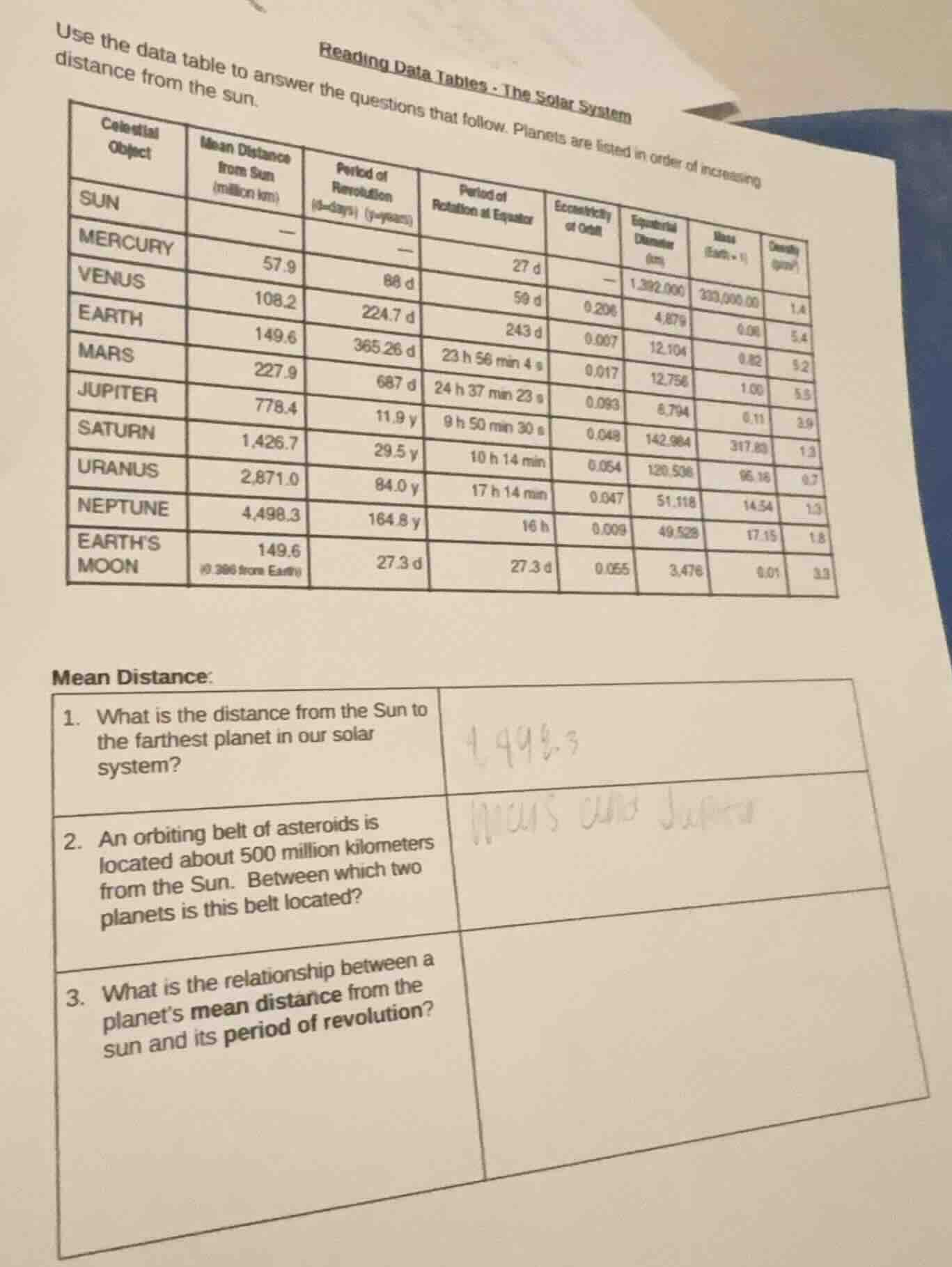
use the data table to answer the questions that follow. planets are listed in order of increasing distance from the sun.
| celestial object | mean distance from sun (million km) | period of revolution (days) (years) | period of rotation at equator | eccentricity of orbit | equatorial diameter (km) | mass (earth = 1) | density (g/cm³) |
|---|---|---|---|---|---|---|---|
| mercury | 57.9 | 88 d | 59 d | 0.206 | 4,879 | 0.06 | 5.4 |
| venus | 108.2 | 224.7 d | 243 d | 0.007 | 12,104 | 0.82 | 5.2 |
| earth | 149.6 | 365.26 d | 23 h 56 min 4 s | 0.017 | 12,756 | 1.00 | 5.5 |
| mars | 227.9 | 687 d | 24 h 37 min 23 s | 0.093 | 6,794 | 0.11 | 3.9 |
| jupiter | 778.4 | 11.9 y | 9 h 50 min 30 s | 0.048 | 142,984 | 317.83 | 1.3 |
| saturn | 1,426.7 | 29.5 y | 10 h 14 min | 0.054 | 120,536 | 95.18 | 0.7 |
| uranus | 2,871.0 | 84.0 y | 17 h 14 min | 0.047 | 51,118 | 14.54 | 1.3 |
| neptune | 4,498.3 | 164.8 y | 16 h | 0.009 | 49,528 | 17.15 | 1.8 |
| earths moon | 149.6 (≈ 386 from earth) | 27.3 d | 27.3 d | 0.055 | 3,476 | 0.01 | 3.3 |
mean distance:
- what is the distance from the sun to the farthest planet in our solar system?
- an orbiting belt of asteroids is located about 500 million kilometers from the sun. between which two planets is this belt located?
- what is the relationship between a planet’s mean distance from the sun and its period of revolution?
Question 1
Step1: Identify the farthest planet
Look at the "Mean Distance from Sun (million km)" column. The planets are Mercury (57.9), Venus (108.2), Earth (149.6), Mars (227.9), Jupiter (778.4), Saturn (1,426.7), Uranus (2,871.0), Neptune (4,498.3). Neptune has the largest mean distance.
Step2: Get Neptune's distance
From the table, Neptune's mean distance from the Sun is 4,498.3 million km.
Step1: List mean distances
Mercury: 57.9, Venus: 108.2, Earth: 149.6, Mars: 227.9, Jupiter: 778.4, Saturn: 1,426.7, Uranus: 2,871.0, Neptune: 4,498.3.
Step2: Find between which planets 500 million km lies
Mars is 227.9 million km, Jupiter is 778.4 million km. 500 is between 227.9 and 778.4.
Step1: Analyze data
Check mean distance and period of revolution for each planet. Mercury (57.9 million km, 88 d), Venus (108.2, 224.7 d), Earth (149.6, 365.26 d), Mars (227.9, 687 d), Jupiter (778.4, 11.9 y), Saturn (1,426.7, 29.5 y), Uranus (2,871.0, 84.0 y), Neptune (4,498.3, 164.8 y).
Step2: Identify the relationship
As the mean distance from the Sun increases (e.g., from Mercury to Neptune), the period of revolution (time to orbit the Sun) also increases. For example, Mercury is closest and has the shortest period; Neptune is farthest and has the longest period. This follows Kepler's third law (though not calculating, the trend is clear: greater distance → longer revolution period).

Snap & solve any problem in the app
Get step-by-step solutions on Sovi AI
Photo-based solutions with guided steps
Explore more problems and detailed explanations
4,498.3 million kilometers