QUESTION IMAGE
Question
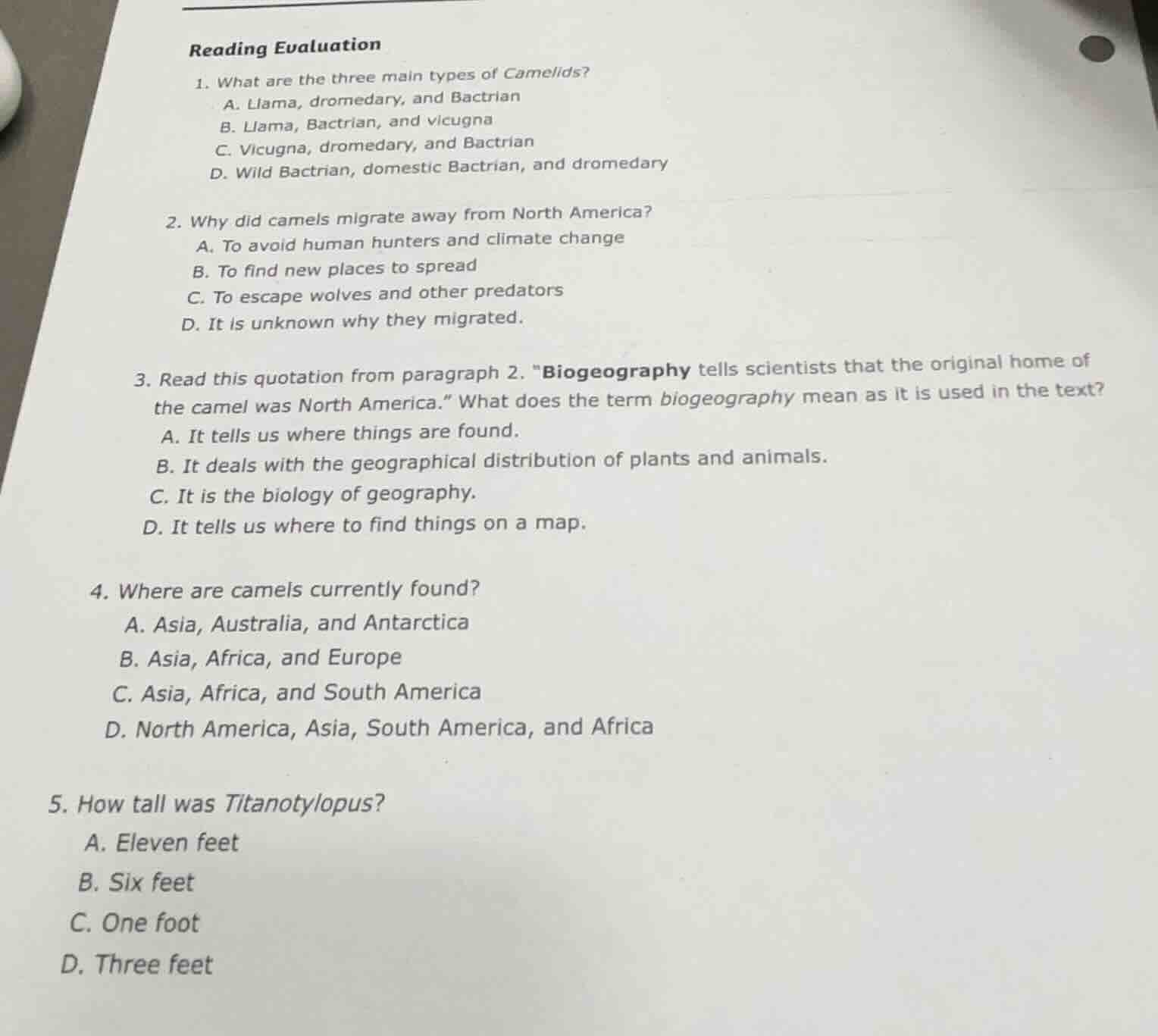
reading evaluation
- what are the three main types of camelids?
a. llama, dromedary, and bactrian
b. llama, bactrian, and vicugna
c. vicugna, dromedary, and bactrian
d. wild bactrian, domestic bactrian, and dromedary
- why did camels migrate away from north america?
a. to avoid human hunters and climate change
b. to find new places to spread
c. to escape wolves and other predators
d. it is unknown why they migrated.
- read this quotation from paragraph 2. \biogeography tells scientists that the original home of
the camel was north america.\ what does the term biogeography mean as it is used in the text?
a. it tells us where things are found.
b. it deals with the geographical distribution of plants and animals.
c. it is the biology of geography.
d. it tells us where to find things on a map.
- where are camels currently found?
a. asia, australia, and antarctica
b. asia, africa, and europe
c. asia, africa, and south america
d. north america, asia, south america, and africa
- how tall was titanotylopus?
a. eleven feet
b. six feet
c. one foot
d. three feet
- The three main types of camelids include New World (llama, vicugna) and Old World (Bactrian) camelids.
- Current scientific consensus is that the exact cause of camels' migration from North America is not definitively known.
- Biogeography is the study of the geographic distribution of organisms (plants and animals).
- Camels are found in Asia (Bactrian), Africa (dromedary), and South America (New World camelids like llamas).
- Titanotylopus, an extinct camelid, is estimated to have stood around 11 feet tall.

Snap & solve any problem in the app
Get step-by-step solutions on Sovi AI
Photo-based solutions with guided steps
Explore more problems and detailed explanations
- B. Llama, Bactrian, and vicugna
- D. It is unknown why they migrated.
- B. It deals with the geographical distribution of plants and animals.
- C. Asia, Africa, and South America
- A. Eleven feet