QUESTION IMAGE
Question
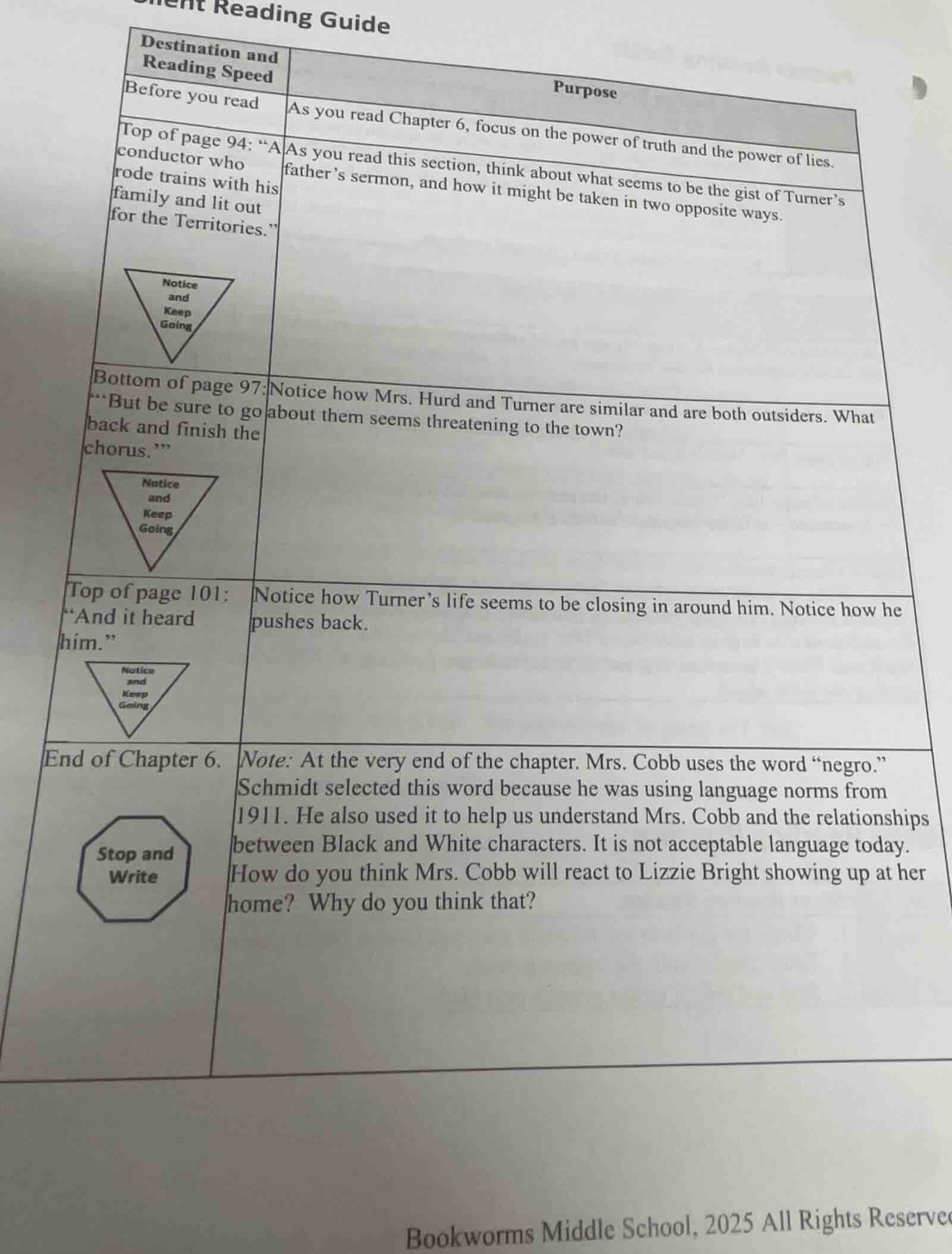
reading guide
destination and reading speed\tpurpose
before you read\tas you read chapter 6, focus on the power of truth and the power of lies.
top of page 94: “a conductor who rode trains with his family and lit out for the territories.”
triangle with “notice and keep going”\tas you read this section, think about what seems to be the gist of turner’s father’s sermon, and how it might be taken in two opposite ways.
bottom of page 97: “‘but be sure to go back and finish the chorus.’”
triangle with “notice and keep going”\tnotice how mrs. hurd and turner are similar and are both outsiders. what about them seems threatening to the town?
top of page 101: “and it heard him.”
triangle with “notice and keep going”\tnotice how turner’s life seems to be closing in around him. notice how he pushes back.
end of chapter 6.
octagon with “stop and write”\tnote: at the very end of the chapter, mrs. cobb uses the word “negro.” schmidt selected this word because he was using language norms from 1911. he also used it to help us understand mrs. cobb and the relationships between black and white characters. it is not acceptable language today.
how do you think mrs. cobb will react to lizzie bright showing up at her home? why do you think that?
- For the "Before you read" task: Focus on analyzing how truth and lies function as forces within Chapter 6, tracking their impacts on characters and events.
- For page 94 section: Identify the core message of Turner's father's sermon, then outline two contradictory interpretations (e.g., one framing it as a call to empathy, another as a justification for exclusion).
- For page 97 section: List shared traits of Mrs. Hurd and Turner that mark them as outsiders, then connect these traits to the town's fear of disruption to its established social order.
- For page 101 section: Document specific events that constrict Turner's choices, then highlight his actions to resist these constraints.
- For end of Chapter 6 task: Mrs. Cobb will react with hostility and anger. This is inferred from her use of the period-typical racist language, which signals she holds discriminatory attitudes toward Black characters like Lizzie Bright, and her alignment with the town's insular, prejudiced norms.

Snap & solve any problem in the app
Get step-by-step solutions on Sovi AI
Photo-based solutions with guided steps
Explore more problems and detailed explanations
- Before reading: Focus on truth/lie power in Chapter 6.
- Page 94: Identify the sermon's gist and two opposing interpretations.
- Page 97: Note Mrs. Hurd and Turner's outsider similarities, then name the threatening trait (their rejection of the town's rigid norms).
- Page 101: Track events closing in on Turner and his acts of resistance.
- End of Chapter 6: Mrs. Cobb will react with hostility and anger. Her use of the 1910s racist term shows she holds discriminatory views, so she will reject Lizzie, a Black character, violating her insular, prejudiced values.