QUESTION IMAGE
Question
reasoning
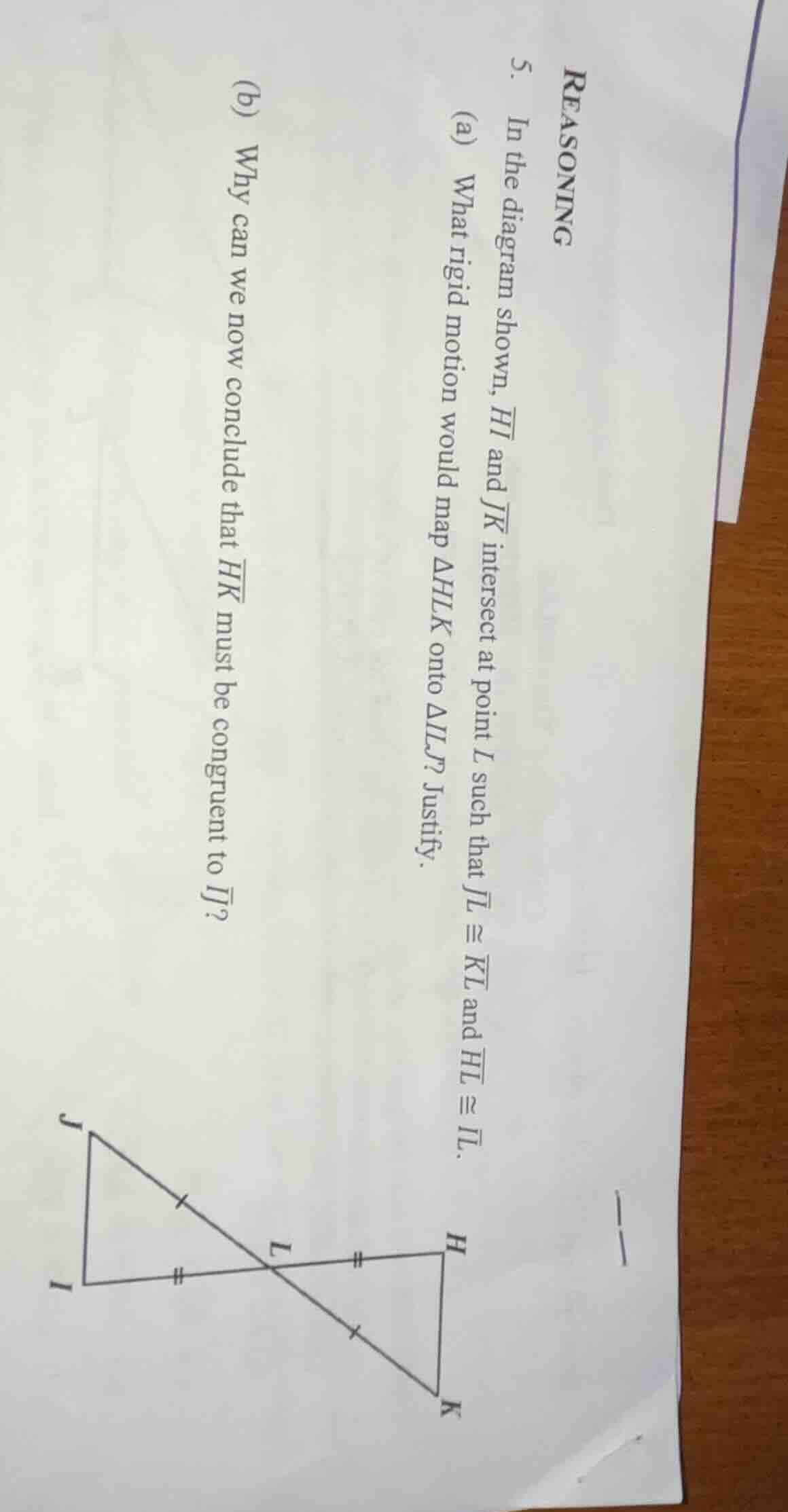
- in the diagram shown, (overline{hi}) and (overline{jk}) intersect at point (l) such that (overline{jl} cong overline{kl}) and (overline{hl} cong overline{il}).
(a) what rigid motion would map (\triangle hlk) onto (\triangle ilj)? justify.
(b) why can we now conclude that (overline{hk}) must be congruent to (overline{ij})?
Part (a)
Step1: Identify Given Congruences
We know \( \overline{JL} \cong \overline{KL} \), \( \overline{HL} \cong \overline{IL} \), and \( \angle HLK \) and \( \angle ILJ \) are vertical angles, so \( \angle HLK \cong \angle ILJ \) (Vertical angles are congruent). By SAS (Side - Angle - Side) congruence criterion, \( \triangle HLK \cong \triangle ILJ \). A rotation about point \( L \) (or a reflection followed by a translation) can map \( \triangle HLK \) onto \( \triangle ILJ \). Specifically, a rotation about point \( L \) such that \( \overline{KL} \) maps to \( \overline{JL} \) and \( \overline{HL} \) maps to \( \overline{IL} \) will work because the included angles are congruent and the sides are congruent.
Step2: Justify the Rigid Motion
Since \( \triangle HLK \cong \triangle ILJ \) by SAS, a rotation about point \( L \) (the intersection point of \( \overline{HI} \) and \( \overline{JK} \)) by the measure of \( \angle KLJ \) (or \( \angle HL I\)) will map \( \triangle HLK \) onto \( \triangle ILJ \). Rigid motions preserve distance and angle measure, and since the triangles are congruent, such a rotation (a type of rigid motion) exists to map one triangle onto the other.
Step1: Use Congruent Triangles
From part (a), we established that \( \triangle HLK \cong \triangle ILJ \) by a rigid motion (rotation, for example). Rigid motions preserve the length of segments. In congruent triangles, corresponding sides are congruent.
Step2: Identify Corresponding Sides
In \( \triangle HLK \) and \( \triangle ILJ \), the side \( \overline{HK} \) in \( \triangle HLK \) corresponds to the side \( \overline{IJ} \) in \( \triangle ILJ \). Since rigid motions (which map congruent triangles) preserve segment length, \( \overline{HK} \cong \overline{IJ} \).

Snap & solve any problem in the app
Get step-by-step solutions on Sovi AI
Photo-based solutions with guided steps
Explore more problems and detailed explanations
A rotation about point \( L \) (or a reflection/translation combination) can map \( \triangle HLK \) onto \( \triangle ILJ \). This is justified by the SAS congruence of \( \triangle HLK \) and \( \triangle ILJ \) ( \( \overline{JL} \cong \overline{KL} \), \( \angle HLK \cong \angle ILJ \), \( \overline{HL} \cong \overline{IL} \) ) and the fact that rigid motions (like rotation) preserve congruence.