QUESTION IMAGE
Question
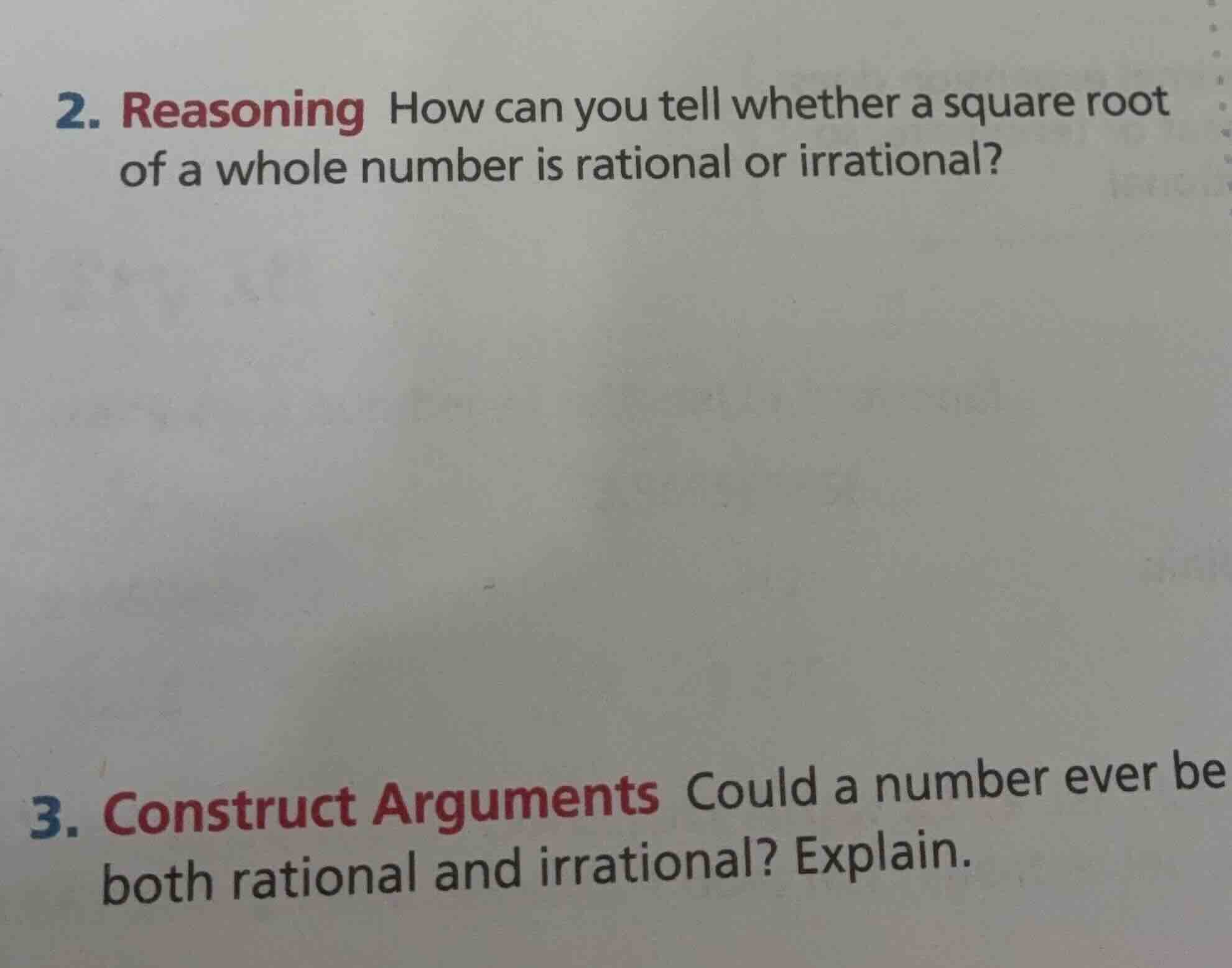
- reasoning how can you tell whether a square root of a whole number is rational or irrational?
- construct arguments could a number ever be both rational and irrational? explain.
Question 2
Step1: Recall definitions
A rational number is a number that can be expressed as $\frac{p}{q}$, where $p,q$ are integers and $q
eq0$. An irrational number is a number that cannot be expressed as such a fraction. For the square root of a whole number $n$ (let $n$ be a whole number, so $n\in\mathbb{W}$), we consider the prime factorization of $n$.
Step2: Analyze perfect squares
If $n$ is a perfect square (i.e., there exists an integer $k$ such that $n = k^2$), then $\sqrt{n}=k$, which is an integer. Since integers are rational (as $k=\frac{k}{1}$), $\sqrt{n}$ is rational. For example, $\sqrt{4} = 2=\frac{2}{1}$, $\sqrt{9}=3=\frac{3}{1}$.
Step3: Analyze non - perfect squares
If $n$ is not a perfect square, then its prime factorization will have at least one prime with an odd exponent. When we take the square root, we cannot express $\sqrt{n}$ as a fraction of two integers. By the definition of irrational numbers, $\sqrt{n}$ will be irrational. For example, $\sqrt{2}$: the prime factorization of $2$ is $2^1$, the exponent of $2$ is $1$ (odd). We can prove $\sqrt{2}$ is irrational by contradiction: assume $\sqrt{2}=\frac{p}{q}$ (in lowest terms), then $2=\frac{p^2}{q^2}\Rightarrow p^2 = 2q^2$. So $p^2$ is even, which implies $p$ is even. Let $p = 2k$, then $(2k)^2=2q^2\Rightarrow4k^2=2q^2\Rightarrow q^2 = 2k^2$, so $q$ is also even, contradicting $p$ and $q$ being in lowest terms.
Step1: Recall definitions
A rational number is a number that can be written as $\frac{a}{b}$, where $a,b$ are integers and $b
eq0$. An irrational number is a number that cannot be written as such a fraction.
Step2: Use the law of excluded middle
The set of real numbers is partitioned into rational and irrational numbers. A number \( x \) either can be expressed as a fraction of two integers (rational) or it cannot (irrational). There is no overlap between the set of rational numbers and the set of irrational numbers. Suppose, for contradiction, that there exists a number \( x \) that is both rational and irrational. Then \( x=\frac{a}{b}\) (rational definition) and \( x
eq\frac{c}{d}\) for any integers \( c,d\) with \( d
eq0\) (irrational definition), which is a contradiction.

Snap & solve any problem in the app
Get step-by-step solutions on Sovi AI
Photo-based solutions with guided steps
Explore more problems and detailed explanations
To determine if the square root of a whole number \( n \) is rational or irrational:
- Factorize \( n \) into its prime factors.
- If, in the prime factorization of \( n \), every prime number has an even exponent (i.e., \( n \) is a perfect square, \( n = k^2 \) for some integer \( k \)), then \( \sqrt{n}=k \), which is rational (since integers are rational, as \( k=\frac{k}{1} \)).
- If, in the prime factorization of \( n \), at least one prime number has an odd exponent (i.e., \( n \) is not a perfect square), then \( \sqrt{n} \) cannot be written as a fraction of two integers and is thus irrational.