QUESTION IMAGE
Question
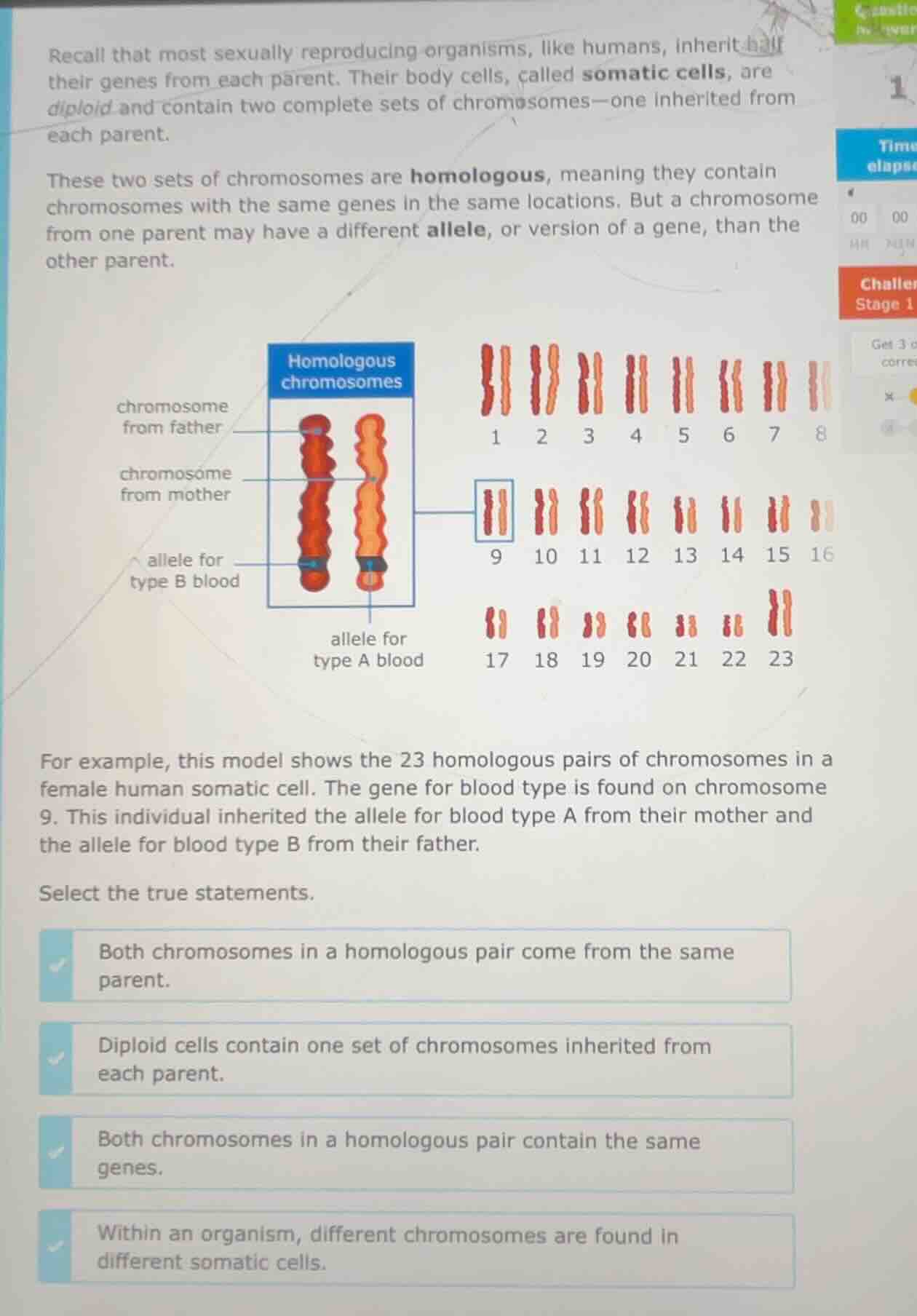
recall that most sexually reproducing organisms, like humans, inherit half their genes from each parent. their body cells, called somatic cells, are diploid and contain two complete sets of chromosomes—one inherited from each parent. these two sets of chromosomes are homologous, meaning they contain chromosomes with the same genes in the same locations. but a chromosome from one parent may have a different allele, or version of a gene, than the other parent. for example, this model shows the 23 homologous pairs of chromosomes in a female human somatic cell. the gene for blood type is found on chromosome 9. this individual inherited the allele for blood type a from their mother and the allele for blood type b from their father. select the true statements. both chromosomes in a homologous pair come from the same parent. diploid cells contain one set of chromosomes inherited from each parent. both chromosomes in a homologous pair contain the same genes. within an organism, different chromosomes are found in different somatic cells.
- The text defines diploid somatic cells as having two complete chromosome sets, one from each parent, confirming this statement is true.
- Homologous chromosomes are explicitly described as containing the same genes in the same locations (though alleles may differ), so this statement is true.
- The first statement is false: homologous pairs consist of one chromosome from each parent, not the same parent.
- The fourth statement is false: somatic cells in an organism contain the same full set of chromosomes, not different chromosomes in different cells.

Snap & solve any problem in the app
Get step-by-step solutions on Sovi AI
Photo-based solutions with guided steps
Explore more problems and detailed explanations
- Correct statements:
- Diploid cells contain one set of chromosomes inherited from each parent.
- Both chromosomes in a homologous pair contain the same genes.