QUESTION IMAGE
Question
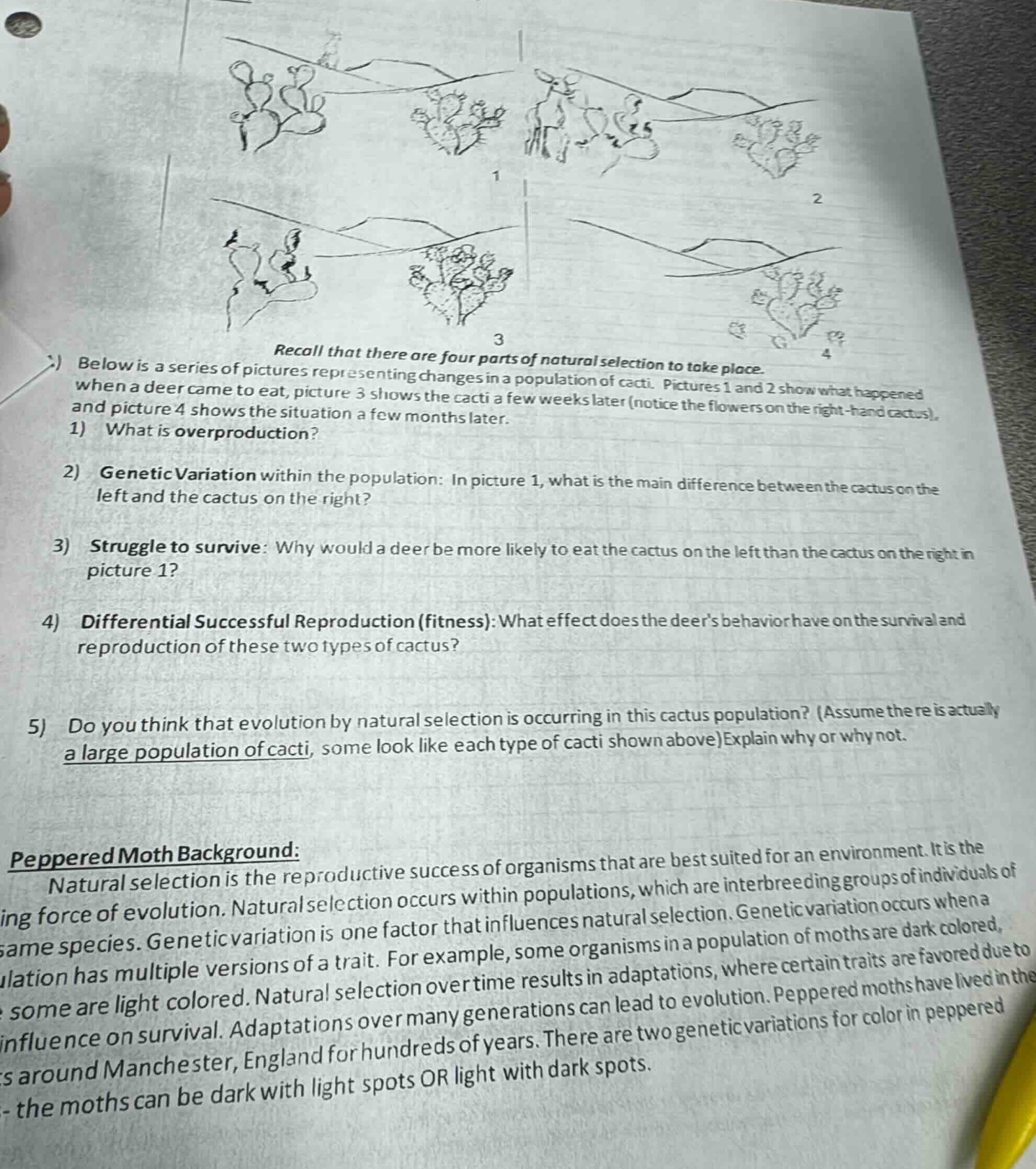
recall that there are four parts of natural selection to take place.below is a series of pictures representing changes in a population of cacti. pictures 1 and 2 show what happened when a deer came to eat, picture 3 shows the cacti a few weeks later (notice the flowers on the right-hand cactus), and picture 4 shows the situation a few months later.1) what is overproduction?2) genetic variation within the population: in picture 1, what is the main difference between the cactus on the left and the cactus on the right?3) struggle to survive: why would a deer be more likely to eat the cactus on the left than the cactus on the right in picture 1?4) differential successful reproduction (fitness): what effect does the deers behavior have on the survival and reproduction of these two types of cactus?5) do you think that evolution by natural selection is occurring in this cactus population? (assume there is actually a large population of cacti, some look like each type of cacti shown above) explain why or why not.peppered moth background:natural selection is the reproductive success of organisms that are best suited for an environment. it is the ing force of evolution. natural selection occurs within populations, which are interbreeding groups of individuals of same species. genetic variation is one factor that influences natural selection. genetic variation occurs when a ulation has multiple versions of a trait. for example, some organisms in a population of moths are dark colored, some are light colored. natural selection over time results in adaptations, where certain traits are favored due to influence on survival. adaptations over many generations can lead to evolution. peppered moths have lived in the s around manchester, england for hundreds of years. there are two genetic variations for color in peppered - the moths can be dark with light spots or light with dark spots.
- Defines the overproduction concept in natural selection.
- Identifies the visible physical difference between the cacti in image 1.
- Connects the cactus trait to deer foraging preference.
- Links deer predation to cactus survival and reproduction rates.
- Evaluates if all natural selection conditions are met in the cactus population.

Snap & solve any problem in the app
Get step-by-step solutions on Sovi AI
Photo-based solutions with guided steps
Explore more problems and detailed explanations
- Overproduction is when a species produces far more offspring (or in this case, cacti individuals) than can possibly survive given environmental resources and pressures.
- The main difference is that the cactus on the left has no (or very few) spines, while the cactus on the right has many spines.
- The deer is more likely to eat the left cactus because it lacks spines—spines act as a physical defense that makes the right cactus harder and less pleasant to eat.
- The deer's behavior means the spineless (left) cacti are more likely to be eaten and die before reproducing, while the spiny (right) cacti are more likely to survive, flower, and reproduce, passing on their spine-producing traits to offspring.
- Yes, evolution by natural selection is occurring. The population has genetic variation (spiny vs. spineless cacti), there is a struggle to survive (deer predation), differential survival occurs (spiny cacti survive more), and successful reproduction follows (spiny cacti reproduce more, passing on their traits). Over time, the proportion of spiny cacti in the population will increase.