QUESTION IMAGE
Question
recognizing necessary information for similarity
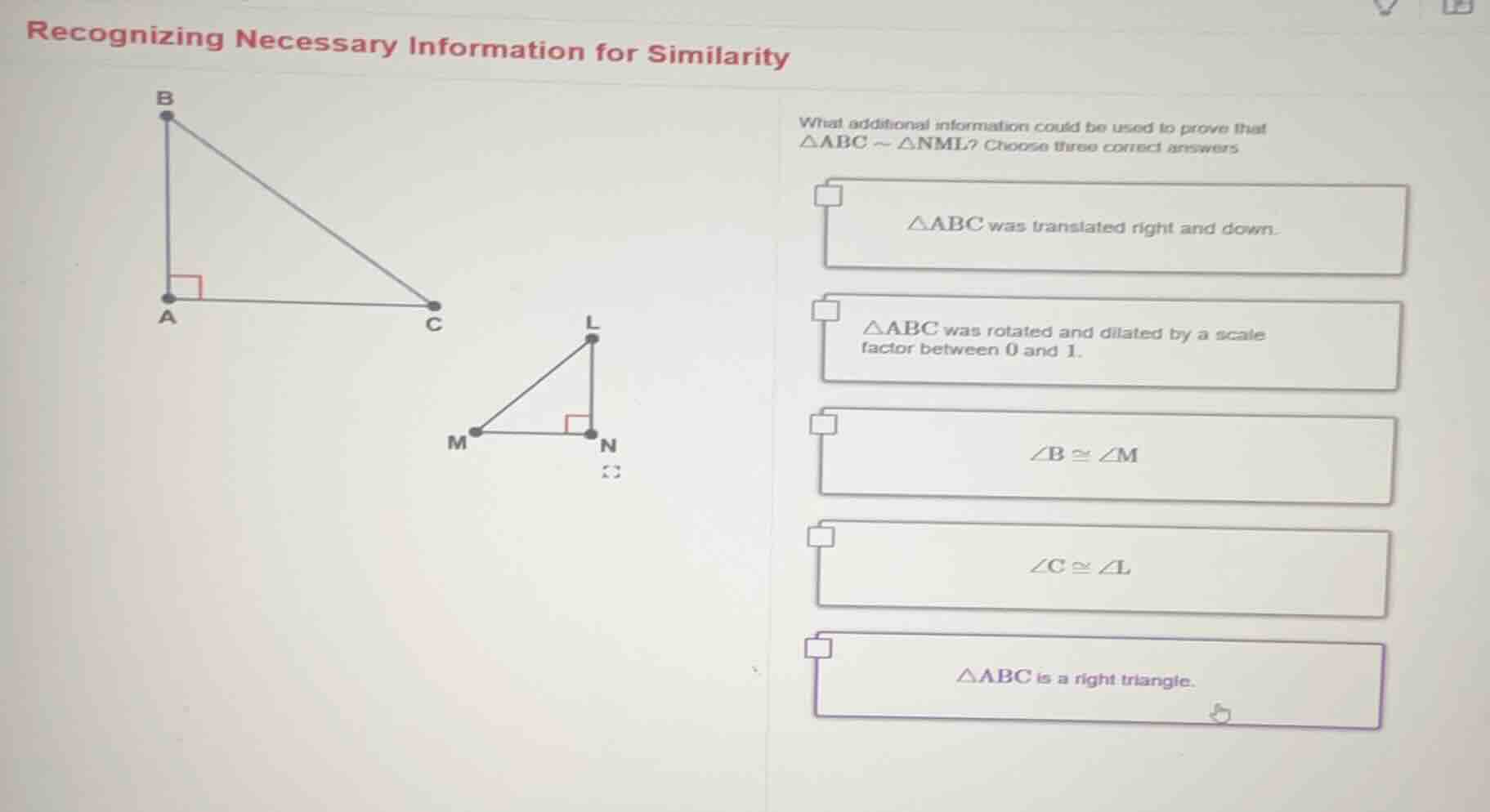
what additional information could be used to prove that
△abc ~ △nml? choose three correct answers
□ △abc was translated right and down.
□ △abc was rotated and dilated by a scale factor between 0 and 1.
□ ∠b ≅ ∠m
□ ∠c ≅ ∠l
□ △abc is a right triangle.
Brief Explanations
- Rotation and Dilation (Scale Factor 0 - 1): Rotation preserves angle measures, and dilation (with scale factor ≠ 0) preserves similarity (all angles congruent, sides proportional). A scale factor between 0 and 1 means the image is smaller, but similarity holds. This proves \(\triangle ABC \sim \triangle NML\).
- \(\angle B \cong \angle M\): Both triangles are right - angled (\(\angle A=\angle N = 90^\circ\)). If \(\angle B\cong\angle M\), then by the AA (Angle - Angle) similarity criterion (two angles congruent), the triangles are similar.
- \(\angle C \cong \angle L\): Again, since \(\angle A=\angle N = 90^\circ\), if \(\angle C\cong\angle L\), by AA similarity, \(\triangle ABC \sim \triangle NML\).
- Translation alone preserves congruence (not just similarity, but congruence is a special case of similarity, but the other options are more direct for proving similarity in the context). Saying \(\triangle ABC\) is a right triangle is redundant because we already know \(\angle A\) is right - angled from the diagram, and it doesn't help prove similarity to \(\triangle NML\) alone.

Snap & solve any problem in the app
Get step-by-step solutions on Sovi AI
Photo-based solutions with guided steps
Explore more problems and detailed explanations
- \(\triangle ABC\) was rotated and dilated by a scale factor between 0 and 1.
- \(\angle B\cong\angle M\)
- \(\angle C\cong\angle L\)