QUESTION IMAGE
Question
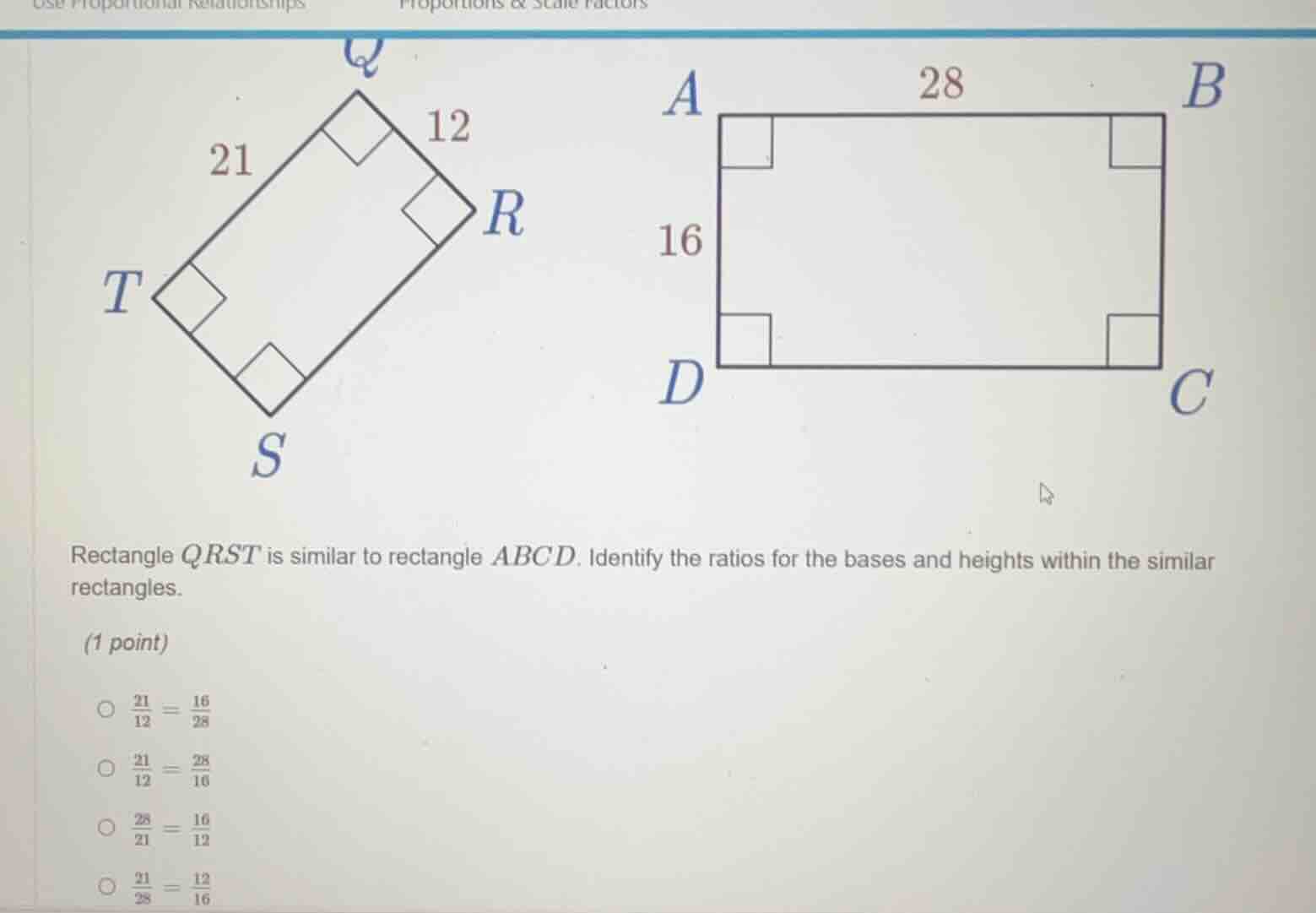
rectangle qrst is similar to rectangle abcd. identify the ratios for the bases and heights within the similar rectangles.
(1 point)
\\(\frac{21}{12} = \frac{16}{28}\\)
\\(\frac{21}{12} = \frac{28}{16}\\)
\\(\frac{28}{21} = \frac{16}{12}\\)
\\(\frac{21}{28} = \frac{12}{16}\\)
Step1: Recall Similar Rectangles Property
For similar rectangles, the ratios of corresponding sides (bases and heights) are equal. Let's identify the sides:
- Rectangle \(QRST\): height \(= 21\), base \(= 12\) (or vice - versa depending on correspondence)
- Rectangle \(ABCD\): height \(= 16\), base \(= 28\) (or vice - versa)
We need to match the corresponding sides. So, the ratio of height of \(QRST\) to height of \(ABCD\) should equal the ratio of base of \(QRST\) to base of \(ABCD\) (or height to base within each rectangle and then set equal).
Let's check each option:
Option 1: \(\frac{21}{12}=\frac{16}{28}\)
Simplify \(\frac{21}{12}=\frac{7}{4} = 1.75\), \(\frac{16}{28}=\frac{4}{7}\approx0.571\). Not equal.
Option 2: \(\frac{21}{12}=\frac{28}{16}\)
Simplify \(\frac{21}{12}=\frac{7}{4}=1.75\), \(\frac{28}{16}=\frac{7}{4} = 1.75\). Equal.
Option 3: \(\frac{28}{21}=\frac{16}{12}\)
Simplify \(\frac{28}{21}=\frac{4}{3}\approx1.333\), \(\frac{16}{12}=\frac{4}{3}\approx1.333\). Wait, but let's check the correspondence. Wait, no, let's re - evaluate. Wait, if we take \(QRST\)'s height as 21 and \(ABCD\)'s height as 16, and \(QRST\)'s base as 12 and \(ABCD\)'s base as 28, no. Wait, actually, the correct correspondence is:
In similar rectangles, the ratio of height of first to height of second = ratio of base of first to base of second.
For \(QRST\) (height = 21, base = 12) and \(ABCD\) (height = 16, base = 28) – no, wait, maybe \(QRST\)'s height is 21, \(ABCD\)'s height is 16? No, wait, actually, the correct way is to see that \(\frac{\text{height of }QRST}{\text{height of }ABCD}=\frac{\text{base of }QRST}{\text{base of }ABCD}\) or \(\frac{\text{height of }QRST}{\text{base of }QRST}=\frac{\text{height of }ABCD}{\text{base of }ABCD}\)
Wait, another way: \(\frac{21}{28}=\frac{12}{16}\) (checking option 4): \(\frac{21}{28}=\frac{3}{4}=0.75\), \(\frac{12}{16}=\frac{3}{4}=0.75\). Wait, now I am confused. Wait, no, let's label the rectangles properly.
Rectangle \(QRST\): let's say length (height) = 21, width (base) = 12.
Rectangle \(ABCD\): length (height) = 16, width (base) = 28. No, that can't be. Wait, maybe the correspondence is \(QRST\)'s length (21) corresponds to \(ABCD\)'s length (28) and \(QRST\)'s width (12) corresponds to \(ABCD\)'s width (16). Then the ratio of length of \(QRST\) to length of \(ABCD\) is \(\frac{21}{28}\), and ratio of width of \(QRST\) to width of \(ABCD\) is \(\frac{12}{16}\). Let's check:
\(\frac{21}{28}=\frac{3}{4}\), \(\frac{12}{16}=\frac{3}{4}\). So this is correct.
Wait, but let's check option 2: \(\frac{21}{12}=\frac{28}{16}\). \(\frac{21}{12}=\frac{7}{4}\), \(\frac{28}{16}=\frac{7}{4}\). So which is correct?
Wait, the key is that in similar figures, corresponding sides are in proportion. So if we consider \(QRST\) with sides 21 and 12, and \(ABCD\) with sides 28 and 16.
So, if we set \(\frac{\text{side1 of }QRST}{\text{side1 of }ABCD}=\frac{\text{side2 of }QRST}{\text{side2 of }ABCD}\)
Let side1 of \(QRST = 21\), side1 of \(ABCD = 28\); side2 of \(QRST = 12\), side2 of \(ABCD = 16\). Then \(\frac{21}{28}=\frac{12}{16}\), which is option 4.
Wait, earlier mistake: when I considered option 2, I mis - matched the sides. Let's re - check:
Option 2: \(\frac{21}{12}=\frac{28}{16}\)
\(\frac{21}{12}=\frac{7}{4}\), \(\frac{28}{16}=\frac{7}{4}\). But what is the correspondence here? If we take 21 as height of \(QRST\), 12 as base of \(QRST\); 28 as base of \(ABCD\), 16 as height of \(ABCD\). Then height of \(QRST\)/base of \(QRST\) = height of \(ABCD\)/base of \(ABCD\)? No, that's not the correct p…

Snap & solve any problem in the app
Get step-by-step solutions on Sovi AI
Photo-based solutions with guided steps
Explore more problems and detailed explanations
\(\boldsymbol{\frac{21}{28}=\frac{12}{16}}\) (the last option: \(\frac{21}{28}=\frac{12}{16}\))