QUESTION IMAGE
Question
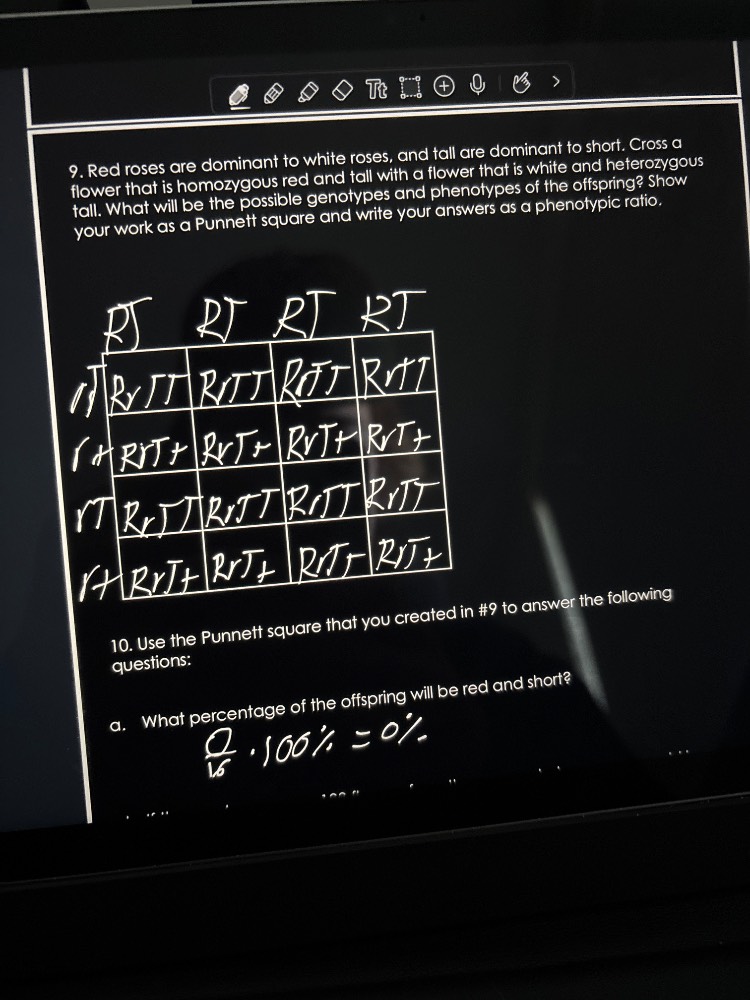
- red roses are dominant to white roses, and tall are dominant to short. cross a flower that is homozygous red and tall with a flower that is white and heterozygous tall. what will be the possible genotypes and phenotypes of the offspring? show your work as a punnett square and write your answers as a phenotypic ratio.10. use the punnett square that you created in #9 to answer the following questions:a. what percentage of the offspring will be red and short?$\frac{0}{16} cdot 100% = 0%$
Step1: Define allele symbols
Let $R$ = red (dominant), $r$ = white (recessive); $T$ = tall (dominant), $t$ = short (recessive)
Step2: Identify parent genotypes
Homozygous red tall: $RRTT$; gametes = $RT$ (all)
White heterozygous tall: $rrTt$; gametes = $rT, rt$
Step3: Correct Punnett square setup
| $RT$ | $RT$ | $RT$ | $RT$ | |
|---|---|---|---|---|
| $rt$ | $RrTt$ | $RrTt$ | $RrTt$ | $RrTt$ |
Step4: Analyze genotypes/phenotypes
- Genotypes: $RrTT$, $RrTt$
- Phenotypes: All red tall (since $R$ is dominant, $T$ is dominant)
Step5: Solve part 10a
Red short requires $R\_tt$. No offspring have $tt$, so percentage = $\frac{0}{16} \times 100\% = 0\%$

Snap & solve any problem in the app
Get step-by-step solutions on Sovi AI
Photo-based solutions with guided steps
Explore more problems and detailed explanations
For question 9:
- Possible genotypes: $RrTT$, $RrTt$
- Phenotypic ratio: 1 (red tall) : 0 (all other phenotypes)
For question 10a:
0%