QUESTION IMAGE
Question
reflection questions
which was the shortest?
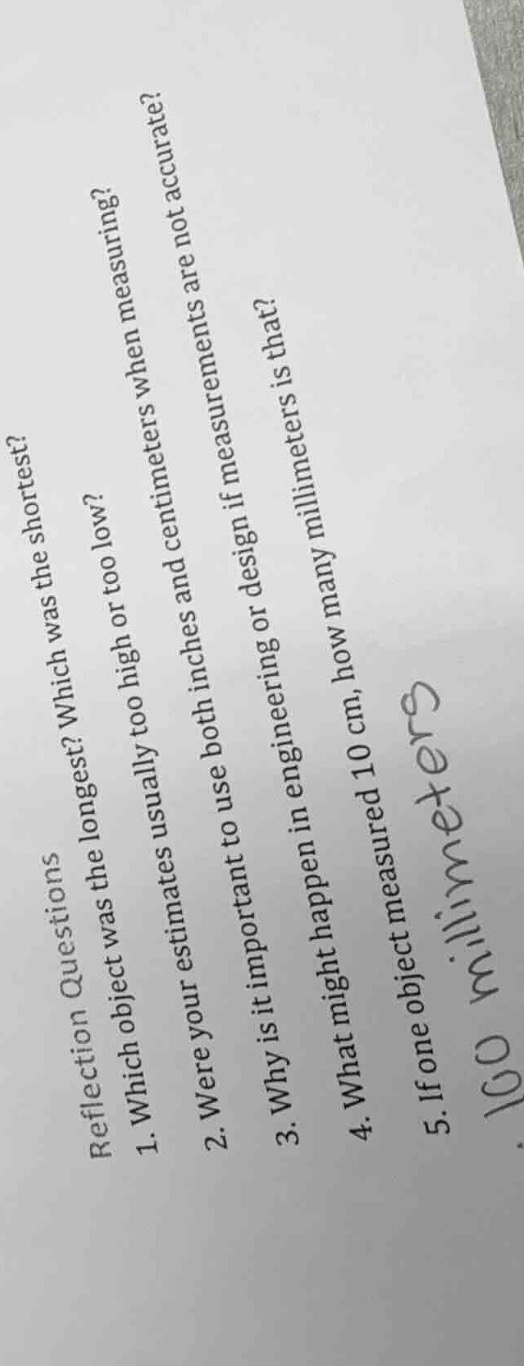
- which object was the longest? which was the shortest?
- were your estimates usually too high or too low when measuring?
- were your estimates usually too high or too low?
- why is it important to use both inches and centimeters when measuring?
- why is it important to use both inches and centimeters if measurements are not accurate?
- why is it important in engineering or design if measurements are not accurate?
- what might happen in engineering or design if measurements are not accurate?
- what might happen in engineering or design if measurements are not accurate?
- what might happen in engineering millimeters is that?
- if one object measured 10 cm, how many millimeters is that?
100 millimeters
Response
Question 5
Step1: Recall unit conversion factor
We know that \(1\) centimeter (\(cm\)) is equal to \(10\) millimeters (\(mm\)). So the conversion factor is \(1\ cm = 10\ mm\).
Step2: Convert 10 cm to mm
To convert \(10\ cm\) to \(mm\), we multiply the length in centimeters by the conversion factor. So we have \(10\ cm\times10\ \frac{mm}{cm}\).
Calculating this, \(10\times10 = 100\).

Snap & solve any problem in the app
Get step-by-step solutions on Sovi AI
Photo-based solutions with guided steps
Explore more problems and detailed explanations
100 millimeters