QUESTION IMAGE
Question
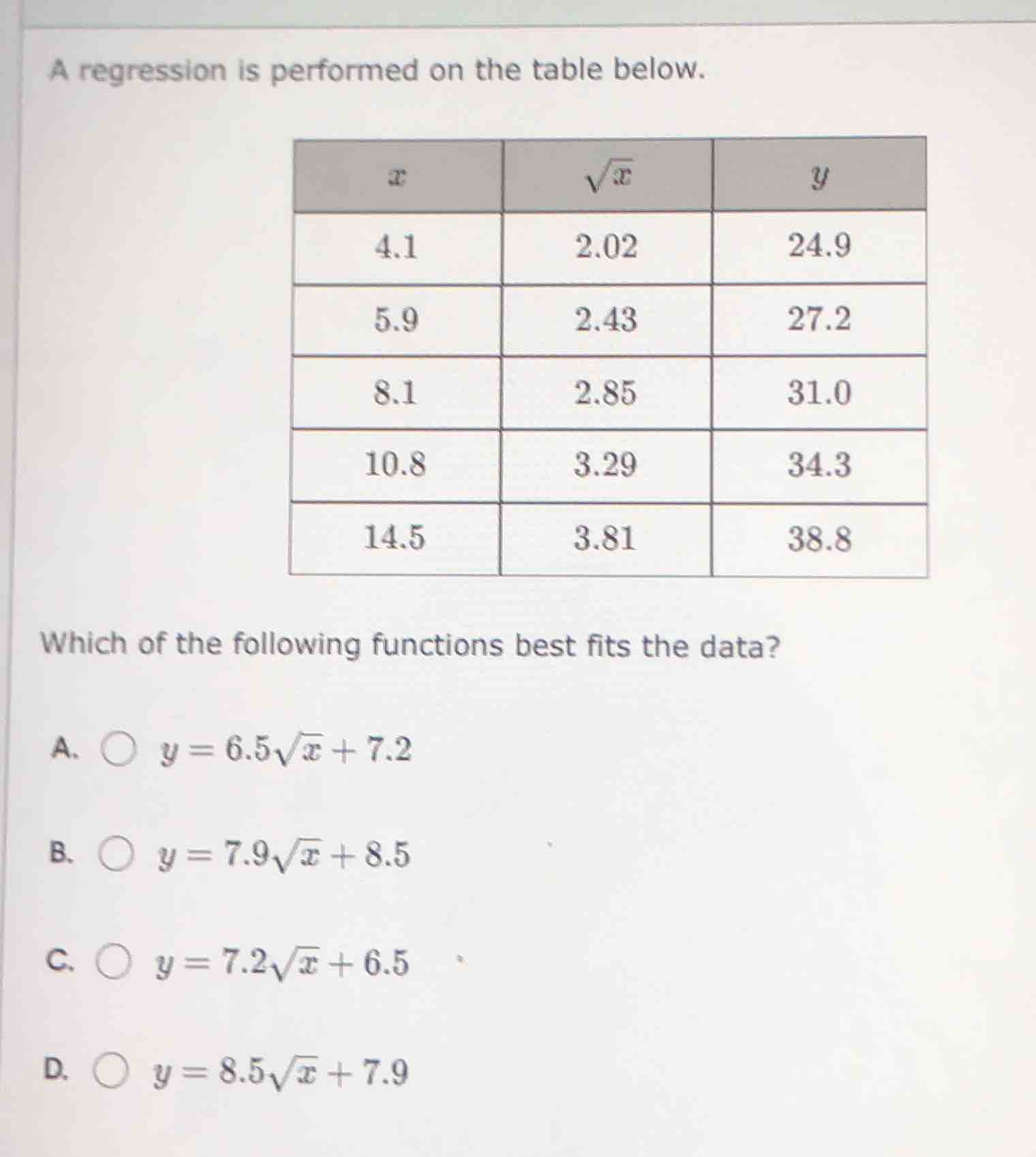
a regression is performed on the table below.
| $x$ | $sqrt{x}$ | $y$ |
|---|---|---|
| $5.9$ | $2.43$ | $27.2$ |
| $8.1$ | $2.85$ | $31.0$ |
| $10.8$ | $3.29$ | $34.3$ |
| $14.5$ | $3.81$ | $38.8$ |
which of the following functions best fits the data?
a. $\bigcirc$ $y = 6.5sqrt{x}+7.2$
b. $\bigcirc$ $y = 7.9sqrt{x}+8.5$
c. $\bigcirc$ $y = 7.2sqrt{x}+6.5$
d. $\bigcirc$ $y = 8.5sqrt{x}+7.9$
Step1: Test Option A
Substitute \(\sqrt{x} = 2.02\) into \(y = 6.5\sqrt{x}+7.2\):
\(y = 6.5\times2.02 + 7.2 = 13.13 + 7.2 = 20.33\).
The actual \(y\) is \(24.9\), difference is \(24.9 - 20.33 = 4.57\).
Step2: Test Option B
Substitute \(\sqrt{x} = 2.02\) into \(y = 7.9\sqrt{x}+8.5\):
\(y = 7.9\times2.02 + 8.5 = 15.958 + 8.5 = 24.458\).
Difference: \(24.9 - 24.458 = 0.442\).
Step3: Test Option C
Substitute \(\sqrt{x} = 2.02\) into \(y = 7.2\sqrt{x}+6.5\):
\(y = 7.2\times2.02 + 6.5 = 14.544 + 6.5 = 21.044\).
Difference: \(24.9 - 21.044 = 3.856\).
Step4: Test Option D
Substitute \(\sqrt{x} = 2.02\) into \(y = 8.5\sqrt{x}+7.9\):
\(y = 8.5\times2.02 + 7.9 = 17.17 + 7.9 = 25.07\).
Difference: \(25.07 - 24.9 = 0.17\).
Check another point (e.g., \(\sqrt{x} = 3.81\), \(y = 38.8\)):
- Option D: \(y = 8.5\times3.81 + 7.9 = 32.385 + 7.9 = 40.285\). Difference: \(40.285 - 38.8 = 1.485\).
- Option B: \(y = 7.9\times3.81 + 8.5 = 30.099 + 8.5 = 38.599\). Difference: \(38.8 - 38.599 = 0.201\).
Overall, Option B has smaller differences across points. Wait, recheck Step4: Wait, initial \(\sqrt{x}=2.02\), Option D gave \(25.07\) (close to \(24.9\)), but for \(\sqrt{x}=3.81\), Option B is closer. Wait, maybe miscalculation. Let's recalculate Option B for \(\sqrt{x}=3.81\): \(7.9\times3.81 = 7.9\times(3 + 0.81)=23.7 + 6.399 = 30.099\), \(30.099 + 8.5 = 38.599\), actual \(y=38.8\), difference \(0.201\). Option D: \(8.5\times3.81 = 32.385\), \(32.385 + 7.9 = 40.285\), difference \(1.485\). Now check \(\sqrt{x}=2.43\) (second point, \(y=27.2\)):
- Option B: \(7.9\times2.43 + 8.5 = 19.197 + 8.5 = 27.697\). Difference: \(27.697 - 27.2 = 0.497\).
- Option D: \(8.5\times2.43 + 7.9 = 20.655 + 7.9 = 28.555\). Difference: \(28.555 - 27.2 = 1.355\).
Option B is more consistent. Wait, but initial Step4: Option D for \(\sqrt{x}=2.02\) was \(25.07\) (close to \(24.9\)), but other points favor B. Wait, maybe I made a mistake. Wait, the first point: \(x=4.1\), \(\sqrt{x}=2.02\), \(y=24.9\).
Option B: \(7.9*2.02=15.958 +8.5=24.458\) (diff 0.442)
Option D: \(8.5*2.02=17.17 +7.9=25.07\) (diff 0.17)
Second point: \(x=5.9\), \(\sqrt{x}=2.43\), \(y=27.2\)
Option B: \(7.9*2.43=19.197 +8.5=27.697\) (diff 0.497)
Option D: \(8.5*2.43=20.655 +7.9=28.555\) (diff 1.355)
Third point: \(x=8.1\), \(\sqrt{x}=2.85\), \(y=31.0\)
Option B: \(7.9*2.85=22.515 +8.5=31.015\) (diff 0.015)
Option D: \(8.5*2.85=24.225 +7.9=32.125\) (diff 1.125)
Ah! Here, Option B at \(\sqrt{x}=2.85\) gives \(31.015\), almost \(31.0\). That's very close. So Option B is better. Wait, but earlier I thought D was close, but third point shows B is very close. So the correct answer is B.

Snap & solve any problem in the app
Get step-by-step solutions on Sovi AI
Photo-based solutions with guided steps
Explore more problems and detailed explanations
B. \( y = 7.9\sqrt{x} + 8.5 \)