QUESTION IMAGE
Question
relating geometric definitions
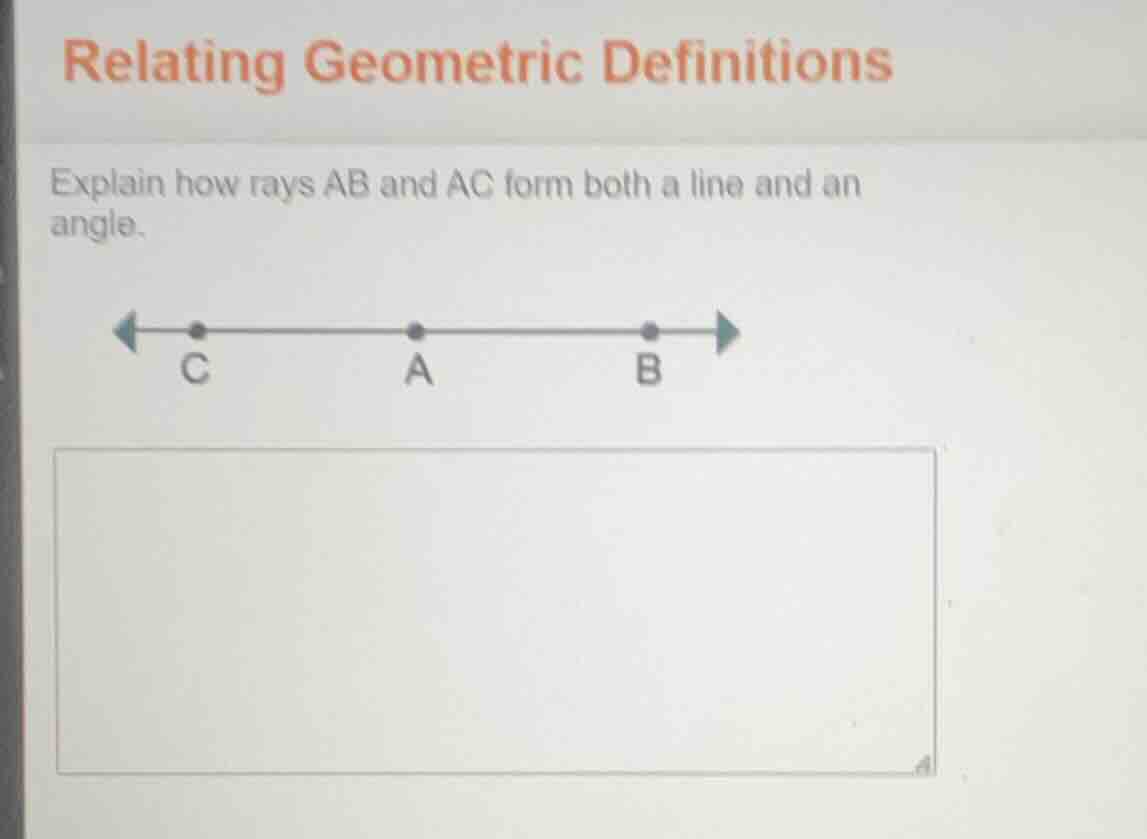
explain how rays ab and ac form both a line and an
angle.
Brief Explanations
- Line Formation: A line is a straight path that extends infinitely in both directions. Ray \( AB \) starts at \( A \) and goes through \( B \) to infinity, and ray \( AC \) starts at \( A \) and goes through \( C \) to infinity. Since \( C \), \( A \), and \( B \) are collinear (lie on a straight line), the combination of rays \( AB \) and \( AC \) extends infinitely in both directions (from \( C \) through \( A \) to \( B \) and beyond), forming a line.
- Angle Formation: An angle is formed by two rays with a common endpoint. Here, rays \( AB \) and \( AC \) share the common endpoint \( A \). Even though they are collinear (forming a straight line), a straight angle is still an angle. A straight angle measures \( 180^\circ \), formed when two rays are opposite each other (collinear) with the same endpoint. So, rays \( AB \) and \( AC \) form a straight angle ( \( 180^\circ \) angle) at \( A \).

Snap & solve any problem in the app
Get step-by-step solutions on Sovi AI
Photo-based solutions with guided steps
Explore more problems and detailed explanations
Rays \( AB \) and \( AC \) form a line because they are collinear (lie on a straight path) and extend infinitely in opposite directions (through \( B \) and \( C \) from \( A \)). They form an angle (a straight angle, \( 180^\circ \)) because they share the common endpoint \( A \) and are opposite rays, satisfying the definition of an angle (two rays with a common vertex).