QUESTION IMAGE
Question
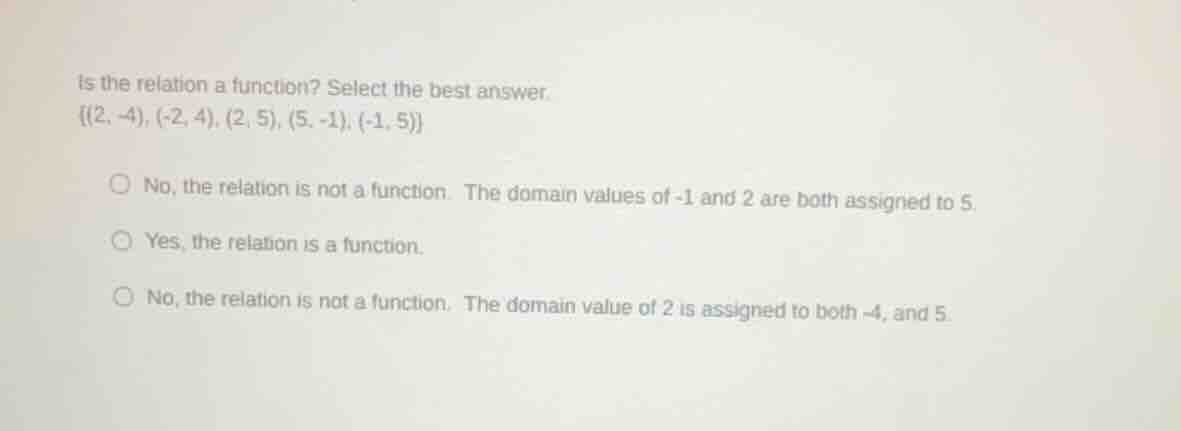
is the relation a function? select the best answer. {(2, -4), (-2, 4), (2, 5), (5, -1), (-1, 5)} no, the relation is not a function. the domain values of -1 and 2 are both assigned to 5. yes, the relation is a function. no, the relation is not a function. the domain value of 2 is assigned to both -4, and 5.
Step1: Recall the definition of a function
A function is a relation where each input (domain value) has exactly one output (range value). In other words, no two ordered pairs in the relation can have the same first element (domain value) with different second elements (range values).
Step2: Analyze the given relation
The given relation is \(\{(2, -4), (-2, 4), (2, 5), (5, -1), (-1, 5)\}\). Let's list out the domain values (the first elements of each ordered pair) and their corresponding range values (the second elements):
- For domain value \(2\), we have range values \(-4\) (from \((2, -4)\)) and \(5\) (from \((2, 5)\)).
- For domain value \(-2\), the range value is \(4\) (from \((-2, 4)\)).
- For domain value \(5\), the range value is \(-1\) (from \((5, -1)\)).
- For domain value \(-1\), the range value is \(5\) (from \((-1, 5)\)).
Since the domain value \(2\) is associated with two different range values (\(-4\) and \(5\)), the relation does not satisfy the definition of a function.
Step3: Evaluate the options
- Option 1: Says domain values of \(-1\) and \(2\) are both assigned to \(5\). But \(-1\) is assigned to \(5\) and \(2\) is assigned to \(-4\) and \(5\), so this is incorrect.
- Option 2: Claims the relation is a function, but we saw that \(2\) has two outputs, so this is incorrect.
- Option 3: Correctly states that the domain value of \(2\) is assigned to both \(-4\) and \(5\), so the relation is not a function.

Snap & solve any problem in the app
Get step-by-step solutions on Sovi AI
Photo-based solutions with guided steps
Explore more problems and detailed explanations
No, the relation is not a function. The domain value of 2 is assigned to both -4, and 5.