QUESTION IMAGE
Question
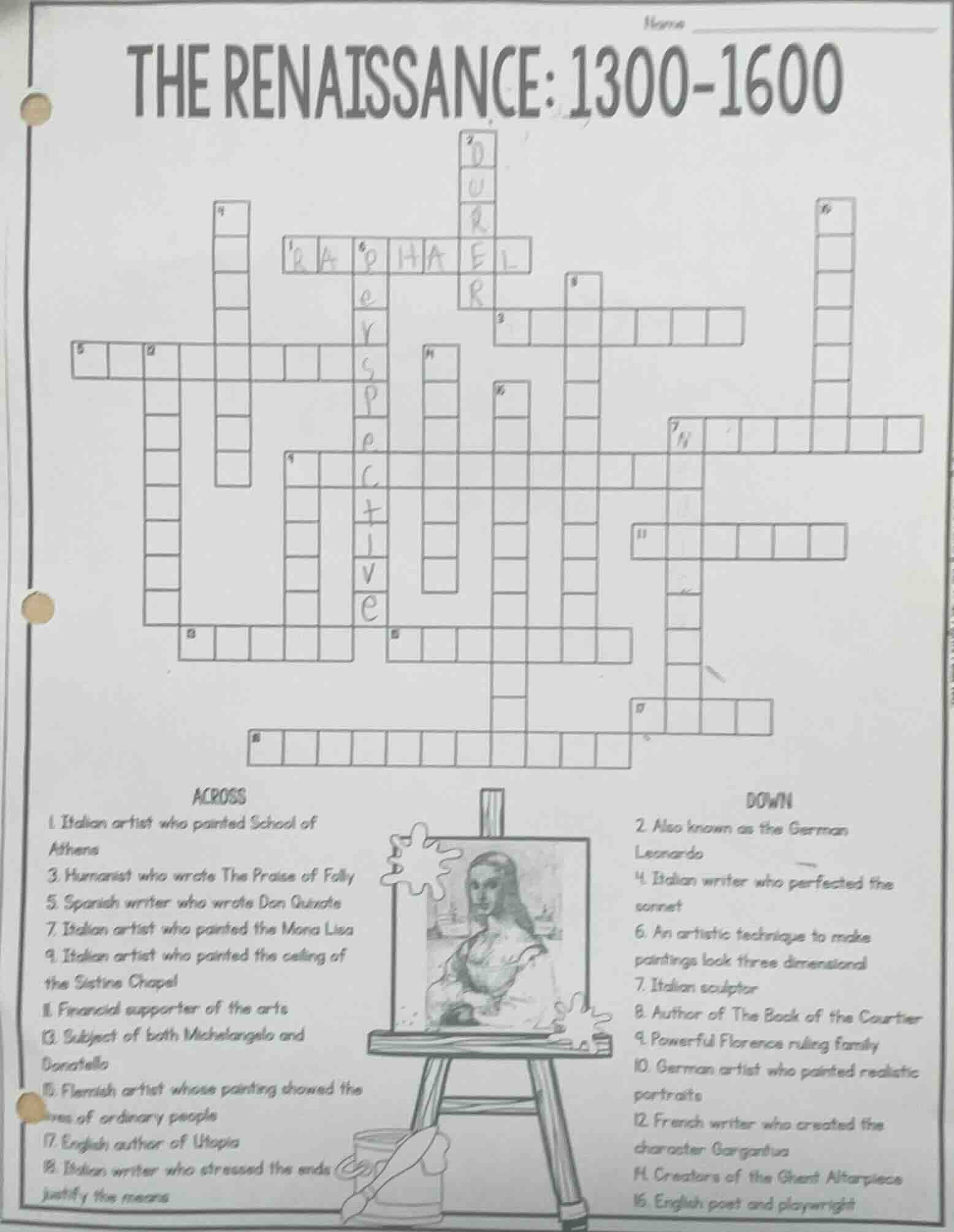
the renaissance: 1300-1600
across
- italian artist who painted school of athens
- humanist who wrote the praise of folly
- spanish writer who wrote don quixote
- italian artist who painted the mona lisa
- italian artist who painted the ceiling of the sistine chapel
- financial supporter of the arts
- subject of both michelangelo and donatello
- flemish artist whose painting showed the lives of ordinary people
- english author of utopia
- italian writer who stressed the ends justify the means
down
- also known as the german leonardo
- italian writer who perfected the sonnet
- an artistic technique to make paintings look three dimensional
- italian sculptor
- author of the book of the courtier
- powerful florence ruling family
- german artist who painted realistic portraits
- french writer who created the character gargantua
- creators of the ghent altarpiece
- english poet and playwright
To solve the crossword, we analyze each clue:
Across Clues:
- Italian artist who painted School of Athens → Raphael (filled in the grid).
- Humanist who wrote The Praise of Folly → Erasmus (length matches, humanist work).
- Spanish writer who wrote Don Quixote → Cervantes (Miguel de Cervantes, author of Don Quixote).
- Italian artist who painted the Mona Lisa → Leonardo (Leonardo da Vinci).
- Italian artist who painted the ceiling of the Sistine Chapel → Michelangelo.
- Financial supporter of the arts → Patron (patrons funded Renaissance art).
- Subject of both Michelangelo and Donatello → David (sculpture of David by both artists).
- Flemish artist whose painting showed the lives of ordinary people → Bruegel (Pieter Bruegel, known for peasant scenes).
- English author of Utopia → More (Thomas More, author of Utopia).
- Italian writer who stressed the ends justify the means → Machiavelli (Niccolò Machiavelli, The Prince).
Down Clues:
- Also known as the German Leonardo → Dürer (Albrecht Dürer, filled in the grid).
- Italian writer who perfected the sonnet → Petrarch (Francesco Petrarch, father of the sonnet).
- An artistic technique to make paintings look three dimensional → Perspective (linear perspective, filled in the grid as "PERSPECTIVE").
- Italian sculptor → Donatello (Renaissance sculptor).
- Author of The Book of the Courtier → Castiglione (Baldassare Castiglione).
- Powerful Florence ruling family → Medici (Medici family, rulers of Florence).
- German artist who painted realistic portraits → Holbein (Hans Holbein the Younger).
- French writer who created the character Gargantua → Rabelais (François Rabelais).
- Creators of the Ghent Altarpiece → Van Eyck (Jan van Eyck and Hubert van Eyck).
- English poet and playwright → Shakespeare (William Shakespeare, though length may vary; if shorter, "Marlowe" or "Jonson," but Shakespeare is iconic).
For example, the filled grid shows "RAPHAEL" (1-Across), "DÜRER" (2-Down), and "PERSPECTIVE" (6-Down) already partially completed. To finish, use the clues above to fill remaining squares.
If you need a specific answer for a clue (e.g., 5-Across: Cervantes, 7-Across: Leonardo, 9-Across: Michelangelo), identify the clue number and use the corresponding solution.

Snap & solve any problem in the app
Get step-by-step solutions on Sovi AI
Photo-based solutions with guided steps
Explore more problems and detailed explanations
To solve the crossword, we analyze each clue:
Across Clues:
- Italian artist who painted School of Athens → Raphael (filled in the grid).
- Humanist who wrote The Praise of Folly → Erasmus (length matches, humanist work).
- Spanish writer who wrote Don Quixote → Cervantes (Miguel de Cervantes, author of Don Quixote).
- Italian artist who painted the Mona Lisa → Leonardo (Leonardo da Vinci).
- Italian artist who painted the ceiling of the Sistine Chapel → Michelangelo.
- Financial supporter of the arts → Patron (patrons funded Renaissance art).
- Subject of both Michelangelo and Donatello → David (sculpture of David by both artists).
- Flemish artist whose painting showed the lives of ordinary people → Bruegel (Pieter Bruegel, known for peasant scenes).
- English author of Utopia → More (Thomas More, author of Utopia).
- Italian writer who stressed the ends justify the means → Machiavelli (Niccolò Machiavelli, The Prince).
Down Clues:
- Also known as the German Leonardo → Dürer (Albrecht Dürer, filled in the grid).
- Italian writer who perfected the sonnet → Petrarch (Francesco Petrarch, father of the sonnet).
- An artistic technique to make paintings look three dimensional → Perspective (linear perspective, filled in the grid as "PERSPECTIVE").
- Italian sculptor → Donatello (Renaissance sculptor).
- Author of The Book of the Courtier → Castiglione (Baldassare Castiglione).
- Powerful Florence ruling family → Medici (Medici family, rulers of Florence).
- German artist who painted realistic portraits → Holbein (Hans Holbein the Younger).
- French writer who created the character Gargantua → Rabelais (François Rabelais).
- Creators of the Ghent Altarpiece → Van Eyck (Jan van Eyck and Hubert van Eyck).
- English poet and playwright → Shakespeare (William Shakespeare, though length may vary; if shorter, "Marlowe" or "Jonson," but Shakespeare is iconic).
For example, the filled grid shows "RAPHAEL" (1-Across), "DÜRER" (2-Down), and "PERSPECTIVE" (6-Down) already partially completed. To finish, use the clues above to fill remaining squares.
If you need a specific answer for a clue (e.g., 5-Across: Cervantes, 7-Across: Leonardo, 9-Across: Michelangelo), identify the clue number and use the corresponding solution.