QUESTION IMAGE
Question
representing relationships
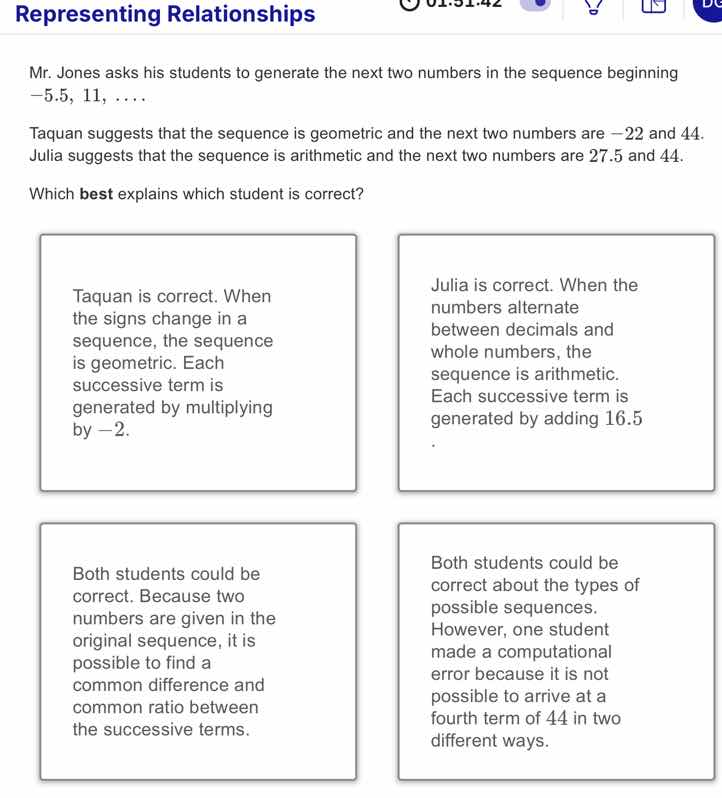
mr. jones asks his students to generate the next two numbers in the sequence beginning -5.5, 11,....
taquan suggests that the sequence is geometric and the next two numbers are -22 and 44.
julia suggests that the sequence is arithmetic and the next two numbers are 27.5 and 44.
which best explains which student is correct?
taquan is correct. when the signs change in a sequence, the sequence is geometric. each successive term is generated by multiplying by -2.
julia is correct. when the numbers alternate between decimals and whole numbers, the sequence is arithmetic. each successive term is generated by adding 16.5.
both students could be correct. because two numbers are given in the original sequence, it is possible to find a common difference and common ratio between the successive terms.
both students could be correct about the types of possible sequences. however, one student made a computational error because it is not possible to arrive at a fourth term of 44 in two different ways.
- First, analyze Taquan's claim (geometric sequence):
- For a geometric sequence, the common ratio \( r=\frac{a_{n + 1}}{a_n}\). Here, \(a_1=-5.5\), \(a_2 = 11\). So \(r=\frac{11}{-5.5}=-2\). Then the third term \(a_3=a_2\times r=11\times(-2)=-22\), and the fourth term \(a_4=a_3\times r=-22\times(-2)=44\). So Taquan's calculation is correct.
- Next, analyze Julia's claim (arithmetic sequence):
- For an arithmetic sequence, the common difference \(d=a_{n + 1}-a_n\). Here, \(d = 11-(-5.5)=16.5\). Then the third term \(a_3=a_2 + d=11 + 16.5 = 27.5\), and the fourth term \(a_4=a_3 + d=27.5+16.5 = 44\). So Julia's calculation is also correct.
- Now, analyze the options:
- The first option says only Taquan is correct, which is wrong as Julia is also correct.
- The second option says only Julia is correct, which is wrong as Taquan is also correct.
- The fourth option says one student made a computational error, but both calculations are correct.
- The third option says both students could be correct because with two terms, we can find a common difference (for arithmetic) and a common ratio (for geometric), and both sequences can be valid with the given two - term start.

Snap & solve any problem in the app
Get step-by-step solutions on Sovi AI
Photo-based solutions with guided steps
Explore more problems and detailed explanations
Both students could be correct. Because two numbers are given in the original sequence, it is possible to find a common difference and a common ratio between the successive terms.