QUESTION IMAGE
Question
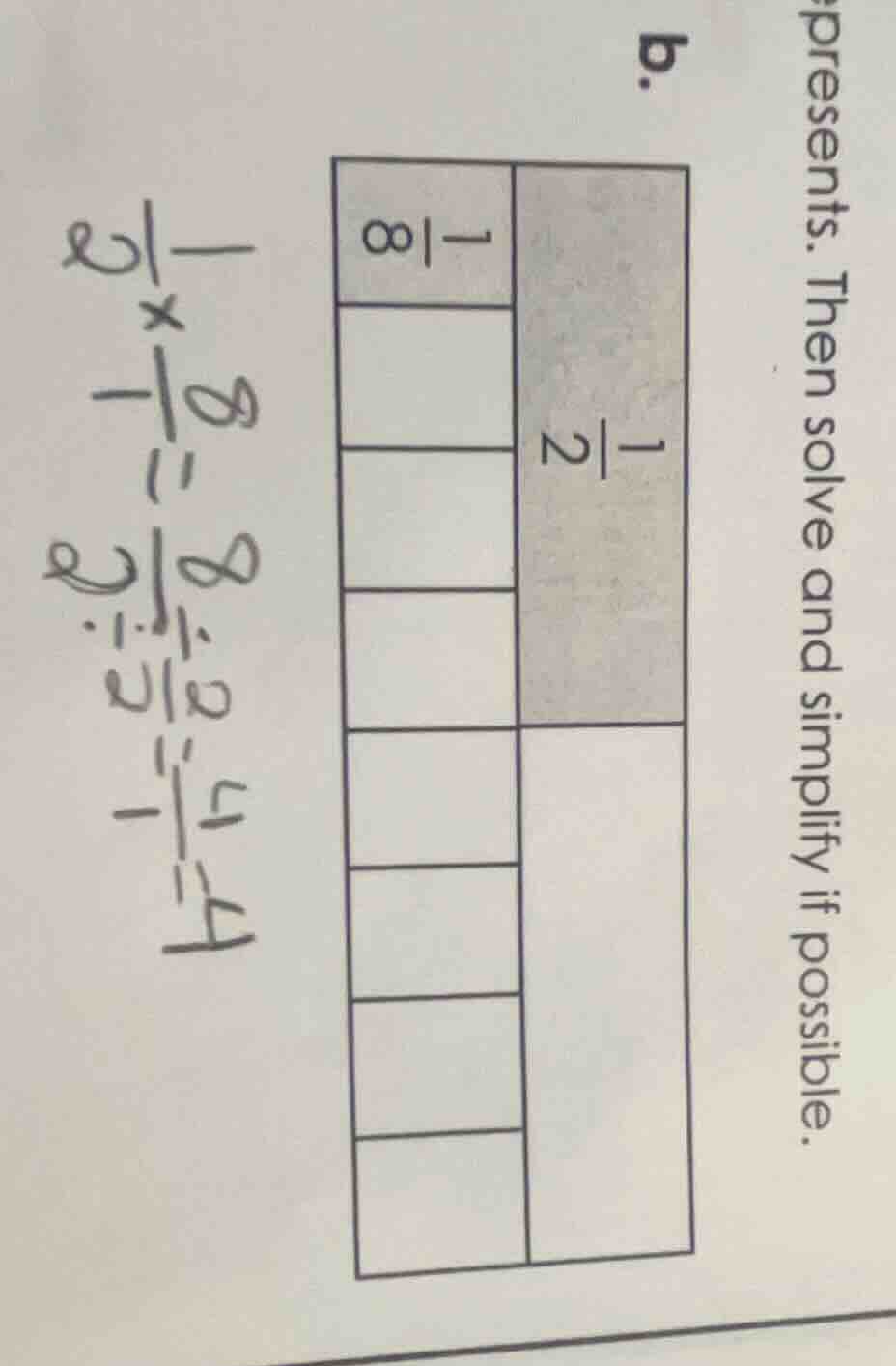
represents. then solve and simplify if possible. b. \\(\frac{1}{2} \times \frac{1}{8} = \frac{8}{8} \div \frac{8}{8} = \frac{4}{4}\\) (handwritten calculation) and a grid with \\(\frac{1}{8}\\) and \\(\frac{1}{2}\\) labeled
Step1: Identify the multiplication
We need to find the product of \(\frac{1}{2}\) and \(\frac{1}{8}\) (from the visual model, the shaded parts represent these fractions). The formula for multiplying fractions is \(\frac{a}{b} \times \frac{c}{d}=\frac{a\times c}{b\times d}\).
So, for \(\frac{1}{2} \times \frac{1}{8}\), we have \(a = 1\), \(b = 2\), \(c = 1\), \(d = 8\).
Step2: Calculate the product
Using the fraction multiplication formula: \(\frac{1}{2} \times \frac{1}{8}=\frac{1\times1}{2\times8}=\frac{1}{16}\)
Wait, but looking at the hand - written work on the left, there was a mistake. The correct multiplication of \(\frac{1}{2}\) and \(\frac{1}{8}\) (not \(\frac{1}{2}\times\frac{8}{1}\)) is done as above. Let's re - examine the visual model. The vertical shaded part is \(\frac{1}{2}\) of the whole, and the horizontal shaded part in the first row is \(\frac{1}{8}\) of the vertical shaded part? Wait, no, maybe the model is showing the multiplication of \(\frac{1}{2}\) and \(\frac{1}{8}\) or maybe \(\frac{1}{2}\) times the number of rows? Wait, the first row has a small square with \(\frac{1}{8}\) and the vertical shaded column is \(\frac{1}{2}\). Let's count the number of small squares in the vertical shaded column. The vertical shaded column has 4 small squares (since the first row's small square is \(\frac{1}{8}\) and maybe the whole vertical column is divided into 4 parts? Wait, no, the hand - written work on the left has \(\frac{1}{2}\times\frac{8}{1}\) which is wrong. Let's do the correct fraction multiplication.
If we consider the area model, the vertical strip is \(\frac{1}{2}\) (width) and the horizontal strip in the first row is \(\frac{1}{8}\) (height). But actually, the correct way is: when multiplying two fractions \(\frac{a}{b}\) and \(\frac{c}{d}\), we multiply the numerators and denominators. So if we have \(\frac{1}{2}\times\frac{1}{8}\), the result is \(\frac{1\times1}{2\times8}=\frac{1}{16}\). But maybe the model is representing \(\frac{1}{2}\) of \(\frac{1}{8}\)? No, \(\frac{1}{2}\) of \(\frac{1}{8}\) is also \(\frac{1}{2}\times\frac{1}{8}=\frac{1}{16}\).
Wait, the hand - written work on the left has \(\frac{1}{2}\times\frac{8}{1}\), which is incorrect. Let's start over.
Step1: Recall fraction multiplication rule
The rule for multiplying two fractions \(\frac{m}{n}\) and \(\frac{p}{q}\) is \(\frac{m}{n}\times\frac{p}{q}=\frac{m\times p}{n\times q}\)
Step2: Apply the rule to \(\frac{1}{2}\) and \(\frac{1}{8}\)
Here, \(m = 1\), \(n = 2\), \(p = 1\), \(q = 8\). So \(\frac{1}{2}\times\frac{1}{8}=\frac{1\times1}{2\times8}=\frac{1}{16}\)

Snap & solve any problem in the app
Get step-by-step solutions on Sovi AI
Photo-based solutions with guided steps
Explore more problems and detailed explanations
\(\frac{1}{16}\)