QUESTION IMAGE
Question
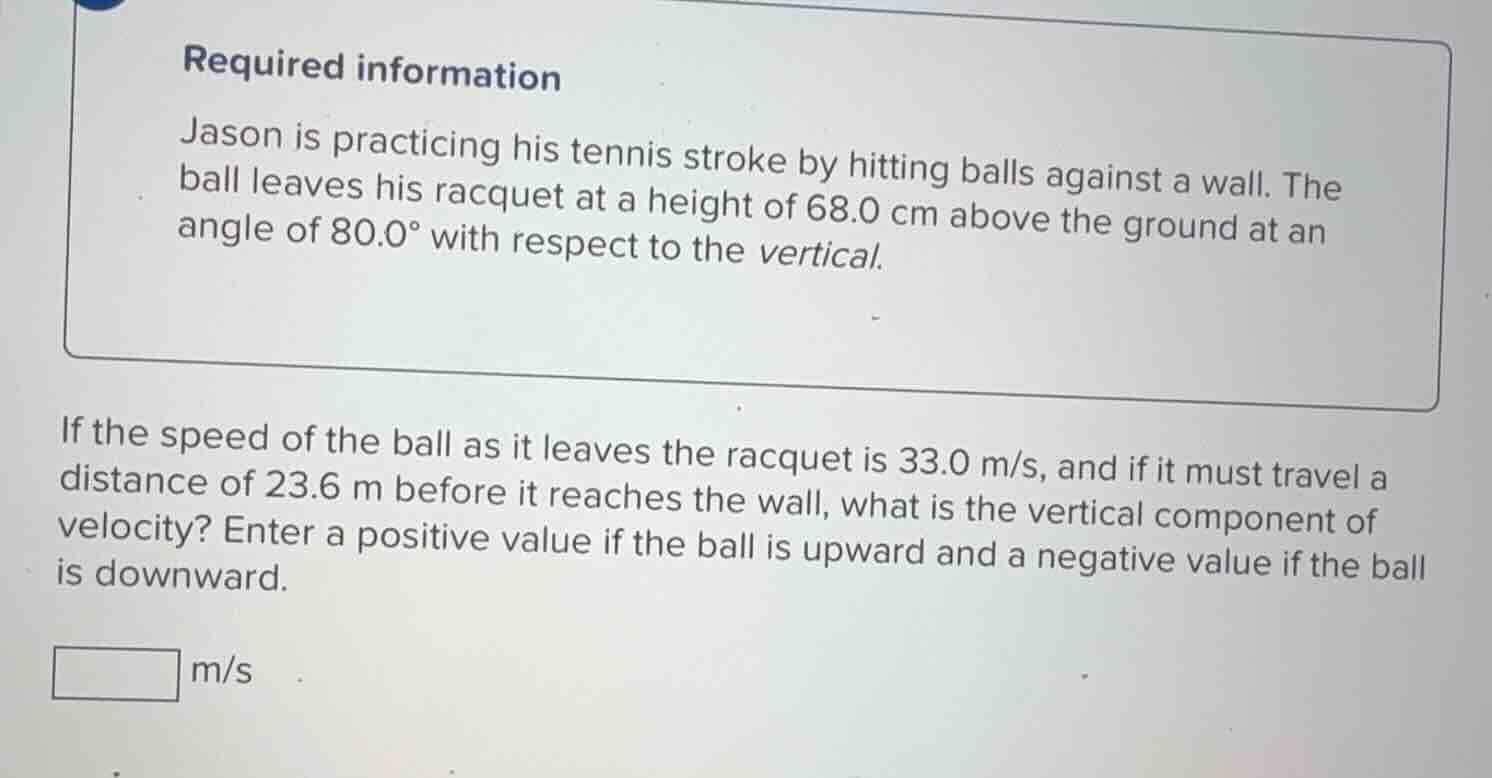
required information jason is practicing his tennis stroke by hitting balls against a wall. the ball leaves his racquet at a height of 68.0 cm above the ground at an angle of 80.0° with respect to the vertical. if the speed of the ball as it leaves the racquet is 33.0 m/s, and if it must travel a distance of 23.6 m before it reaches the wall, what is the vertical component of velocity? enter a positive value if the ball is upward and a negative value if the ball is downward. m/s
Step1: Find horizontal velocity component
First, convert the angle to horizontal reference: the angle with the vertical is $80.0^\circ$, so the angle with the horizontal is $90.0^\circ - 80.0^\circ = 10.0^\circ$.
The horizontal velocity component is $v_x = v_0 \cos(10.0^\circ)$
$v_x = 33.0 \cos(10.0^\circ) \approx 32.50$ m/s
Step2: Calculate time to reach wall
Use horizontal distance $d = v_x t$, solve for $t$:
$t = \frac{d}{v_x} = \frac{23.6}{32.50} \approx 0.726$ s
Step3: Initial vertical velocity component
The initial vertical velocity (upward positive) is $v_{0y} = v_0 \sin(10.0^\circ)$
$v_{0y} = 33.0 \sin(10.0^\circ) \approx 5.72$ m/s
Step4: Find final vertical velocity
Use kinematic equation $v_y = v_{0y} - g t$, where $g = 9.81$ m/s²
$v_y = 5.72 - (9.81 \times 0.726)$
$v_y = 5.72 - 7.12 \approx -1.40$ m/s

Snap & solve any problem in the app
Get step-by-step solutions on Sovi AI
Photo-based solutions with guided steps
Explore more problems and detailed explanations
$-1.40$ m/s