QUESTION IMAGE
Question
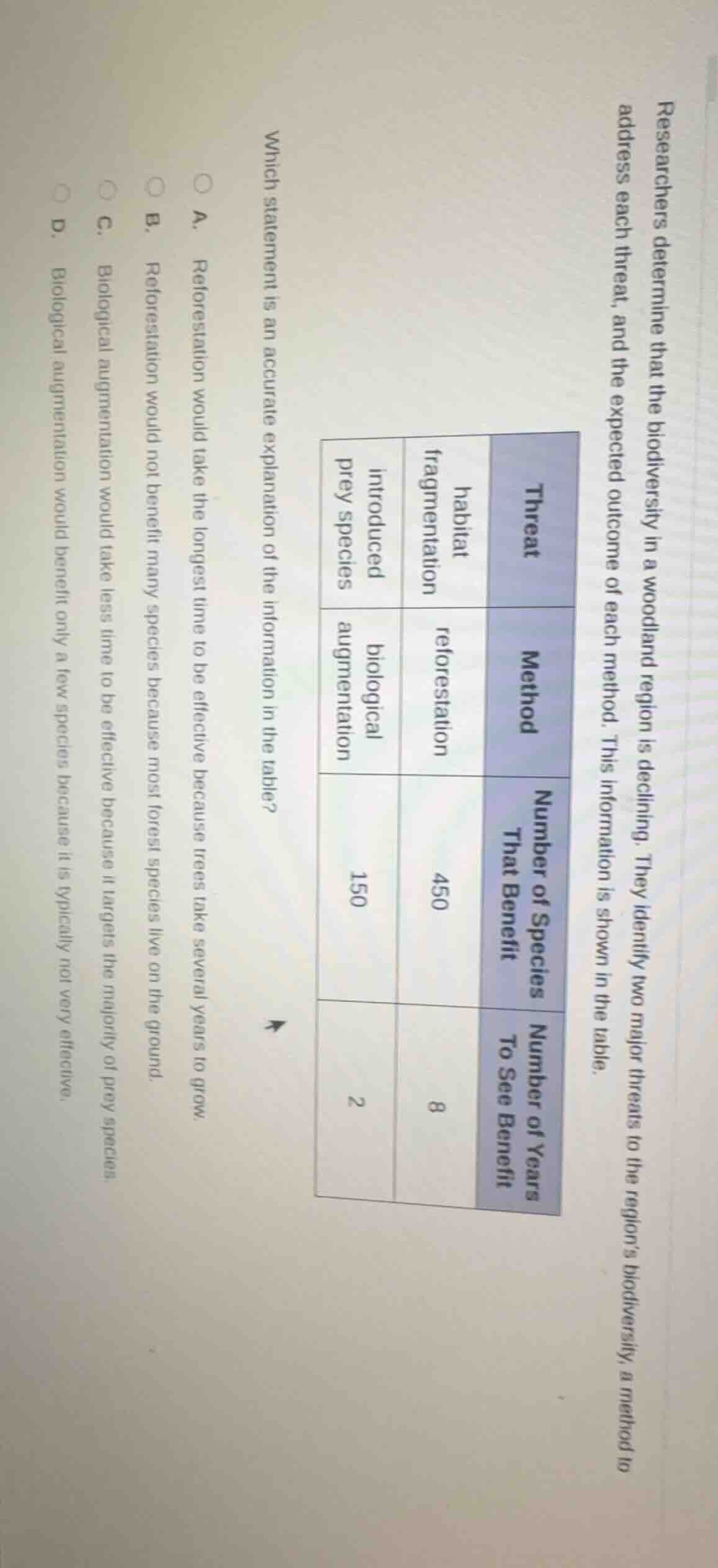
researchers determine that the biodiversity in a woodland region is declining. they identify two major threats to the region’s biodiversity, a method to address each threat, and the expected outcome of each method. this information is shown in the table.
| threat | method | number of species that benefit | number of years to see benefit |
|---|---|---|---|
| introduced prey species | biological augmentation | 150 | 2 |
which statement is an accurate explanation of the information in the table?
a. reforestation would take the longest time to be effective because trees take several years to grow.
b. reforestation would not benefit many species because most forest species live on the ground.
c. biological augmentation would take less time to be effective because it targets the majority of prey species.
d. biological augmentation would benefit only a few species because it is typically not very effective.
- For reforestation: The table shows it takes 8 years to see benefits, which is longer than the 2 years for biological augmentation, and benefits 450 species (a large number, so it benefits many forest species).
- For biological augmentation: It takes 2 years (shorter than reforestation) and benefits only 150 species, meaning it targets a smaller subset (prey species) rather than the majority.
- Option A matches the timeline for reforestation (8 years is longer than 2 years, and trees take time to grow).
- Option B is wrong because reforestation benefits 450 species, which is many.
- Option C is wrong because biological augmentation benefits only 150 species, not the majority of prey species.
- Option D is wrong because the table does not state it is ineffective, only that it benefits fewer species.

Snap & solve any problem in the app
Get step-by-step solutions on Sovi AI
Photo-based solutions with guided steps
Explore more problems and detailed explanations
A. Reforestation would take the longest time to be effective because trees take several years to grow.