QUESTION IMAGE
Question
the respiratory and circulatory systems tutorial
directions
read the instructions for this self - checked activity. type in your response to each question, and check your answers. at the end of the activity, write a brief evaluation of your work.
activity
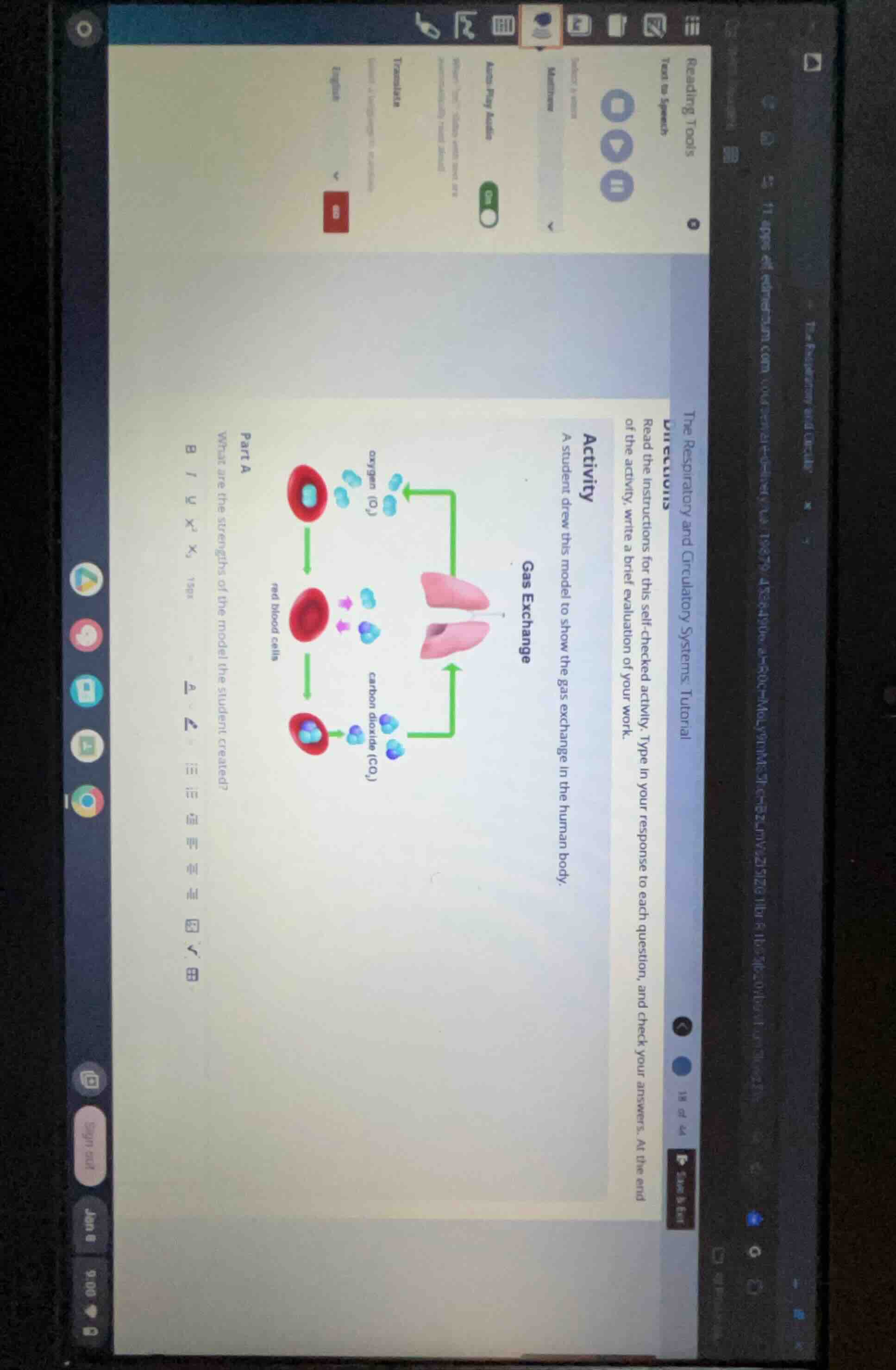
a student drew this model to show the gas exchange in the human body.
part a
what are the strengths of the model the student created?
Brief Explanations
- Clear Visual Flow: The model uses arrows to clearly show the direction of gas movement: oxygen entering the lungs, moving into red blood cells, and carbon dioxide moving from red blood cells to the lungs to exit the body.
- Key Components Labeled: It explicitly identifies the critical structures (lungs, red blood cells) and gases (oxygen, carbon dioxide) involved in pulmonary gas exchange.
- Simplified but Accurate Core Concept: It successfully illustrates the fundamental process of gas exchange (oxygen uptake and carbon dioxide release) in a way that is easy to understand, without unnecessary complexity.

Snap & solve any problem in the app
Get step-by-step solutions on Sovi AI
Photo-based solutions with guided steps
Explore more problems and detailed explanations
The strengths of the model are:
- It uses clear directional arrows to visually demonstrate the movement of oxygen and carbon dioxide during gas exchange.
- It labels all essential components: the lungs, red blood cells, oxygen ($O_2$), and carbon dioxide ($CO_2$).
- It simplifies the core biological process of pulmonary gas exchange into an easy-to-follow, intuitive diagram that effectively communicates the basic function.