QUESTION IMAGE
Question
rev. 01/27/2022
the women of world war i
directions: use the information from the previous page, to help you answer the following questions.
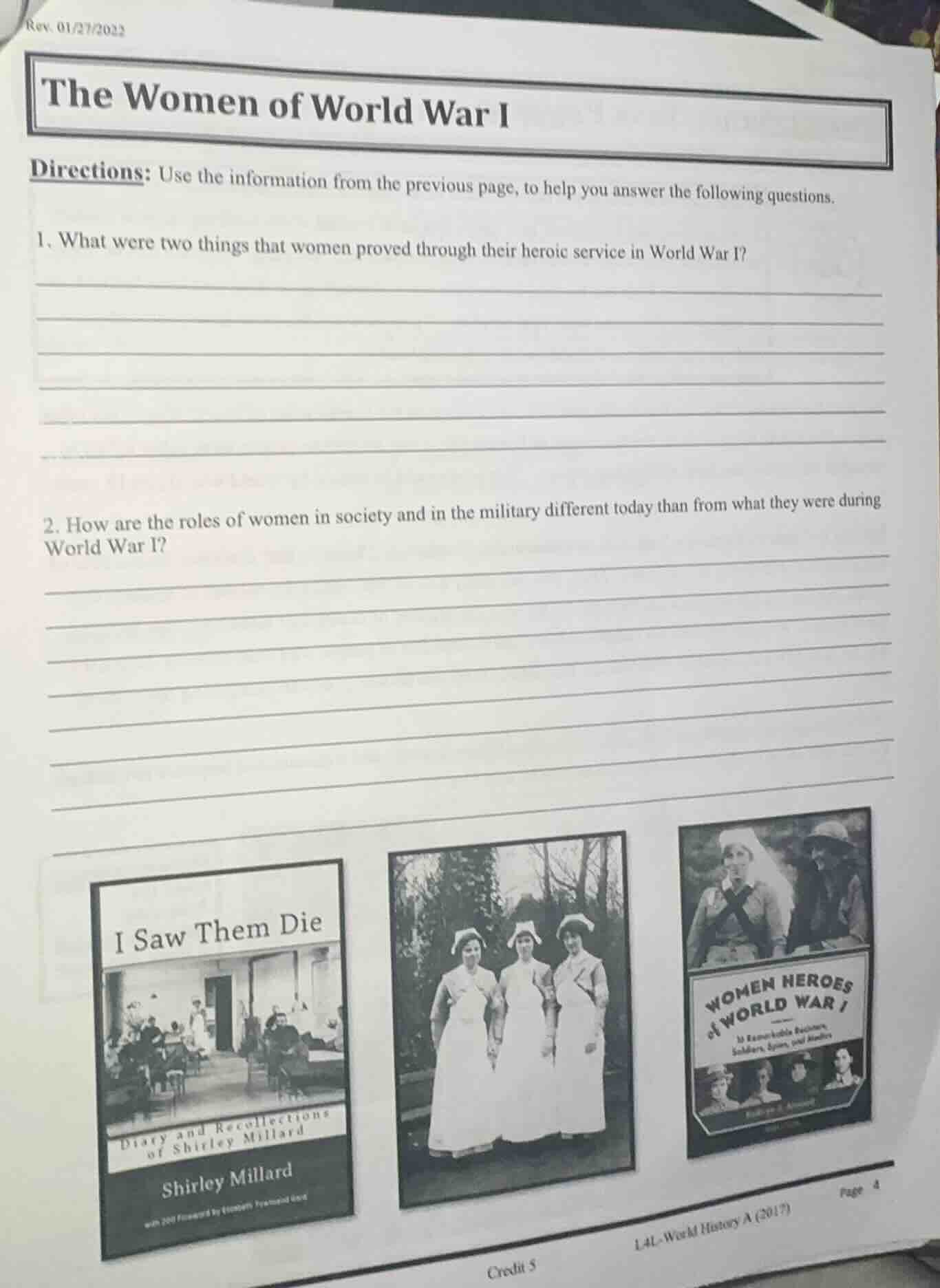
- what were two things that women proved through their heroic service in world war i?
- how are the roles of women in society and in the military different today than from what they were during world war i?
(images: i saw them die - diary and recollections of shirley millard; three women in nurse uniforms; women heroes of world war i)
credit 5
l4l-world history a (2017) page 4
To answer these questions, we would need the information from the "previous page" referenced in the directions. Since that information is not provided here, we can't give a specific answer. However, we can provide general guidance on how to approach them:
For Question 1:
To answer "What were two things that women proved through their heroic service in World War I?", you would look for evidence in the provided text about the capabilities, contributions, or societal perceptions that women's service challenged or demonstrated. For example, women's service in WWI often proved that they were capable of taking on roles traditionally held by men (like factory work, nursing on the front lines, or administrative roles in the military) and that they could be brave and heroic under extreme circumstances, challenging the idea that women were only suited for domestic roles.
For Question 2:
To answer "How are the roles of women in society and in the military different today than from what they were during World War I?", you would compare the opportunities, positions, and societal acceptance of women's roles now versus during WWI. During WWI, women's roles in the military were often limited to support roles (like nursing, clerical work) and in society, they were starting to break into male-dominated fields but still faced significant restrictions. Today, women serve in combat roles, hold high-ranking positions in the military, and have greater representation in a wide range of professions and leadership roles in society.
If you can provide the information from the previous page, I can help you formulate more specific answers.

Snap & solve any problem in the app
Get step-by-step solutions on Sovi AI
Photo-based solutions with guided steps
Explore more problems and detailed explanations
To answer these questions, we would need the information from the "previous page" referenced in the directions. Since that information is not provided here, we can't give a specific answer. However, we can provide general guidance on how to approach them:
For Question 1:
To answer "What were two things that women proved through their heroic service in World War I?", you would look for evidence in the provided text about the capabilities, contributions, or societal perceptions that women's service challenged or demonstrated. For example, women's service in WWI often proved that they were capable of taking on roles traditionally held by men (like factory work, nursing on the front lines, or administrative roles in the military) and that they could be brave and heroic under extreme circumstances, challenging the idea that women were only suited for domestic roles.
For Question 2:
To answer "How are the roles of women in society and in the military different today than from what they were during World War I?", you would compare the opportunities, positions, and societal acceptance of women's roles now versus during WWI. During WWI, women's roles in the military were often limited to support roles (like nursing, clerical work) and in society, they were starting to break into male-dominated fields but still faced significant restrictions. Today, women serve in combat roles, hold high-ranking positions in the military, and have greater representation in a wide range of professions and leadership roles in society.
If you can provide the information from the previous page, I can help you formulate more specific answers.