QUESTION IMAGE
Question
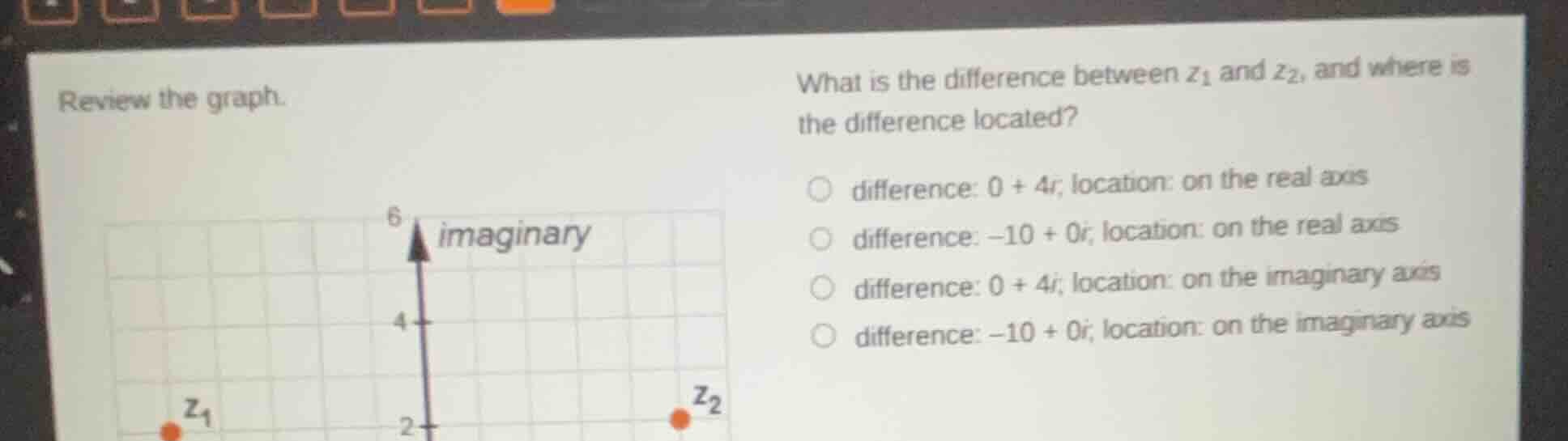
review the graph.
what is the difference between ( z_1 ) and ( z_2 ), and where is the difference located?
\\( \circ \\) difference: ( 0 + 4i ); location: on the real axis
\\( \circ \\) difference: ( -10 + 0i ); location: on the real axis
\\( \circ \\) difference: ( 0 + 4i ); location: on the imaginary axis
\\( \circ \\) difference: ( -10 + 0i ); location: on the imaginary axis
- First, determine the complex numbers \( z_1 \) and \( z_2 \) from the graph. Assume \( z_1 \) is at \( -5 + 2i \) (left on real axis, \( y = 2 \)) and \( z_2 \) is at \( 5 + 2i \) (right on real axis, \( y = 2 \)).
- Calculate the difference \( z_1 - z_2 = (-5 + 2i)-(5 + 2i)=-5 - 5+2i - 2i=-10 + 0i \). Wait, no, maybe another approach. Wait, maybe the imaginary parts are same? Wait, looking at the graph, \( z_1 \) and \( z_2 \) have same imaginary component (since they are on the same horizontal line, \( y = 2 \)). Wait, maybe I misread. Wait, the options have differences with imaginary part 4 or real part -10. Wait, maybe \( z_1 \) is at \( -5 + 2i \) and \( z_2 \) is at \( 5 + 2i \), then \( z_1 - z_2=-10 + 0i \), which is on the real axis (since imaginary part is 0). Alternatively, if \( z_1 \) and \( z_2 \) have real parts same and imaginary parts differ? Wait, no, the options: let's re - evaluate. Wait, maybe the complex numbers are \( z_1=a + bi \) and \( z_2=c + di \). From the graph, if \( z_1 \) is at, say, \( -5 + 2i \) and \( z_2 \) is at \( 5 + 2i \), then \( z_1 - z_2=(-5 - 5)+(2 - 2)i=-10+0i \), which is on the real axis (because imaginary part is 0). Now check the options: the option with difference \( -10 + 0i \) and location on real axis is one of the options. Wait, but also, if the imaginary parts are different: suppose \( z_1=x + 2i \) and \( z_2=x + 6i \), then \( z_1 - z_2=0-4i \) or \( z_2 - z_1=0 + 4i \). Wait, maybe I made a mistake earlier. Let's look at the y - axis (imaginary axis) labels: 2,4,6. So if \( z_1 \) is at, say, \( x + 2i \) and \( z_2 \) is at \( x + 6i \), then \( z_2 - z_1=(x - x)+(6 - 2)i = 0+4i \), which is on the imaginary axis (since real part is 0). Wait, now I'm confused. Wait, the graph: the imaginary axis is vertical. Let's assume the two points \( z_1 \) and \( z_2 \) have the same real part (so they are vertically aligned) and different imaginary parts. So \( z_1 = a+bi \), \( z_2=a + di \), then \( z_1 - z_2=(a - a)+(b - d)i=(b - d)i \). If \( b - d=-4 \), then \( z_1 - z_2=0-4i \), but the options have \( 0 + 4i \), so maybe \( z_2 - z_1=0 + 4i \). And since the real part is 0, the number is on the imaginary axis (because a complex number \( 0+4i \) is of the form \( 0+yi \), so it lies on the imaginary axis). Wait, now I think I messed up the first approach. Let's start over.
Complex numbers on the complex plane: real part is x - axis, imaginary part is y - axis. So a complex number \( z=x + yi \). If two complex numbers have the same real part (x - coordinate), then their difference will have real part 0 (since \( (x + y_1i)-(x + y_2i)=(x - x)+(y_1 - y_2)i=(y_1 - y_2)i \)), so the difference is a pure imaginary number, lying on the imaginary axis. If two complex numbers have the same imaginary part (y - coordinate), their difference will have imaginary part 0, lying on the real axis.
Looking at the graph, the two points \( z_1 \) and \( z_2 \): let's assume \( z_1 \) is at, say, \( x_1 + y_1i \) and \( z_2 \) is at \( x_2 + y_2i \). From the options, the difference with \( 0+4i \) has real part 0, so the two numbers must have the same real part (so \( x_1=x_2 \)) and different imaginary parts (\( y_1 - y_2 = 4 \) or \( y_2 - y_1 = 4 \)). So the difference is \( 0+4i \) (if \( y_2 - y_1 = 4 \)), and since the real part is 0, it's on the imaginary axis.
Now, check the options: the option "difference: \( 0 + 4i \); location: on the imaginary axis" is one of the options. Let's verify: if \( z_1=a + bi \) and \( z_2=a + (b - 4)i \), then \( z_2 - z_1=(a - a)+((b - 4)-b)i=-4i \…

Snap & solve any problem in the app
Get step-by-step solutions on Sovi AI
Photo-based solutions with guided steps
Explore more problems and detailed explanations
C. difference: \( 0 + 4i \); location: on the imaginary axis (assuming the option labels are A, B, C, D with C being "difference: \( 0 + 4i \); location: on the imaginary axis")