QUESTION IMAGE
Question
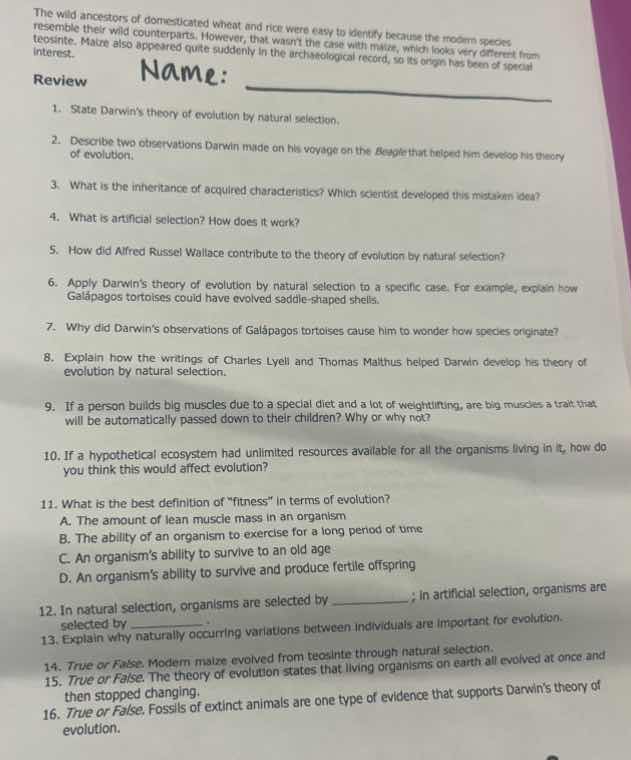
review
- state darwins theory of evolution by natural selection.
- describe two observations darwin made on his voyage on the beagle that helped him develop his theory of evolution.
- what is the inheritance of acquired characteristics? which scientist developed this mistaken idea?
- what is artificial selection? how does it work?
- how did alfred russel wallace contribute to the theory of evolution by natural selection?
- apply darwins theory of evolution by natural selection to a specific case. for example, explain how galápagos tortoises could have evolved saddle-shaped shells.
- why did darwins observations of galápagos tortoises cause him to wonder how species originate?
- explain how the writings of charles lyell and thomas malthus helped darwin develop his theory of evolution by natural selection.
- if a person builds big muscles due to a special diet and a lot of weightlifting, are big muscles a trait that will be automatically passed down to their children? why or why not?
- if a hypothetical ecosystem had unlimited resources available for all the organisms living in it, how do you think this would affect evolution?
- what is the best definition of \fitness\ in terms of evolution?
a. the amount of lean muscle mass in an organism
b. the ability of an organism to exercise for a long period of time
c. an organisms ability to survive to an old age
d. an organisms ability to survive and produce fertile offspring
- in natural selection, organisms are selected by ____________; in artificial selection, organisms are selected by ____________.
- explain why naturally occurring variations between individuals are important for evolution.
- true or false. modern man evolved from teosinte through natural selection.
- true or false. the theory of evolution states that living organisms on earth all evolved at once and then stopped changing.
- true or false. fossils of extinct animals are one type of evidence that supports darwins theory of evolution.
Brief Explanations
- Summarizes Darwin's core evolutionary mechanism based on survival and heritable traits.
- Lists key observations from the Beagle voyage that informed Darwin's thinking.
- Defines the outdated evolutionary idea and names its originator.
- Explains human-driven selective breeding and its mechanism.
- Notes Wallace's independent development of natural selection and its impact on Darwin.
- Applies natural selection principles to Galápagos tortoise shell evolution.
- Connects tortoise trait variation across islands to species origin questions.
- Links Lyell's uniformitarianism and Malthus's population ideas to Darwin's theory.
- Distinguishes acquired vs. heritable traits to address trait inheritance.
- Explains how unlimited resources remove natural selection pressure.
- Identifies the evolutionary definition of fitness from the options.
- Contrasts the selective agents in natural vs. artificial selection.
- Explains how variation provides the raw material for natural selection.
- Corrects the false claim about modern human evolution from Neanderthals.
- Corrects the false claim about evolution being a one-time event.
- Confirms that fossil evidence supports evolutionary theory.

Snap & solve any problem in the app
Get step-by-step solutions on Sovi AI
Photo-based solutions with guided steps
Explore more problems and detailed explanations
- Organisms with heritable, favorable traits survive/reproduce more; over time, these traits become common in the population, leading to evolutionary adaptation.
- 1) Unique adaptations of species to specific island habitats (e.g., Galápagos finches, tortoises). 2) Fossils of extinct large mammals that resembled modern South American species.
- The idea that traits an organism acquires during its lifetime can be passed to offspring; Jean-Baptiste Lamarck developed this mistaken idea.
- Artificial selection is the process where humans intentionally breed organisms with desired traits to produce offspring with those traits. Humans select which individuals reproduce, favoring traits useful to humans (e.g., crop yield, dog coat color).
- Alfred Russel Wallace independently developed the theory of evolution by natural selection and sent his manuscript to Darwin. This prompted Darwin to finally publish his own work On the Origin of Species in 1859, and Wallace's work provided independent support for the theory.
- In Galápagos tortoises: 1) Variation existed in shell shape (dome-shaped vs. saddle-shaped). 2) Saddle-shaped shells allowed tortoises to reach tall cactus pads (a key food source) on drier islands with sparse low vegetation. 3) Tortoises with saddle-shaped shells survived and reproduced more successfully in this environment, passing the trait to offspring. Over generations, saddle-shaped shells became common in tortoise populations on those islands.
- Darwin observed that tortoises on different Galápagos islands had distinct shell shapes and body sizes, each matched to the island's specific food sources and environment. This variation suggested that the tortoises had adapted to their local conditions, making him question how these distinct, closely related species originated from a common ancestor.
- 1) Charles Lyell's Principles of Geology argued that Earth changes slowly via uniform processes (uniformitarianism), which showed Darwin that Earth was old enough for evolution to occur over long periods. 2) Thomas Malthus's essay on population stated that human populations grow faster than resources, leading to competition and death. Darwin applied this to all organisms, realizing that competition for limited resources drives natural selection.
- No, the big muscles will not be automatically passed down. The muscles are an acquired trait, developed through environmental factors (weightlifting) rather than being encoded in the person's heritable DNA. Only traits controlled by genes can be passed to offspring.
- If an ecosystem had unlimited resources, there would be no competition for food, space, or other needs. All organisms would survive and reproduce equally, removing the selective pressure that drives natural selection. Evolution via natural selection would largely stop, as there would be no favoring of specific heritable traits.
- D. An organism's ability to survive and produce fertile offspring
- In natural selection, organisms are selected by environmental pressures; in artificial selection, organisms are selected by human choice.
- Naturally occurring variations are heritable differences between individuals. These variations mean some individuals have traits that make them more likely to survive and reproduce in a given environment. Over time, these favorable traits become more common in the population, driving evolution. Without variation, there would be no traits for natural selection to act on.
- False
- False
- True