QUESTION IMAGE
Question
reviewing computing probability
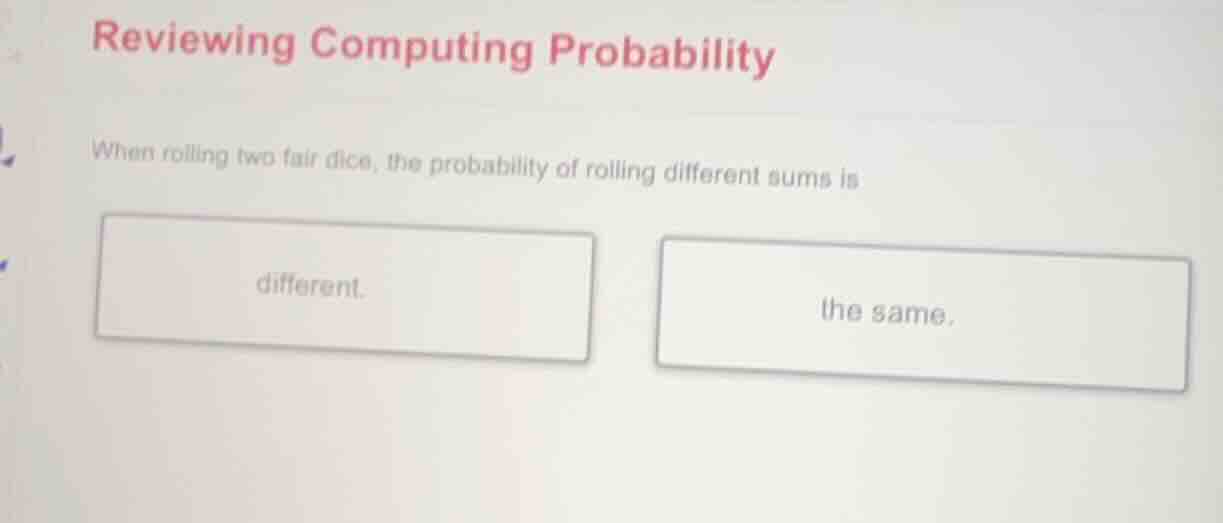
when rolling two fair dice, the probability of rolling different sums is
different.
the same.
Step1: Analyze possible sums of two dice
When rolling two fair dice, the minimum sum is \(1 + 1=2\) and the maximum sum is \(6+6 = 12\). The possible sums are \(2,3,4,5,6,7,8,9,10,11,12\). Each sum has a different number of combinations to achieve it. For example, sum of \(2\) can only be achieved by \((1,1)\) (1 way), sum of \(3\) by \((1,2)\) and \((2,1)\) (2 ways), sum of \(7\) by \((1,6),(2,5),(3,4),(4,3),(5,2),(6,1)\) (6 ways), etc. So the number of outcomes for each sum is different, which means the probability (which is number of favorable outcomes over total outcomes \(36\)) for each sum is different.
Step2: Conclusion on probability of different sums
Since each sum has a different probability of occurring, the probability of rolling different sums (i.e., the probability that two rolls of two dice have different sums) - but actually, the question is about the probability of rolling different sums (maybe a mis - phrasing, likely meaning the probability of each sum is different). Since each sum has a different number of combinations, their probabilities are different.

Snap & solve any problem in the app
Get step-by-step solutions on Sovi AI
Photo-based solutions with guided steps
Explore more problems and detailed explanations
A. different.