QUESTION IMAGE
Question
reviewing the main idea
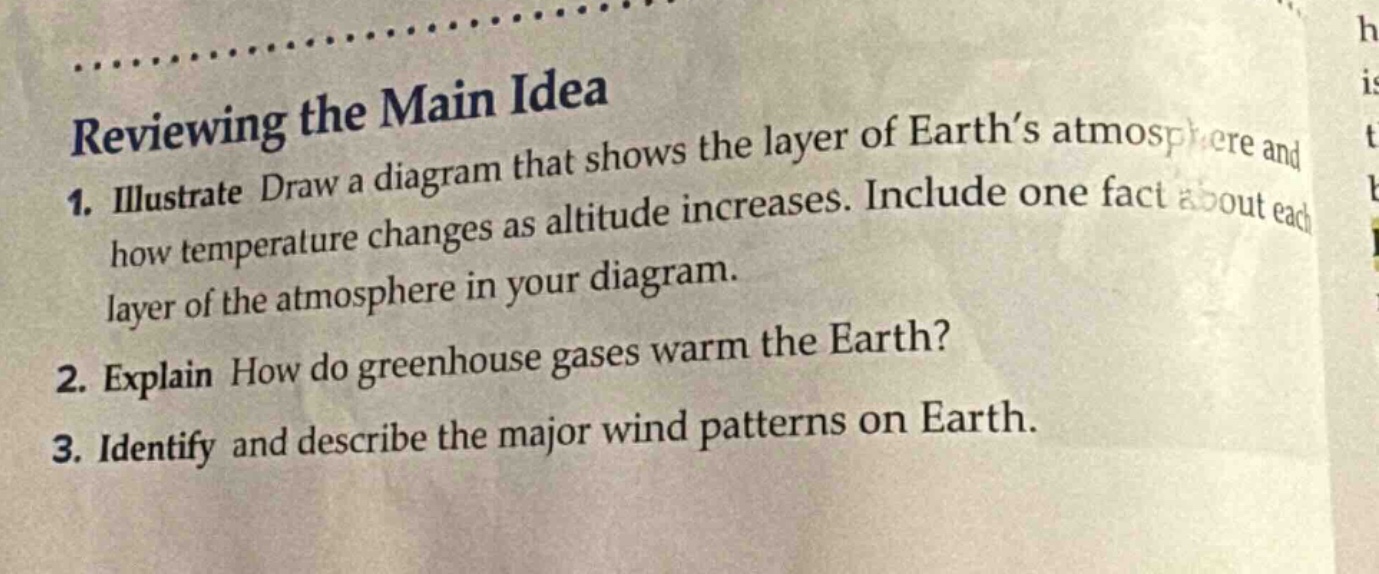
- illustrate draw a diagram that shows the layer of earth’s atmosphere and how temperature changes as altitude increases. include one fact about each layer of the atmosphere in your diagram.
- explain how do greenhouse gases warm the earth?
- identify and describe the major wind patterns on earth.
Sub - question 1 (Illustrate the atmosphere layers and temperature - altitude relation)
The Earth's atmosphere has several layers: Troposphere, Stratosphere, Mesosphere, Thermosphere, and Exosphere.
- Troposphere: It is the lowest layer, extending up to about 8 - 15 km. Temperature decreases with increasing altitude here. Most weather phenomena occur in this layer.
- Stratosphere: Extends from the top of the troposphere to about 50 km. Temperature increases with altitude due to the presence of the ozone layer which absorbs ultraviolet radiation.
- Mesosphere: From about 50 km to 85 km. Temperature decreases with altitude, reaching very low values (around - 90°C at the top). Meteors burn up in this layer.
- Thermosphere: From 85 km to 600 km. Temperature increases significantly with altitude as it is exposed to high - energy solar radiation. The auroras occur in this layer.
- Exosphere: The outermost layer, gradually merging with space. Temperature is very high, and gas molecules are very sparse.
To draw the diagram, we can have a vertical axis representing altitude (increasing upwards) and a horizontal axis or a side - note for temperature (with an arrow indicating the direction of temperature change) and layer - specific facts.
Greenhouse gases (such as carbon dioxide, methane, water vapor) in the Earth's atmosphere allow short - wave solar radiation (visible light, ultraviolet) to pass through and reach the Earth's surface. The Earth's surface then absorbs this radiation and re - emits it as long - wave infrared radiation. Greenhouse gases are good at absorbing this long - wave infrared radiation. When they absorb this radiation, they re - emit some of it back towards the Earth's surface and some in other directions. This process traps heat in the atmosphere, preventing it from escaping into space, and thus warms the Earth. This is similar to how a greenhouse works, where the glass allows sunlight in but traps the heat inside.
The major wind patterns on Earth are caused by the uneven heating of the Earth's surface by the sun and the Coriolis effect (due to the Earth's rotation).
- Trade Winds:
- Location: Blow from the subtropical high - pressure zones (around 30°N and 30°S) towards the equatorial low - pressure zone (ITCZ - Intertropical Convergence Zone).
- Direction: In the Northern Hemisphere, they blow from the northeast; in the Southern Hemisphere, from the southeast.
- Reason: Uneven heating (equator is warmer) and Coriolis effect (deflects winds to the right in the Northern Hemisphere and left in the Southern Hemisphere).
- Westerlies:
- Location: Blow from the subtropical high - pressure zones (30°N and 30°S) towards the sub - polar low - pressure zones (around 60°N and 60°S).
- Direction: In the Northern Hemisphere, they blow from the southwest; in the Southern Hemisphere, from the northwest.
- Reason: Pressure gradient (from high to low pressure) and Coriolis effect. These winds are responsible for much of the weather in the mid - latitudes.
- Polar Easterlies:
- Location: Blow from the polar high - pressure zones (around 90°N and 90°S) towards the sub - polar low - pressure zones (60°N and 60°S).
- Direction: In the Northern Hemisphere, they blow from the northeast; in the Southern Hemisphere, from the southeast.
- Reason: Cold, dense air at the poles flows towards the lower - latitude sub - polar lows, and the Coriolis effect influences their direction.

Snap & solve any problem in the app
Get step-by-step solutions on Sovi AI
Photo-based solutions with guided steps
Explore more problems and detailed explanations
- Troposphere:
- Altitude range: 0 - 8 - 15 km (varies with latitude and season).
- Temperature change: Decreases with altitude (average lapse rate of about 6.5°C per km).
- Fact: Contains about 75% of the atmosphere's mass and is where weather happens.
- Stratosphere:
- Altitude range: 8 - 15 km to 50 km.
- Temperature change: Increases with altitude (due to ozone absorption of UV).
- Fact: Ozone layer is here, protecting life from harmful UV radiation.
- Mesosphere:
- Altitude range: 50 km to 85 km.
- Temperature change: Decreases with altitude (reaches ~ - 90°C at the mesopause).
- Fact: Meteors burn up here, creating shooting stars.
- Thermosphere:
- Altitude range: 85 km to 600 km.
- Temperature change: Increases with altitude (can reach thousands of degrees due to solar radiation).
- Fact: Auroras (northern and southern lights) occur here.
- Exosphere:
- Altitude range: 600 km to beyond (up to 10,000 km or more).
- Temperature change: Very high (but gas is so sparse that temperature is not easily defined in the traditional sense).
- Fact: Satellites and space shuttles orbit in the lower part of the exosphere.
(For the diagram, a simple vertical bar with labeled layers, altitude markers, temperature trend arrows, and the above facts can be drawn.)