QUESTION IMAGE
Question
revisiting exponents & their functions quick check
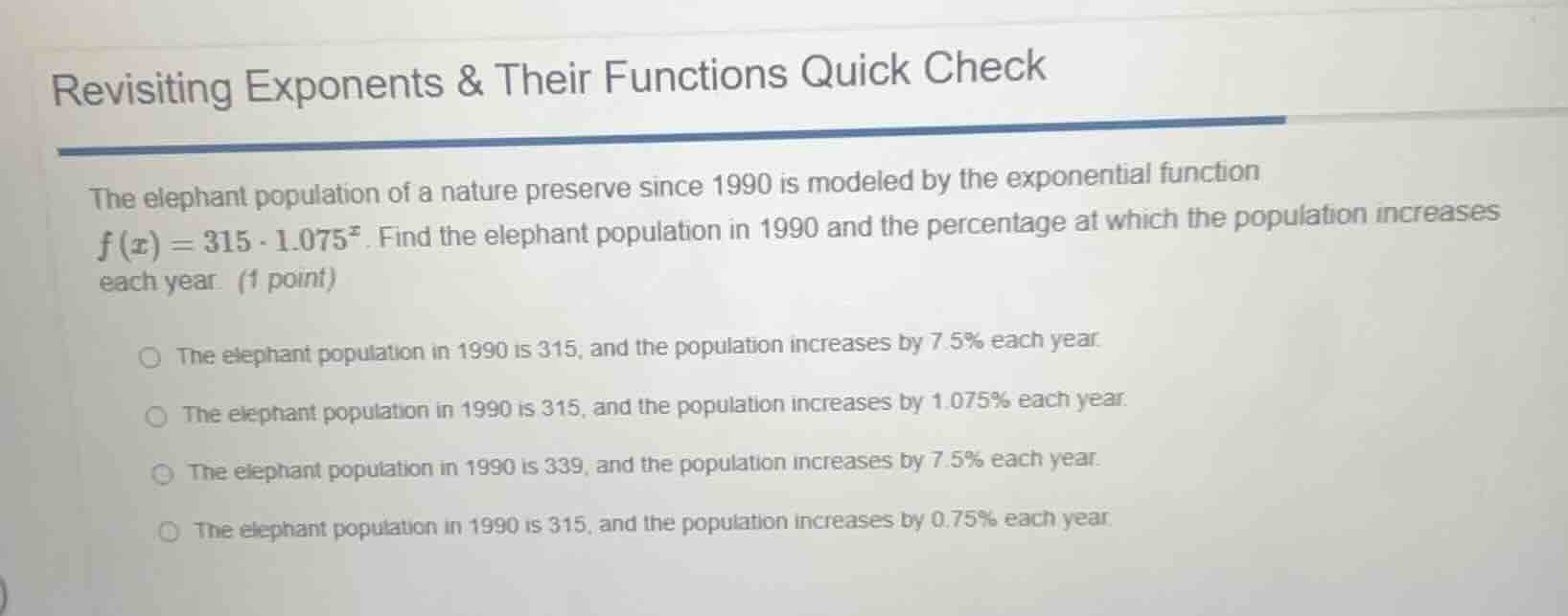
the elephant population of a nature preserve since 1990 is modeled by the exponential function
$f(x) = 315 \cdot 1.075^x$. find the elephant population in 1990 and the percentage at which the population increases
each year. (1 point)
\\(\circ\\) the elephant population in 1990 is 315, and the population increases by 7.5% each year.
\\(\circ\\) the elephant population in 1990 is 315, and the population increases by 1.075% each year.
\\(\circ\\) the elephant population in 1990 is 339, and the population increases by 7.5% each year.
\\(\circ\\) the elephant population in 1990 is 315, and the population increases by 0.75% each year.
To find the population in 1990, we note that in the exponential function \( f(x)=315\cdot1.075^{x} \), when \( x = 0 \) (representing the year 1990, since \( x \) is the number of years after 1990), we have \( f(0)=315\cdot1.075^{0}=315\cdot1 = 315 \). For the growth rate, the general form of an exponential growth function is \( f(x)=a(1 + r)^{x} \), where \( a \) is the initial amount and \( r \) is the growth rate. Comparing \( 315\cdot1.075^{x} \) with \( a(1 + r)^{x} \), we see that \( 1 + r=1.075 \), so \( r = 1.075- 1=0.075 = 7.5\% \).

Snap & solve any problem in the app
Get step-by-step solutions on Sovi AI
Photo-based solutions with guided steps
Explore more problems and detailed explanations
A. The elephant population in 1990 is 315, and the population increases by 7.5% each year.