QUESTION IMAGE
Question
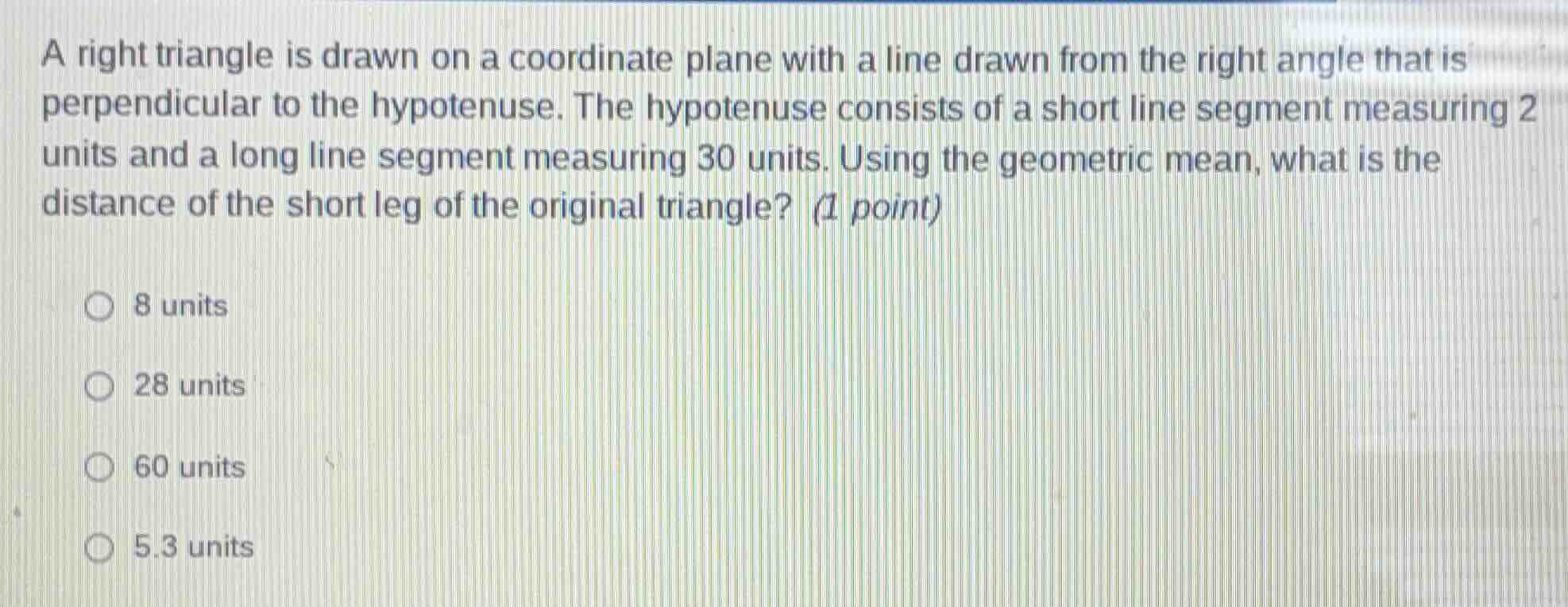
a right triangle is drawn on a coordinate plane with a line drawn from the right angle that is perpendicular to the hypotenuse. the hypotenuse consists of a short line segment measuring 2 units and a long line segment measuring 30 units. using the geometric mean, what is the distance of the short leg of the original triangle? (1 point) 8 units 28 units 60 units 5.3 units
Step1: Recall geometric mean in right triangles
In a right triangle, when an altitude is drawn from the right angle to the hypotenuse, the length of a leg is the geometric mean of the length of the hypotenuse segment adjacent to that leg and the length of the entire hypotenuse. The entire hypotenuse length is the sum of the two segments, so first find the total hypotenuse length: \(2 + 30=32\) units? Wait, no, wait. Wait, actually, the formula is that if the hypotenuse is split into segments of length \(a\) and \(b\), and the leg adjacent to segment \(a\) is \(l\), then \(l = \sqrt{a\times(a + b)}\)? No, wait, no. Wait, the correct geometric mean theorem (altitude-on-hypotenuse theorem) states that each leg of the right triangle is the geometric mean of the hypotenuse and the segment of the hypotenuse adjacent to that leg. Wait, let's clarify:
Let the right triangle be \(ABC\) with right angle at \(C\), and altitude \(CD\) to hypotenuse \(AB\), where \(AD = a\), \(DB = b\), \(AC = x\) (short leg), \(BC = y\) (long leg), \(CD = h\). Then:
\(x^{2}=AD\times AB\)
\(y^{2}=DB\times AB\)
\(h^{2}=AD\times DB\)
Wait, in the problem, the hypotenuse consists of a short segment (let's say \(AD = 2\) units) and a long segment ( \(DB = 30\) units). So the entire hypotenuse \(AB=AD + DB=2 + 30 = 32\) units? Wait, no, wait, maybe I got the segments reversed. Wait, the short leg is adjacent to the short segment of the hypotenuse? Wait, no, actually, the shorter leg is adjacent to the shorter segment of the hypotenuse. Wait, let's check the formula again.
Wait, the geometric mean theorem: In a right triangle, the length of each leg is the geometric mean of the length of the hypotenuse and the length of the segment of the hypotenuse adjacent to that leg. So if the hypotenuse is split into two segments, \(m\) and \(n\) (where \(m\) is the segment adjacent to leg \(x\), and \(n\) is the segment adjacent to leg \(y\)), and the hypotenuse length is \(m + n\), then:
\(x=\sqrt{m\times(m + n)}\)? No, wait, no. Wait, actually, the correct formula is that \(x^{2}=m\times(m + n)\)? No, that can't be. Wait, let's take an example. Suppose we have a right triangle with legs 3 and 4, hypotenuse 5. If we draw the altitude to the hypotenuse, it splits the hypotenuse into segments of length \(9/5 = 1.8\) and \(16/5 = 3.2\). Then, the leg 3 should be the geometric mean of 5 and 1.8: \(\sqrt{5\times1.8}=\sqrt{9}=3\), which works. Similarly, leg 4 is \(\sqrt{5\times3.2}=\sqrt{16}=4\), which works. So yes, the formula is: leg \(x\) (adjacent to segment \(m\)) satisfies \(x^{2}=m\times\text{hypotenuse}\), where hypotenuse is \(m + n\).
Wait, in the problem, the hypotenuse has a short segment (let's say \(m = 2\) units) and a long segment \(n = 30\) units. So the hypotenuse length is \(m + n=32\) units? Wait, but then the short leg should be adjacent to the short segment \(m = 2\) units. So then the short leg \(x\) would satisfy \(x^{2}=m\times(m + n)=2\times32 = 64\), so \(x = 8\) units. Wait, that matches one of the options (8 units). Let's verify:
If the short leg is 8 units, then \(8^{2}=64\). The hypotenuse is \(2 + 30 = 32\) units. Then \(2\times32 = 64\), which matches \(x^{2}=m\times\text{hypotenuse}\). So that works.
Wait, but let's check the other options. 28 units: \(28^{2}=784\). If we take the long segment (30) and hypotenuse (32), \(30\times32 = 960
eq784\). 60 units: \(60^{2}=3600\), \(2\times32 = 64
eq3600\). 5.3 units: \(5.3^{2}\approx28.09\), \(2\times32 = 64
eq28.09\). So the correct answer should be 8 units.
Wait, but let's re-express the…

Snap & solve any problem in the app
Get step-by-step solutions on Sovi AI
Photo-based solutions with guided steps
Explore more problems and detailed explanations
8 units (corresponding to the option "8 units")