QUESTION IMAGE
Question
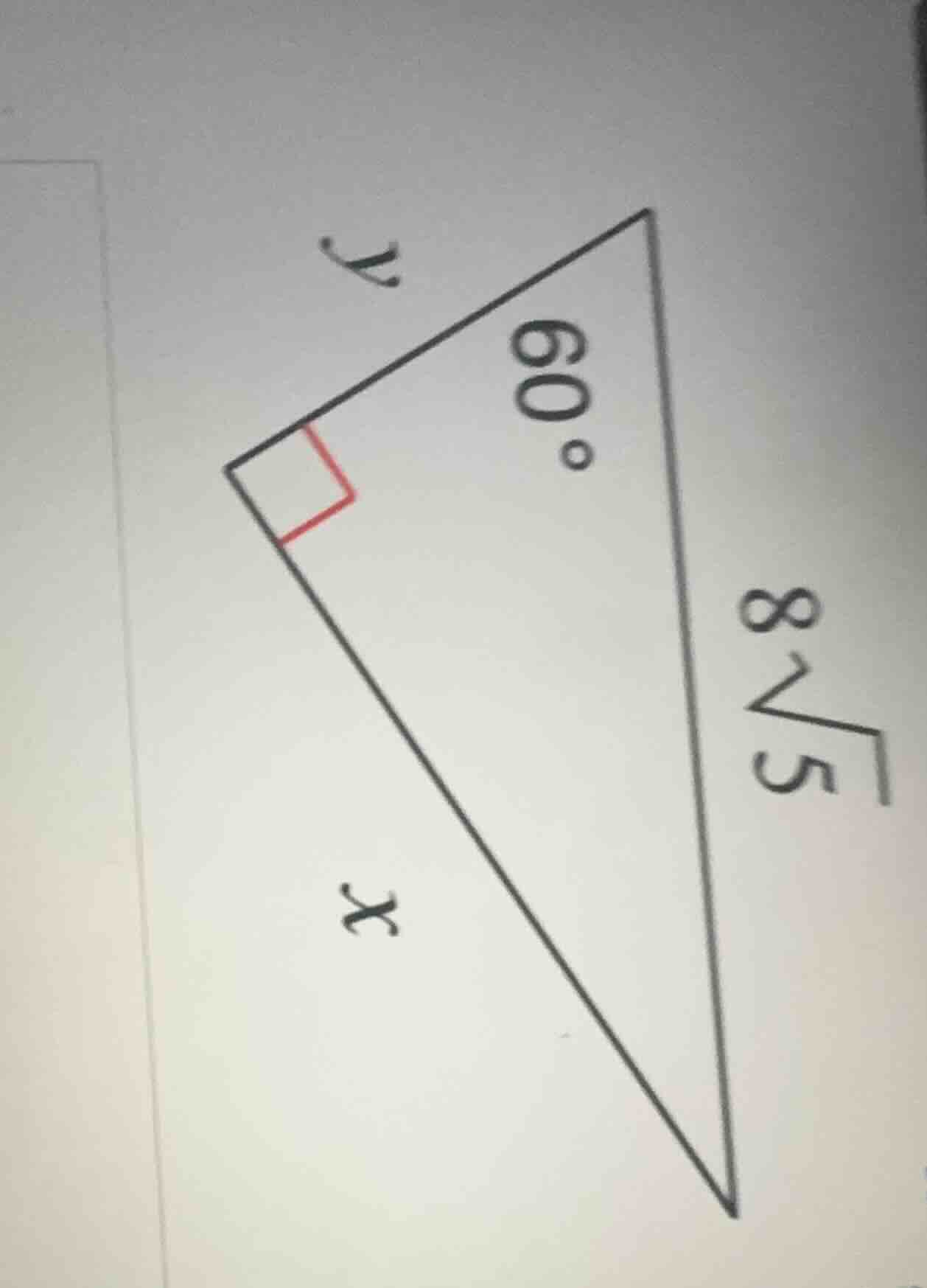
in the right triangle (with a right angle marked and a 60° angle, one side is (8sqrt{5}), and the other two sides are labeled (x) and (y)), find the lengths of (x) and (y) (or related calculations).
Step1: Identify the triangle type
This is a right - angled triangle with one angle \(60^{\circ}\), so the third angle is \(30^{\circ}\) (since the sum of angles in a triangle is \(180^{\circ}\), \(180 - 90 - 60=30^{\circ}\)). In a \(30 - 60 - 90\) triangle, the sides are in the ratio \(1:\sqrt{3}:2\), where the side opposite \(30^{\circ}\) is the shortest side (let's call it \(a\)), the side opposite \(60^{\circ}\) is \(a\sqrt{3}\), and the hypotenuse is \(2a\). Here, the hypotenuse is \(8\sqrt{5}\)? Wait, no, wait. Wait, the side opposite \(60^{\circ}\) or \(30^{\circ}\)? Wait, the right angle, the \(60^{\circ}\) angle, so the side adjacent to \(60^{\circ}\) is \(y\), the side opposite to \(60^{\circ}\) is \(x\), and the hypotenuse is \(8\sqrt{5}\)? Wait, no, maybe I mixed up. Wait, let's use trigonometric ratios. Let's denote the right - angled vertex, the \(60^{\circ}\) vertex, and the third vertex. Let's say the right angle is at the vertex with the red square, one angle is \(60^{\circ}\), so the sides: let's let the side adjacent to \(60^{\circ}\) be \(y\), the side opposite to \(60^{\circ}\) be \(x\), and the hypotenuse be \(8\sqrt{5}\)? Wait, no, the side labeled \(8\sqrt{5}\) is opposite to which angle? Wait, the angle of \(60^{\circ}\), the right angle, so the side opposite \(60^{\circ}\) is \(x\), the side adjacent to \(60^{\circ}\) is \(y\), and the hypotenuse is... Wait, no, the side with length \(8\sqrt{5}\) is the hypotenuse? Wait, no, in a right - angled triangle, the hypotenuse is opposite the right angle. So the right angle is at the red square, so the hypotenuse is the side opposite the right angle, which is the side with length \(8\sqrt{5}\)? Wait, no, the side with length \(8\sqrt{5}\) is one of the legs? Wait, I think I made a mistake. Let's use cosine and sine. \(\cos(60^{\circ})=\frac{\text{adjacent}}{\text{hypotenuse}}\), \(\sin(60^{\circ})=\frac{\text{opposite}}{\text{hypotenuse}}\). Wait, the angle of \(60^{\circ}\), so adjacent side to \(60^{\circ}\) is \(y\), opposite side is \(x\), and hypotenuse is \(h\). But we know that in a right - angled triangle, if one angle is \(60^{\circ}\), then \(\cos(60^{\circ})=\frac{y}{h}\) and \(\sin(60^{\circ})=\frac{x}{h}\), and \(\cos(60^{\circ}) = 0.5\), \(\sin(60^{\circ})=\frac{\sqrt{3}}{2}\). Wait, but what is the hypotenuse? Wait, maybe the side labeled \(8\sqrt{5}\) is the hypotenuse? Wait, no, maybe the side labeled \(8\sqrt{5}\) is the side opposite \(60^{\circ}\)? Wait, I think I messed up the labeling. Let's start over. Let's denote:
Let the right - angled triangle have vertices \(A\) (right angle, red square), \(B\) ( \(60^{\circ}\) angle), and \(C\) (the third angle). Then, side \(AB = y\) (adjacent to \(60^{\circ}\) angle at \(B\)), side \(AC=x\) (opposite to \(60^{\circ}\) angle at \(B\)), and side \(BC = 8\sqrt{5}\) (hypotenuse, opposite the right angle at \(A\)).
Now, using trigonometric ratios:
\(\cos(60^{\circ})=\frac{AB}{BC}=\frac{y}{8\sqrt{5}}\)
Since \(\cos(60^{\circ})=\frac{1}{2}\), we have \(\frac{1}{2}=\frac{y}{8\sqrt{5}}\), so \(y = \frac{8\sqrt{5}}{2}=4\sqrt{5}\)
\(\sin(60^{\circ})=\frac{AC}{BC}=\frac{x}{8\sqrt{5}}\)
Since \(\sin(60^{\circ})=\frac{\sqrt{3}}{2}\), we have \(x = 8\sqrt{5}\times\frac{\sqrt{3}}{2}=4\sqrt{15}\)
Wait, but maybe the side labeled \(8\sqrt{5}\) is not the hypotenuse. Wait, maybe the side labeled \(8\sqrt{5}\) is the side opposite \(30^{\circ}\) angle. Wait, the third angle is \(30^{\circ}\) (since \(180 - 90 - 60 = 30\)). In a \(30 - 60 - 90\) triangle, the side opposite \(30^{\circ}\) is the shortest side, and…

Snap & solve any problem in the app
Get step-by-step solutions on Sovi AI
Photo-based solutions with guided steps
Explore more problems and detailed explanations
If we assume the hypotenuse is \(8\sqrt{5}\), then \(x = 4\sqrt{15}\) and \(y = 4\sqrt{5}\)