QUESTION IMAGE
Question
9)
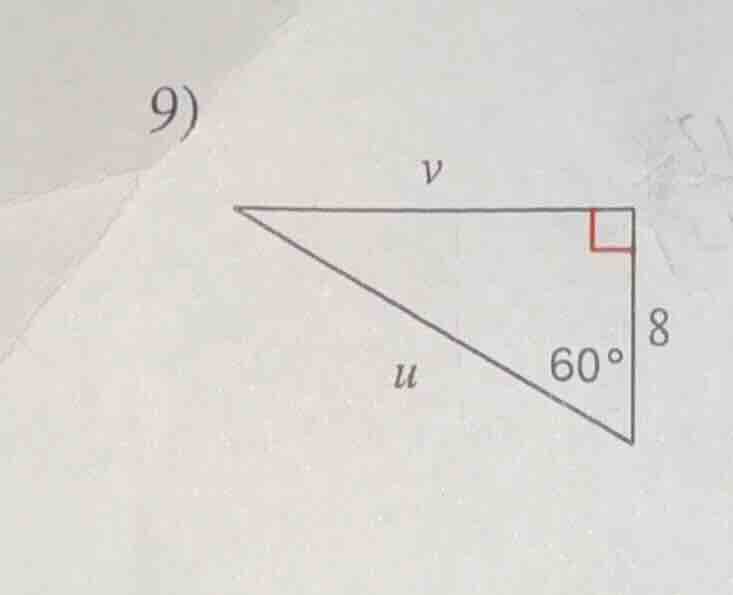
(right triangle with right angle, one leg 8, angle 60° at the leg, hypotenuse u, other leg v)
To solve for \( u \) and \( v \) in the right - triangle with a \( 60^{\circ} \) angle and the side adjacent to \( 60^{\circ} \) equal to 8:
Step 1: Recall the trigonometric ratios
In a right - triangle, we know the following trigonometric relationships:
- \(\cos\theta=\frac{\text{adjacent}}{\text{hypotenuse}}\)
- \(\tan\theta=\frac{\text{opposite}}{\text{adjacent}}\)
- Also, in a \( 30 - 60-90 \) triangle, the sides are in the ratio \( 1:\sqrt{3}:2 \), where the side opposite \( 30^{\circ} \) is the shortest side, the side opposite \( 60^{\circ} \) is \(\sqrt{3}\) times the shortest side, and the hypotenuse is twice the shortest side.
First, let's find the angle opposite to the side of length 8. Since the triangle is right - angled, the sum of angles in a triangle is \( 180^{\circ} \). So the third angle \( \alpha=180^{\circ}-90^{\circ}-60^{\circ} = 30^{\circ} \). The side of length 8 is adjacent to the \( 60^{\circ} \) angle and opposite to the \( 30^{\circ} \) angle.
Step 2: Find the hypotenuse \( u \)
In a \( 30 - 60 - 90 \) triangle, the hypotenuse \( u \) is twice the length of the side opposite the \( 30^{\circ} \) angle. The side opposite the \( 30^{\circ} \) angle is 8. So, by the property of \( 30 - 60 - 90 \) triangles, \( u = 2\times8=16 \)
We can also use the cosine function to verify. We know that \(\cos60^{\circ}=\frac{\text{adjacent}}{\text{hypotenuse}}\). We know that \(\cos60^{\circ}=\frac{1}{2}\) and the adjacent side to \( 60^{\circ} \) is 8 and the hypotenuse is \( u \). So \(\cos60^{\circ}=\frac{8}{u}\), since \(\cos60^{\circ}=\frac{1}{2}\), we have \(\frac{1}{2}=\frac{8}{u}\), cross - multiplying gives us \( u = 16 \)
Step 3: Find the side \( v \) (the side opposite the \( 60^{\circ} \) angle)
We can use the tangent function. \(\tan60^{\circ}=\frac{\text{opposite}}{\text{adjacent}}\). The opposite side to \( 60^{\circ} \) is \( v \) and the adjacent side is 8. We know that \(\tan60^{\circ}=\sqrt{3}\). So \(\tan60^{\circ}=\frac{v}{8}\), which means \( v = 8\times\tan60^{\circ}=8\sqrt{3}\)
We can also use the \( 30 - 60 - 90 \) triangle ratio. The side opposite \( 60^{\circ} \) (which is \( v \)) is \(\sqrt{3}\) times the side opposite \( 30^{\circ} \) (which is 8). So \( v = 8\sqrt{3}\)
If we want to find \( u \):
Step 1: Use the cosine ratio
We know that in a right - triangle, \(\cos\theta=\frac{\text{adjacent}}{\text{hypotenuse}}\). For \(\theta = 60^{\circ}\), the adjacent side \( a = 8\) and the hypotenuse is \( u \). We know that \(\cos60^{\circ}=\frac{1}{2}\). So we set up the equation \(\cos60^{\circ}=\frac{8}{u}\)
\(\frac{1}{2}=\frac{8}{u}\)
Step 2: Solve for \( u \)
Cross - multiply the equation \(\frac{1}{2}=\frac{8}{u}\). We get \( u\times1=2\times8\)
\( u = 16 \)
If we want to find \( v \):
Step 1: Use the tangent ratio
We know that \(\tan\theta=\frac{\text{opposite}}{\text{adjacent}}\). For \(\theta = 60^{\circ}\), the opposite side is \( v \) and the adjacent side is 8. We know that \(\tan60^{\circ}=\sqrt{3}\). So \(\tan60^{\circ}=\frac{v}{8}\)
Step 2: Solve for \( v \)
Multiply both sides of the equation \(\tan60^{\circ}=\frac{v}{8}\) by 8. We get \( v = 8\times\tan60^{\circ}\)
Since \(\tan60^{\circ}=\sqrt{3}\), then \( v = 8\sqrt{3}\)
Final Answers
- If we are finding \( u \):

Snap & solve any problem in the app
Get step-by-step solutions on Sovi AI
Photo-based solutions with guided steps
Explore more problems and detailed explanations
\( u = 16 \)
- If we are finding \( v \):