QUESTION IMAGE
Question
riving a formula for volume of a pyramid
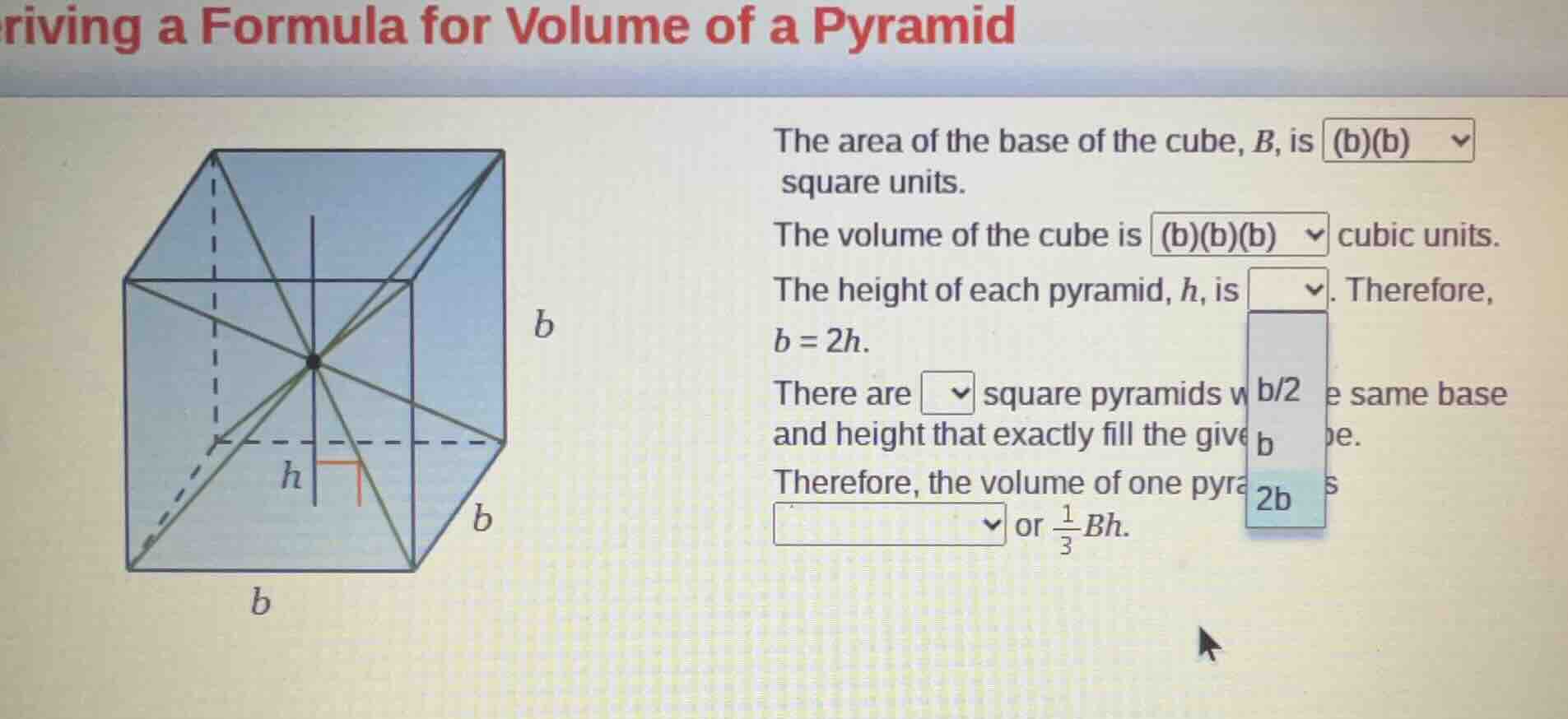
the area of the base of the cube, ( b ), is ((b)(b)) square units.
the volume of the cube is ((b)(b)(b)) cubic units.
the height of each pyramid, ( h ), is (\boldsymbol{\text{dropdown}}). therefore, ( b = 2h ).
there are (\boldsymbol{\text{dropdown}}) square pyramids with the same base and height that exactly fill the given cube.
therefore, the volume of one pyramid is (\boldsymbol{\text{dropdown}}) or (\frac{1}{3}bh).
Step1: Analyze the height of the pyramid
From the equation \( b = 2h \), we can solve for \( h \) by dividing both sides by 2. So \( h=\frac{b}{2} \). So the height of each pyramid is \( \frac{b}{2} \).
Step2: Determine the number of pyramids in the cube
Looking at the cube and the pyramids formed, we can see that there are 6 square pyramids? Wait, no, actually, in a cube, if we divide it into pyramids with the same base and height, the number of such pyramids that fill the cube: Let's think about the volume of the cube \( V = b^3 \) and the volume of one pyramid. But from the diagram, we can see that the cube is divided into 6 pyramids? Wait, no, actually, the standard way: a cube can be divided into 6 square pyramids? Wait, no, let's check the volume. The volume of the cube is \( b^3 \). If we have pyramids with base area \( B = b^2 \) and height \( h=\frac{b}{2} \), but wait, the formula for the volume of a pyramid is \( \frac{1}{3}Bh \). Wait, in the cube, if we consider the pyramids, actually, the cube can be divided into 6 pyramids? No, wait, let's look at the diagram. The cube has side length \( b \), and the height of each pyramid is \( \frac{b}{2} \) (since \( b = 2h \)). Now, how many pyramids? Let's see, the cube's volume is \( b^3 \). The volume of one pyramid is \( \frac{1}{3}Bh=\frac{1}{3}b^2\times\frac{b}{2}=\frac{b^3}{6} \). Then the number of pyramids would be \( \frac{b^3}{\frac{b^3}{6}} = 6 \)? Wait, no, maybe I made a mistake. Wait, the problem says "There are [ ] square pyramids with the same base and height that exactly fill the given cube." Wait, looking at the diagram, the cube is divided into 6 pyramids? Wait, no, actually, the correct number is 6? Wait, no, let's check the standard. Wait, a cube can be divided into 6 square pyramids, each with base area \( b^2 \) and height \( \frac{b}{2} \). But maybe in this case, the number is 6? Wait, no, let's re - examine. The volume of the cube is \( b^3 \). The volume of one pyramid is \( \frac{1}{3}Bh \), and since \( B = b^2 \) and \( h=\frac{b}{2} \), then \( V_{pyramid}=\frac{1}{3}\times b^2\times\frac{b}{2}=\frac{b^3}{6} \). Then the number of pyramids \( n=\frac{V_{cube}}{V_{pyramid}}=\frac{b^3}{\frac{b^3}{6}} = 6 \). But wait, maybe the diagram shows 6? Wait, no, the options? Wait, maybe I misread. Wait, the problem's next part: "Therefore, the volume of one pyramid is [ ] or \( \frac{1}{3}Bh \)". Let's see, the volume of the cube is \( b^3 \), and if there are 6 pyramids, then the volume of one pyramid is \( \frac{b^3}{6} \), but also, since \( B = b^2 \) and \( h=\frac{b}{2} \), \( \frac{1}{3}Bh=\frac{1}{3}\times b^2\times\frac{b}{2}=\frac{b^3}{6} \), which matches. But maybe the number of pyramids is 6? Wait, no, maybe the diagram is different. Wait, looking at the cube, the center point, and the pyramids: actually, the cube can be divided into 6 square pyramids, each with a face of the cube as the base and the center of the cube as the apex. So the number of pyramids is 6? Wait, but let's check the height. The distance from the center of the cube to a face is \( \frac{b}{2} \), which is the height of each pyramid. So the number of pyramids is 6. But wait, the problem's dropdown for the number of pyramids: maybe I made a mistake. Wait, let's think again. The volume of the cube is \( b^3 \). The volume of one pyramid is \( \frac{1}{3}Bh \), and if \( B = b^2 \) and \( h=\frac{b}{2} \), then \( \frac{1}{3}b^2\times\frac{b}{2}=\frac{b^3}{6} \). So the number of pyramids is \( \frac{b^3}{\frac{b^3}{6}} = 6 \). But maybe the problem has a different approac…

Snap & solve any problem in the app
Get step-by-step solutions on Sovi AI
Photo-based solutions with guided steps
Explore more problems and detailed explanations
- Height of each pyramid: \( \frac{b}{2} \)
- Number of pyramids: 6
- Volume of one pyramid: \( \frac{b^3}{6} \)