QUESTION IMAGE
Question
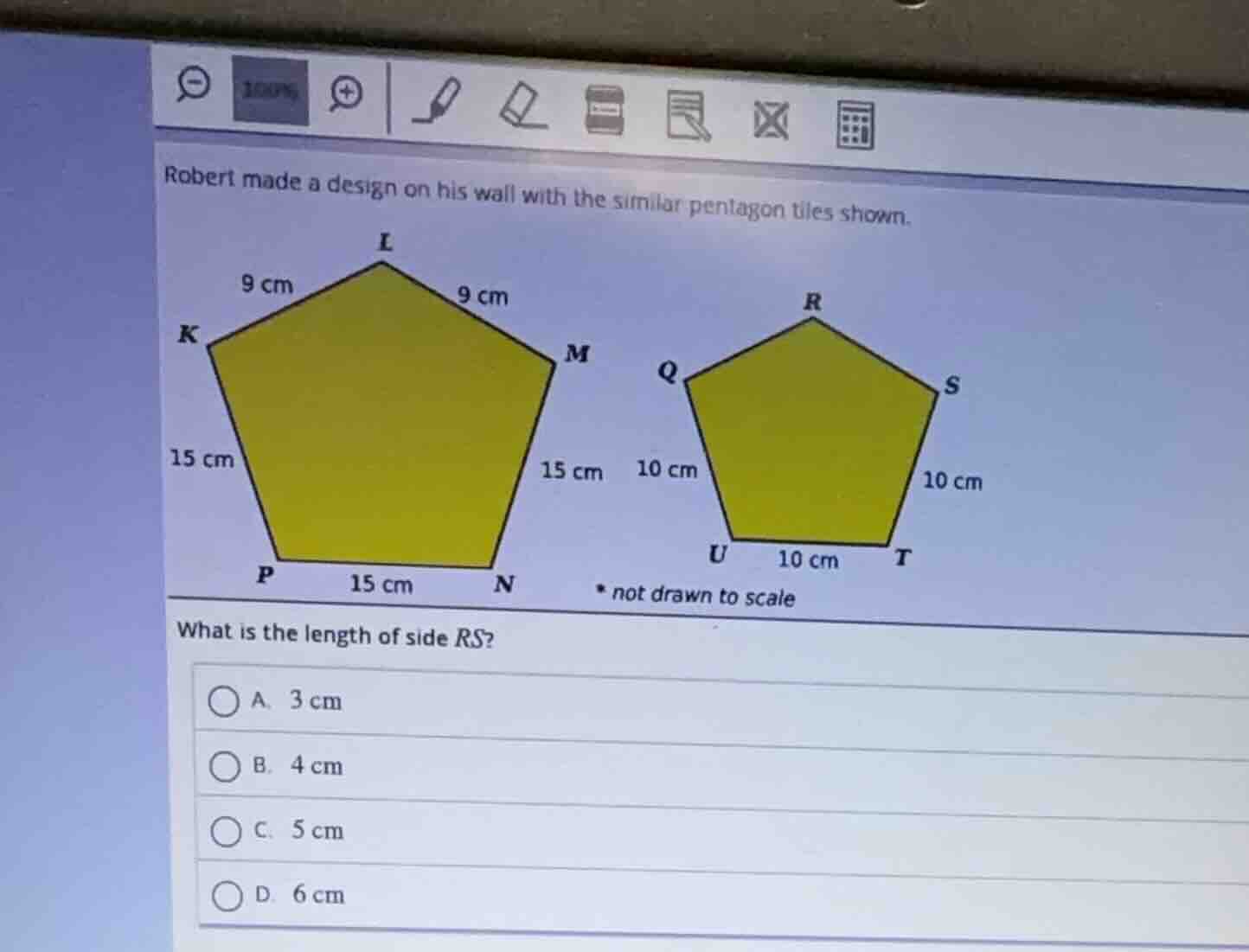
robert made a design on his wall with the similar pentagon tiles shown.
(image of two similar pentagons: left pentagon klmnp with sides kl=9 cm, lm=9 cm, mn=15 cm, np=15 cm, pk=15 cm; right pentagon qrstu with sides qu=10 cm, ut=10 cm, ts=10 cm, sr=10 cm (wait, no, original: qu=10 cm, ut=10 cm, ts=10 cm? no, original: qu=10 cm, ut=10 cm, ts=10 cm? wait, original ocr: right pentagon qust (wait, labels: q, r, s, t, u. sides: qu=10 cm, ut=10 cm, ts=10 cm? no, original: \10 cm\ (qu), \10 cm\ (ut), \10 cm\ (ts)? wait, no, the image shows right pentagon with sides qu=10 cm, ut=10 cm, ts=10 cm? wait, the question is: what is the length of side rs?
options: a. 3 cm, b. 4 cm, c. 5 cm, d. 6 cm
- not drawn to scale
Step1: Find the scale factor
The two pentagons are similar. For the first pentagon, a side length is 15 cm, and the corresponding side in the second pentagon is 10 cm. So the scale factor from the first to the second is $\frac{10}{15}=\frac{2}{3}$.
Step2: Apply the scale factor to side $LM$ (which corresponds to $RS$)
Side $LM$ is 9 cm. To find $RS$, we multiply $LM$ by the scale factor: $9\times\frac{2}{3} = 6$? Wait, no, wait. Wait, maybe I mixed up the correspondence. Wait, the first pentagon has sides 15, 15, 15, 9, 9. The second has 10, 10, 10,?,?. Wait, maybe the corresponding sides: the side of length 15 in the first corresponds to 10 in the second. So the scale factor is $\frac{10}{15}=\frac{2}{3}$. Wait, but the side $LM$ is 9, so $RS$ should be $9\times\frac{2}{3}$? Wait, no, maybe the other way. Wait, maybe the first pentagon's side 15 corresponds to the second's 10, so the ratio of second to first is $\frac{10}{15}=\frac{2}{3}$. So the side in the second (RS) corresponding to the first's LM (9) would be $9\times\frac{2}{3}=6$? But wait, the options have 6 as D. Wait, but let's check again. Wait, maybe I had the scale factor reversed. Let's see: the first pentagon is larger? Wait, the first has sides 15, the second 10, so the second is smaller. So the scale factor from first to second is $\frac{10}{15}=\frac{2}{3}$. So a side of length 9 in the first (LM) would correspond to a side of length $9\times\frac{2}{3}=6$ in the second (RS). Wait, but let's check the sides. The first pentagon: $KN = 15$, $NM = 15$, $MP = 15$? Wait, no, the first pentagon is $K, L, M, N, P$. So $KL = 9$, $LM = 9$, $MN = 15$, $NP = 15$, $PK = 15$? Wait, maybe. Then the second pentagon is $Q, R, S, T, U$. So $QR =?$, $RS =?$, $ST = 10$, $TU = 10$, $UQ = 10$? Wait, no, the second pentagon has sides $UQ = 10$, $QR =?$, $RS =?$, $ST = 10$, $TU = 10$? Wait, maybe the sides of length 15 in the first (NP, PK, MN) correspond to 10 in the second (TU, UQ, ST). So the scale factor is $\frac{10}{15}=\frac{2}{3}$. Then the sides of length 9 in the first (KL, LM) correspond to RS and QR? Wait, no, maybe KL corresponds to QR, LM corresponds to RS. So KL is 9, so QR is $9\times\frac{2}{3}=6$? Wait, but the options have D as 6. Wait, but let's recalculate. Wait, 15/10 = 3/2, so the scale factor from second to first is 3/2. So if the second's side is x, first's is 9, then $x\times\frac{3}{2}=9$, so $x = 9\times\frac{2}{3}=6$. Yes, that's correct. So RS is 6 cm.

Snap & solve any problem in the app
Get step-by-step solutions on Sovi AI
Photo-based solutions with guided steps
Explore more problems and detailed explanations
D. 6 cm