QUESTION IMAGE
Question
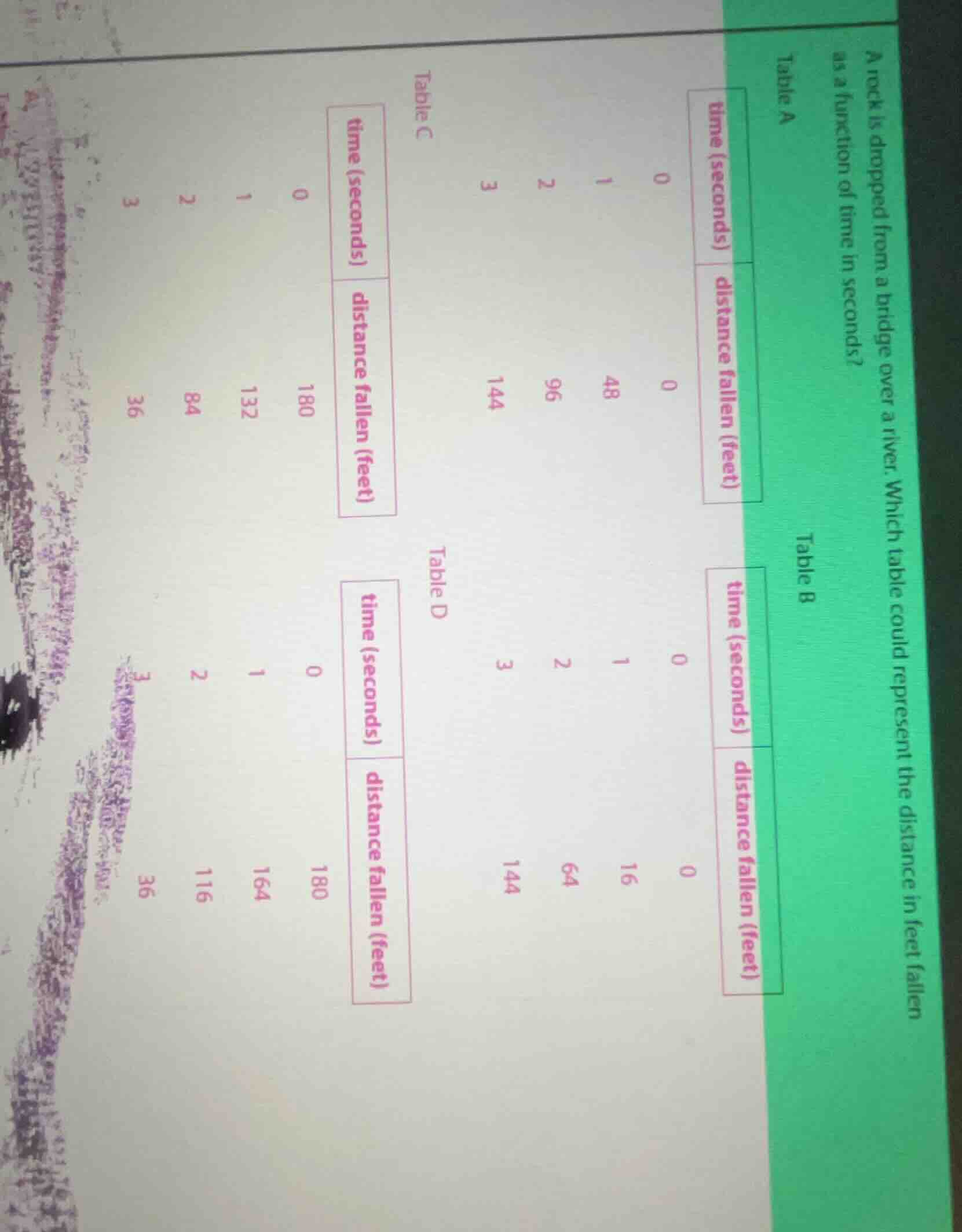
a rock is dropped from a bridge over a river. which table could represent the distance in feet fallen as a function of time in seconds? table a: time (seconds) 0,1,2,3; distance fallen (feet) 0,48,96,144. table b: time (seconds) 0,1,2,3; distance fallen (feet) 0,16,64,144. table c: time (seconds) 0,1,2,3; distance fallen (feet) 180,132,84,36. table d: time (seconds) 0,1,2,3; distance fallen (feet) 180,164,116,36.
Step1: Recall free - fall formula
The distance an object falls in free - fall (neglecting air resistance) is given by the formula $d = 16t^{2}$, where $d$ is the distance in feet and $t$ is the time in seconds. This is because the acceleration due to gravity near the Earth's surface is approximately $32\mathrm{ft/s}^2$, and using the kinematic equation $d=\frac{1}{2}at^{2}$ with $a = 32\mathrm{ft/s}^2$, we get $d=\frac{1}{2}\times32t^{2}=16t^{2}$.
Step2: Check each table
- Table A:
- For $t = 0$, $d = 0$ (correct, since at $t = 0$, the rock has not fallen yet).
- For $t = 1$, using $d = 16t^{2}$, $d=16\times1^{2}=16$, but Table A has $d = 48$. So Table A is incorrect.
- Table B:
- For $t = 0$, $d = 0$ (correct).
- For $t = 1$, $d=16\times1^{2}=16$ (matches Table B).
- For $t = 2$, $d = 16\times2^{2}=16\times4 = 64$ (matches Table B).
- For $t = 3$, $d=16\times3^{2}=16\times9 = 144$ (matches Table B).
- Table C:
- For $t = 1$, using $d = 16t^{2}$, $d = 16$, but Table C has $d = 132$. So Table C is incorrect.
- Table D:
- For $t = 1$, using $d = 16t^{2}$, $d = 16$, but Table D has $d = 164$. So Table D is incorrect.

Snap & solve any problem in the app
Get step-by-step solutions on Sovi AI
Photo-based solutions with guided steps
Explore more problems and detailed explanations
Table B (with time (seconds) 0, 1, 2, 3 and distance fallen (feet) 0, 16, 64, 144)