QUESTION IMAGE
Question
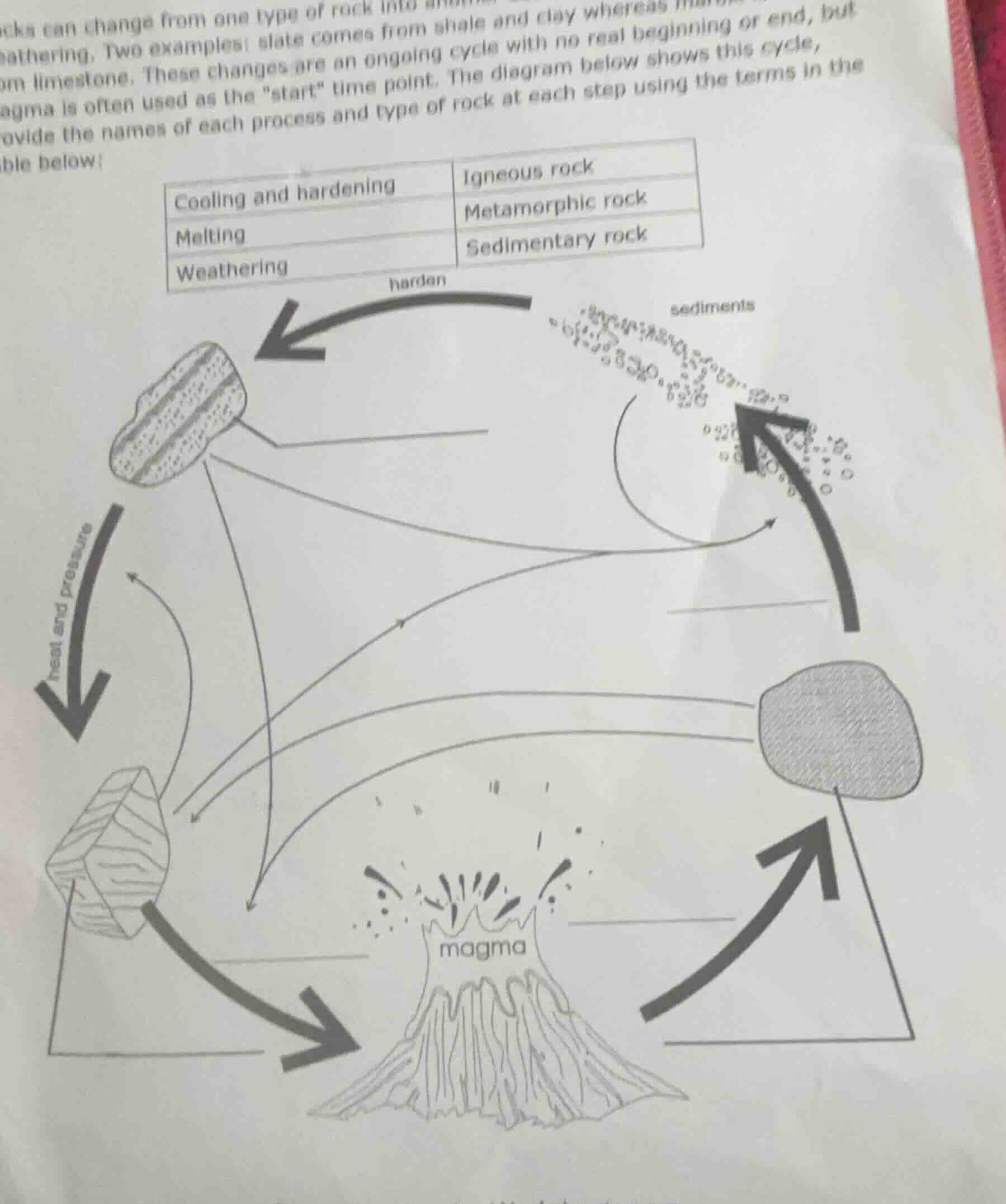
rocks can change from one type of rock intoeathering. two examples: slate comes from shale and clay whereasom limestone. these changes are an ongoing cycle with no real beginning or end, butagma is often used as the \start\ time point. the diagram below shows this cycle,rovide the names of each process and type of rock at each step using the terms in theble below:cooling and hardeningmeltingweatheringigneous rockmetamorphic rocksedimentary rockhardensedimentsheat and pressuremagma
Brief Explanations
- Magma to Igneous Rock: Magma forms igneous rock via cooling and hardening.
- Igneous Rock to Sediments: Igneous rock breaks down into sediments through weathering.
- Sediments to Sedimentary Rock: Sediments form sedimentary rock when they harden.
- Sedimentary Rock to Metamorphic Rock: Sedimentary rock becomes metamorphic rock from heat and pressure.
- Metamorphic Rock to Magma: Metamorphic rock melts back into magma.
- Igneous/Metamorphic to Sediments: Both can also form sediments via weathering; metamorphic/igneous can melt to magma.

Snap & solve any problem in the app
Get step-by-step solutions on Sovi AI
Photo-based solutions with guided steps
Explore more problems and detailed explanations
- Magma → Gray rock (right): Process: Cooling and hardening; Rock type: Igneous rock
- Gray rock (right) → Sediments: Process: Weathering; Rock type: Sediments (precursor to sedimentary rock)
- Sediments → Layered rock (top left): Process: Harden; Rock type: Sedimentary rock
- Layered rock (top left) → Banded rock (left): Process: Heat and pressure; Rock type: Metamorphic rock
- Banded rock (left) → Magma: Process: Melting; Rock type: Magma
- Additional cycle paths:
- Banded rock (left) → Sediments: Process: Weathering
- Gray rock (right) → Magma: Process: Melting
- Layered rock (top left) → Magma: Process: Melting