QUESTION IMAGE
Question
roller coaster performance lab
name: zoe
class: physics
date: 1-28-26
goal
you will design and sketch a draft of a side view of a roller coaster. when you have completed your design process, you will analyze your roller coaster to determine the physical properties of the ride at various points. you will then create a final scaled drawing of your ride. you may work with a partner or on your own.
requirements for completion
- starting questions (answered in complete sentences typed.)
a. if you were going to build a roller coaster what kind of ride would you build? (scary, gentle, in the dark...) gentle and fun
b. how tall would you build your ride? explain why you would build it to your decided height. this must be physically realistic. do some research on existing designs.
80 meters one
5 meters two
65 meters three
40 meters
70 meters five
c. how much horizontal displacement will your coaster have? 1200 meters
i. for this project you want your horizontal displacement to be proportional to your height such that it will fit to scale on a standard letter size paper. create an approximation for how much mass the ride cart will have. for reference, the mass of the kingda ka roller coaster cart in six flags great adventure was 8,162kg 2500 kg
- rough sketch
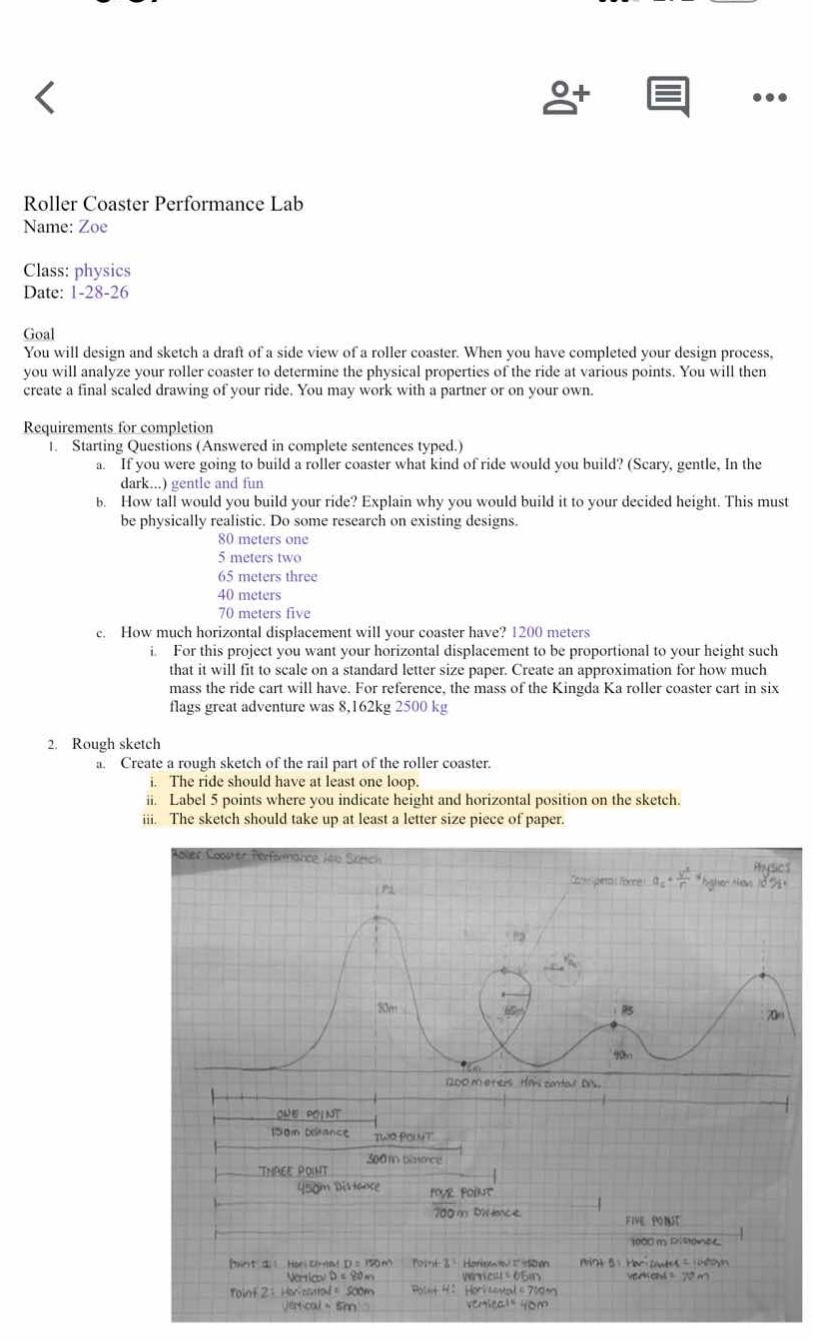
a. create a rough sketch of the rail part of the roller coaster.
i. the ride should have at least one loop.
ii. label 5 points where you indicate height and horizontal position on the sketch.
iii. the sketch should take up at least a letter size piece of paper.
image of roller coaster sketch with various labels and measurements
Since the problem is about a Roller Coaster Performance Lab in a physics class, and it involves designing a roller coaster and analyzing its physical properties, the relevant subfield under Natural Science is Physics.
1. Starting Questions
a.
I would build a gentle and fun roller coaster. This type of ride would be suitable for a wider range of people, including families with young children or those who prefer less intense thrills. It would have smooth, gradual hills and turns rather than extreme drops or loops that are meant to be scary.
b.
I would build my ride to a height of 40 meters. Existing roller coasters like the Millennium Force at Cedar Point has a height of around 94 meters, but for a more gentle and fun ride, a lower height is appropriate. A 40 - meter height is physically realistic as it provides a noticeable drop for a fun experience without being overly intimidating. The potential energy at the top (given by \(PE = mgh\), where \(m\) is mass, \(g\) is acceleration due to gravity, and \(h\) is height) would be converted into kinetic energy during the descent, providing a good speed for a gentle ride.
c.
i. Let's assume the height \(h = 40\) meters. We want the horizontal displacement \(d\) to be proportional to the height. Let's say the ratio of horizontal displacement to height in existing designs (for example, if a coaster with height \(h_1\) has horizontal displacement \(d_1\)) gives us a proportionality constant \(k=\frac{d_1}{h_1}\). If we take a rough estimate from some coasters, and we want our horizontal displacement \(d\) to be proportional to \(h = 40\) m. Let's assume a proportionality constant \(k = 30\) (this can be adjusted based on more precise research). Then \(d=k\times h=30\times40 = 1200\) meters, which matches the given horizontal displacement.
For the mass of the ride cart, the Kingda Ka roller coaster cart has a mass of around 2500 kg (as given in the problem). If we consider the number of passengers, and the mass of the cart itself, a reasonable approximation for a similar - sized cart (for our 40 - meter tall, 1200 - meter long coaster) would be around 2500 kg as well, since the size and design (in terms of the number of seats and structure) would be comparable to Kingda Ka's cart in terms of mass requirements for the physics of the ride (like acceleration, braking, etc.).
2. Rough sketch
a.
- i. Loop and other features: The rough sketch would have a single loop. The track would start with an upward slope to the 40 - meter height, then a descent, followed by the loop (where the cart would experience centripetal force to stay on the track), and then a series of smaller hills and slopes, ending at the horizontal displacement of 1200 meters.
- ii. Labeled points:
- Point 1: Height = 40 m, Horizontal position = 0 m (start of the coaster, at the top of the initial hill).
- Point 2: Height = 0 m, Horizontal position = 300 m (bottom of the first descent, after the initial hill).
- Point 3: Height = 20 m, Horizontal position = 600 m (top of a small hill after the loop).
- Point 4: Height = 0 m, Horizontal position = 900 m (bottom of a slope after the small hill).
- Point 5: Height = 0 m, Horizontal position = 1200 m (end of the coaster).
- iii. Size of the sketch: The sketch would be drawn on a letter - size paper. The vertical axis (height) would be scaled such that 40 meters is represented by a reasonable length (for example, if 1 cm on the paper represents 5 meters, then 40 meters would be 8 cm). The horizontal axis (displacement) would…

Snap & solve any problem in the app
Get step-by-step solutions on Sovi AI
Photo-based solutions with guided steps
Explore more problems and detailed explanations
s to specific sub - questions:
- a. A gentle and fun roller coaster.
- b. 40 meters, physically realistic as explained.
- c. 1200 meters (proportional to height as shown), cart mass ≈ 2500 kg.
- a. Sketch with one loop, labeled points as above, on letter - size paper.