QUESTION IMAGE
Question
rotate c
rotate b
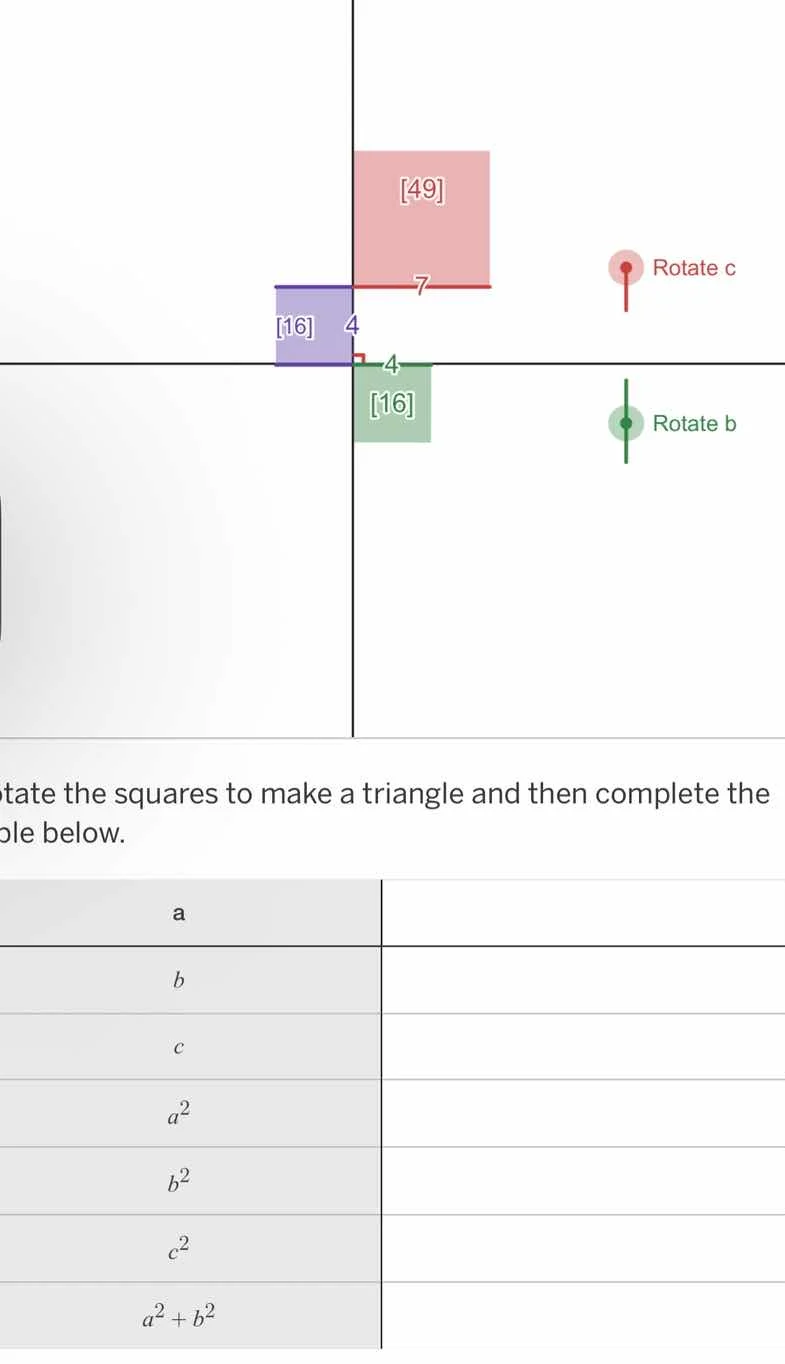
rotate the squares to make a triangle and then complete the table below.
a
b
c
a²
b²
c²
a² + b²
Step1: Identify side lengths
From the squares, the side lengths of the legs (a and b) are 4 (since the square with area 16 has side length $\sqrt{16}=4$), and the hypotenuse (c) has side length 7 (since the square with area 49 has side length $\sqrt{49}=7$). Wait, actually, let's check: the two smaller squares have area 16, so their sides are 4 (a = 4, b = 4? Wait, no, maybe a and b are 4 and 4? Wait, the purple square is [16], so side 4; green square is [16], side 4; red square is [49], side 7. So this is a right triangle with legs a = 4, b = 4? Wait, no, maybe a and b are 4 and 4, and c is 7? Wait, no, Pythagorean theorem: $a^2 + b^2 = c^2$? Wait, 4² + 4² = 16 + 16 = 32, but 7² is 49. Wait, maybe I misread. Wait, the purple square is [16], so side 4 (a = 4), green square is [16], side 4 (b = 4), red square is [49], side 7 (c = 7). Wait, but 4² + 4² = 32 ≠ 49. Wait, maybe the legs are 4 and something else? Wait, no, the diagram: the purple square is at the corner, with side 4, green square is below, side 4, red square is above, side 7. Wait, maybe a = 4, b = 4, c = 7? But that doesn't satisfy Pythagoras. Wait, maybe the red square is the hypotenuse square, so $c^2 = 49$, so c = 7. The two smaller squares: one is [16] (a² = 16, so a = 4), another [16] (b² = 16, so b = 4). Then $a^2 + b^2 = 16 + 16 = 32$, but $c^2 = 49$. Wait, that can't be. Wait, maybe I made a mistake. Wait, maybe the green square is side 4, purple square is side 4, and red square is side $\sqrt{16 + 16} = \sqrt{32} ≈ 5.656$, but the red square is [49], so side 7. Wait, maybe the diagram has a = 4, b = 3? No, the squares are [16] (side 4) and [9]? No, the green square is [16], purple is [16], red is [49]. Wait, maybe the problem is to fill the table with the values from the squares. So:
a: side of purple square, which is 4 (since area 16, so $\sqrt{16}=4$)
b: side of green square, which is 4 (same reason)
c: side of red square, which is 7 (since area 49, $\sqrt{49}=7$)
$a^2$: area of purple square, 16
$b^2$: area of green square, 16
$c^2$: area of red square, 49
$a^2 + b^2$: 16 + 16 = 32
Wait, but maybe the triangle is a right triangle, so $a^2 + b^2$ should equal $c^2$, but here 32 ≠ 49. Maybe the diagram is different. Wait, maybe the green square is side 3? No, the green square is [16], so side 4. Wait, maybe the red square is not the hypotenuse? No, the "Rotate c" is for the hypotenuse. Wait, maybe the problem is just to fill the table with the values from the squares, regardless of Pythagoras. So:
a: 4 (side of purple square)
b: 4 (side of green square)
c: 7 (side of red square)
$a^2$: 16 (area of purple square)
$b^2$: 16 (area of green square)
$c^2$: 49 (area of red square)
$a^2 + b^2$: 16 + 16 = 32
So the table should be filled as:
a: 4
b: 4
c: 7
$a^2$: 16
$b^2$: 16
$c^2$: 49
$a^2 + b^2$: 32

Snap & solve any problem in the app
Get step-by-step solutions on Sovi AI
Photo-based solutions with guided steps
Explore more problems and detailed explanations
| Value | |
|---|---|
| b | 4 |
| c | 7 |
| $a^2$ | 16 |
| $b^2$ | 16 |
| $c^2$ | 49 |
| $a^2 + b^2$ | 32 |