QUESTION IMAGE
Question
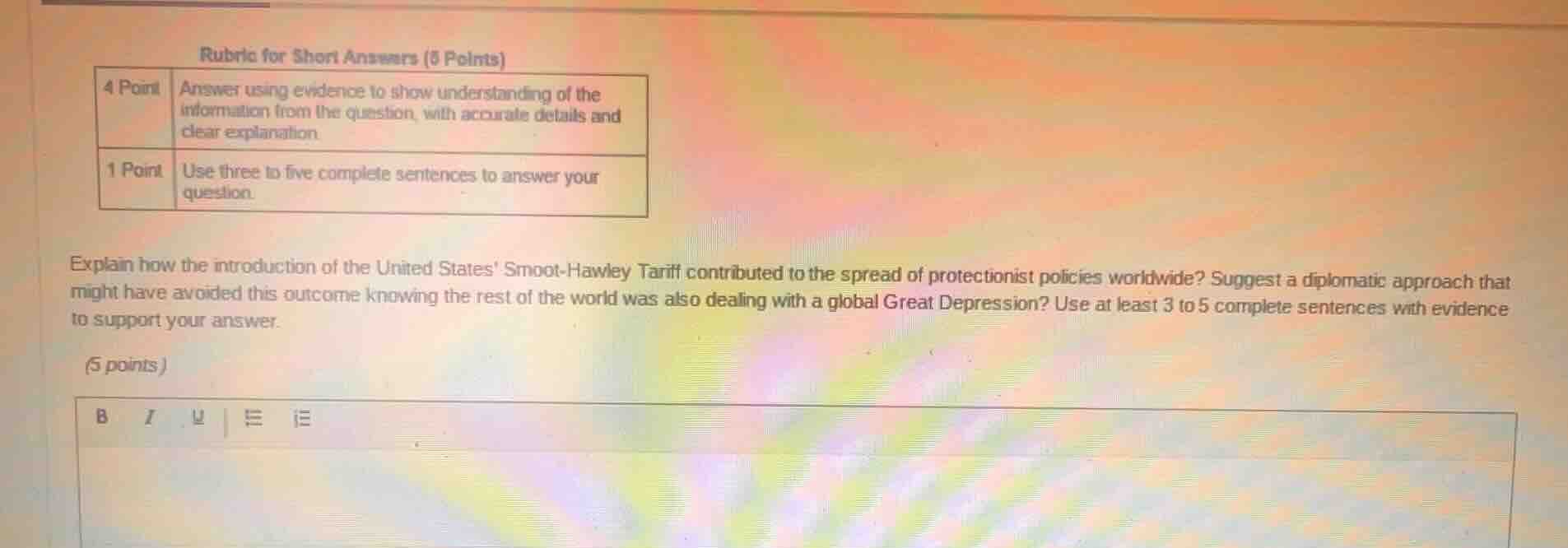
rubric for short answers (5 points)
4 point answer using evidence to show understanding of the
information from the question, with accurate details and
clear explanation
1 point use three to five complete sentences to answer your
question.
explain how the introduction of the united states’ smoot - hawley tariff contributed to the spread of protectionist policies worldwide? suggest a diplomatic approach that
might have avoided this outcome knowing the rest of the world was also dealing with a global great depression? use at least 3 to 5 complete sentences with evidence
to support your answer.
(5 points)
The Smoot-Hawley Tariff, enacted in 1930, raised U.S. import duties on over 20,000 goods to record levels, designed to protect domestic farmers and manufacturers during the Great Depression. This triggered immediate retaliation: countries like Canada, France, and Germany imposed their own high tariffs on U.S. exports, creating a domino effect where nations closed their markets to shield domestic industries, amplifying global protectionism. By 1932, global trade had plummeted by over 60% as this cycle of retaliation deepened the economic crisis. A diplomatic alternative would have been a multilateral trade negotiation framework, such as a precursor to the General Agreement on Tariffs and Trade (GATT), where the U.S. worked with major trading partners to collectively reduce tariff barriers instead of unilaterally raising them. This collaborative approach would have prevented retaliatory measures, preserved international trade flows, and mitigated the global economic downturn by maintaining access to foreign markets for all nations struggling with Depression-era unemployment and production declines.

Snap & solve any problem in the app
Get step-by-step solutions on Sovi AI
Photo-based solutions with guided steps
Explore more problems and detailed explanations
The Smoot-Hawley Tariff of 1930, which raised U.S. import tariffs to historic highs, directly fueled the global spread of protectionism by prompting immediate retaliatory tariffs from key trading partners. Countries like Canada imposed tariffs on 16 U.S. goods in response, while France and Germany raised duties on American exports, creating a cycle where nations closed their markets to protect domestic industries amid the Great Depression. This retaliation caused global trade to collapse by more than 60% by 1932, worsening economic hardship worldwide and normalizing protectionist policies as a desperate response to crisis. A more effective diplomatic approach would have been for the U.S. to lead multilateral trade talks with major economies to coordinate gradual, mutual tariff reductions, similar to the post-WWII GATT framework. This collaborative strategy would have avoided the tit-for-tat retaliation, preserved international trade flows, and provided a coordinated, global solution to economic distress instead of the unilateral, self-defeating protectionism of Smoot-Hawley.