QUESTION IMAGE
Question
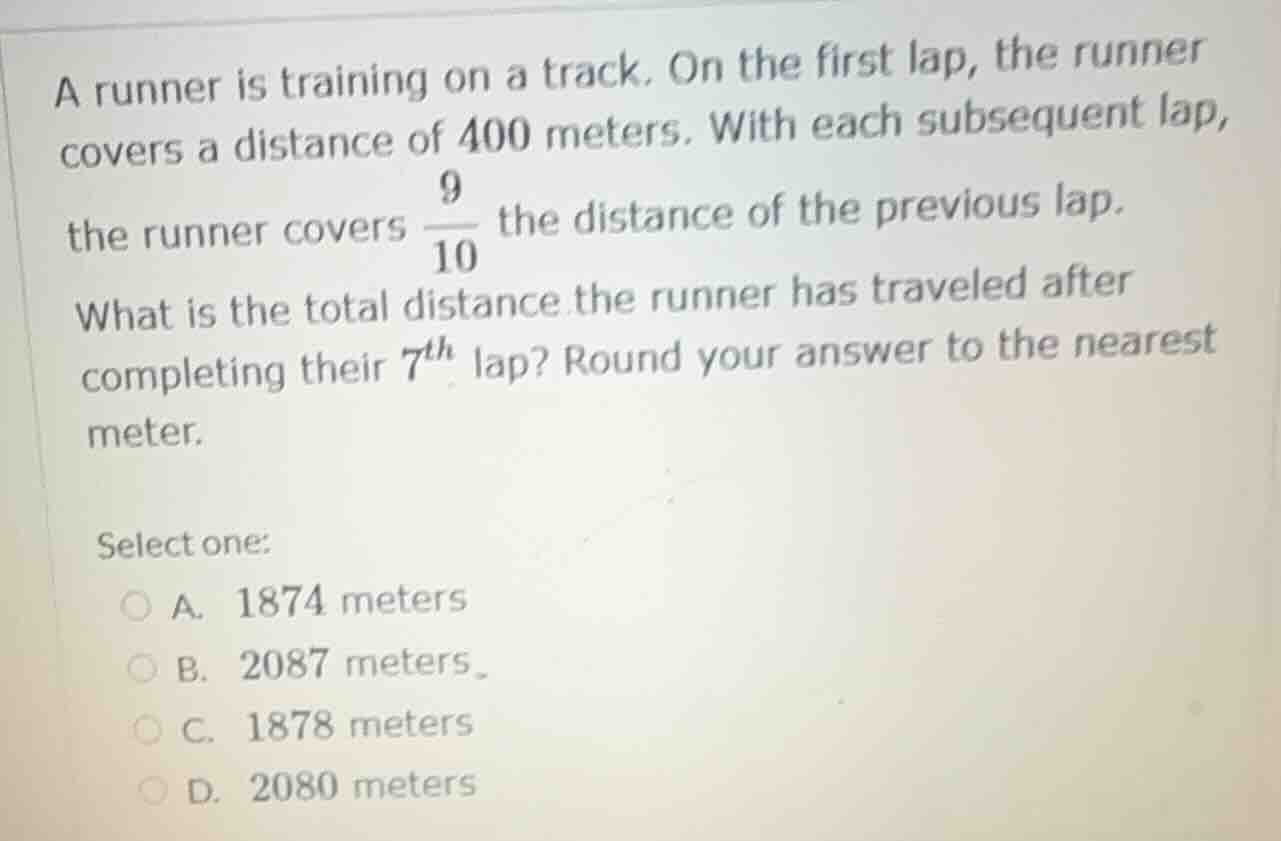
a runner is training on a track. on the first lap, the runner covers a distance of 400 meters. with each subsequent lap, the runner covers \\(\frac{9}{10}\\) the distance of the previous lap. what is the total distance the runner has traveled after completing their \\(7^{th}\\) lap? round your answer to the nearest meter. select one: \\(\circ\\) a. 1874 meters \\(\circ\\) b. 2087 meters. \\(\circ\\) c. 1878 meters \\(\circ\\) d. 2080 meters
Step1: Identify geometric series values
First term $a_1 = 400$, common ratio $r = \frac{9}{10} = 0.9$, number of terms $n = 7$
Step2: Use finite geometric series formula
The formula for the sum of the first $n$ terms of a geometric series is $S_n = a_1 \cdot \frac{1 - r^n}{1 - r}$
Step3: Calculate $r^n$
$r^7 = 0.9^7 = 0.4782969$
Step4: Compute numerator and denominator
$1 - r^7 = 1 - 0.4782969 = 0.5217031$
$1 - r = 1 - 0.9 = 0.1$
Step5: Solve for total distance
$S_7 = 400 \cdot \frac{0.5217031}{0.1} = 400 \cdot 5.217031 = 2086.8124$
Step6: Round to nearest meter
Round $2086.8124$ to the nearest whole number.

Snap & solve any problem in the app
Get step-by-step solutions on Sovi AI
Photo-based solutions with guided steps
Explore more problems and detailed explanations
B. 2087 meters