QUESTION IMAGE
Question
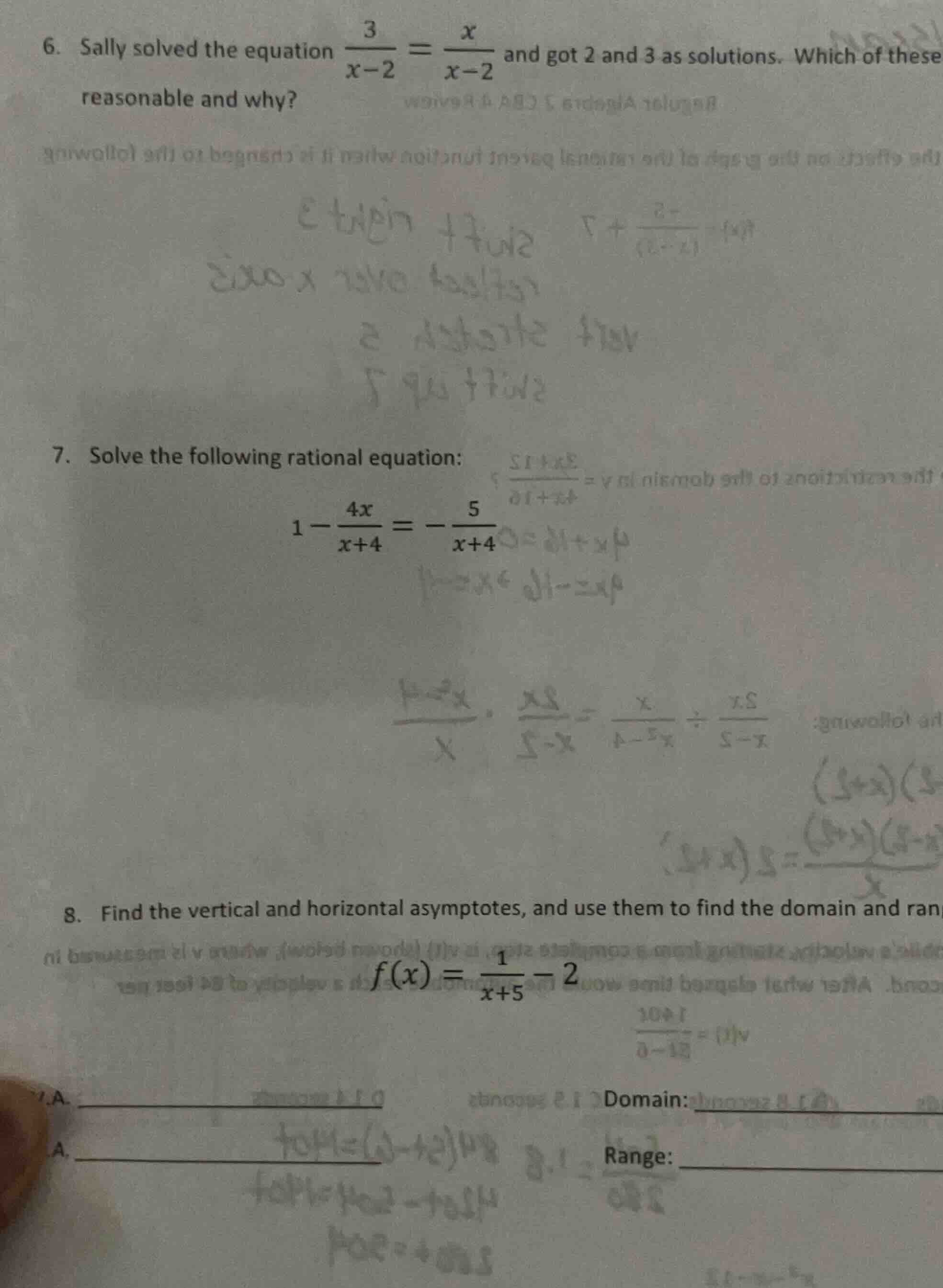
- sally solved the equation $\frac{3}{x-2} = \frac{x}{x-2}$ and got 2 and 3 as solutions. which of these reasonable and why?
- solve the following rational equation:
$1 - \frac{4x}{x+4} = -\frac{5}{x+4}$
- find the vertical and horizontal asymptotes, and use them to find the domain and range
$f(x) = \frac{1}{x+5} - 2$
domain: ____
range: ____
Problem 6
Step1: Identify undefined value
The denominator $x-2$ cannot be 0, so $x
eq 2$.
Step2: Solve the equation
Multiply both sides by $x-2$:
$3 = x$
Step3: Verify solutions
$x=2$ makes the original equation undefined, so it is an extraneous solution. $x=3$ is valid.
Step1: Identify undefined value
Denominator $x+4
eq 0$, so $x
eq -4$.
Step2: Multiply by common denominator
Multiply all terms by $x+4$:
$1 \cdot (x+4) - 4x = -5$
Step3: Simplify and solve
$x+4-4x = -5$
$-3x + 4 = -5$
$-3x = -9$
$x = 3$
Step4: Verify solution
$x=3$ does not make $x+4=0$, so it is valid.
Step1: Find vertical asymptote
Set denominator $x+5=0$, so $x=-5$.
Step2: Find horizontal asymptote
As $x \to \pm\infty$, $\frac{1}{x+5} \to 0$, so $y=0-2=-2$.
Step3: Determine domain
All real numbers except vertical asymptote: $x
eq -5$.
Step4: Determine range
All real numbers except horizontal asymptote: $y
eq -2$.

Snap & solve any problem in the app
Get step-by-step solutions on Sovi AI
Photo-based solutions with guided steps
Explore more problems and detailed explanations
Only 3 is reasonable. $x=2$ makes the denominator of the original rational equation equal to 0, so it is not in the domain and is an extraneous solution. $x=3$ satisfies the original equation.
---