QUESTION IMAGE
Question
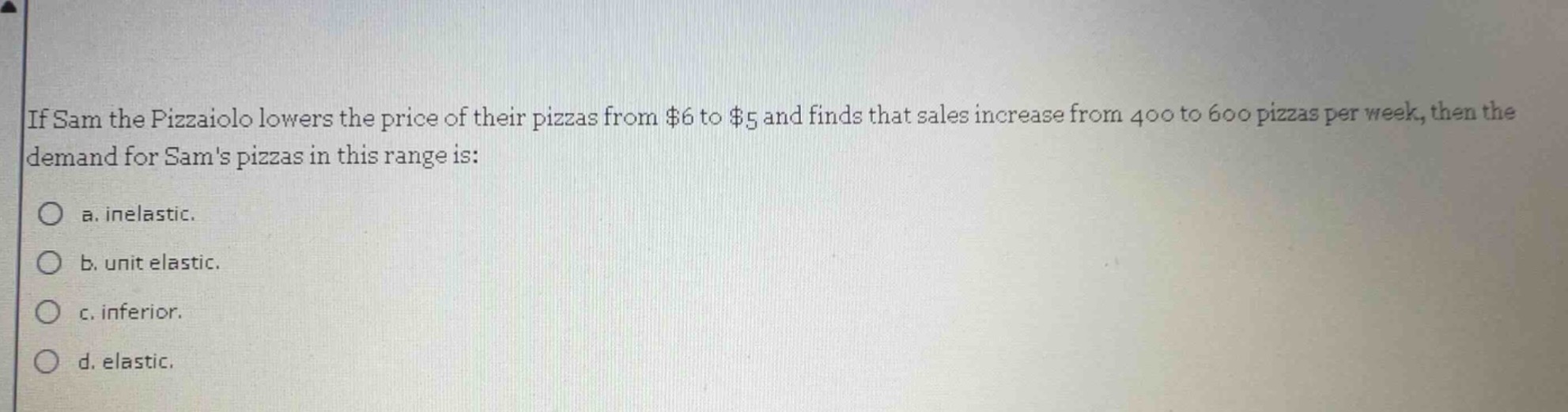
if sam the pizzaiolo lowers the price of their pizzas from $6 to $5 and finds that sales increase from 400 to 600 pizzas per week, then the demand for sams pizzas in this range is:
a. inelastic.
b. unit elastic.
c. inferior.
d. elastic.
Step1: Define elasticity formula
Price elasticity of demand:
$$E_d = \frac{\% \Delta Q_d}{\% \Delta P}$$
Using midpoint method:
$$\% \Delta Q_d = \frac{Q_2 - Q_1}{\frac{Q_2 + Q_1}{2}} \times 100$$
$$\% \Delta P = \frac{P_2 - P_1}{\frac{P_2 + P_1}{2}} \times 100$$
Step2: Calculate % change in quantity
$Q_1=400$, $Q_2=600$
$$\% \Delta Q_d = \frac{600 - 400}{\frac{600 + 400}{2}} \times 100 = \frac{200}{500} \times 100 = 40\%$$
Step3: Calculate % change in price
$P_1=\$6$, $P_2=\$5$
$$\% \Delta P = \frac{5 - 6}{\frac{5 + 6}{2}} \times 100 = \frac{-1}{5.5} \times 100 \approx -18.18\%$$
Step4: Compute elasticity value
$$E_d = \frac{40\%}{-18.18\%} \approx -2.2$$
We use absolute value $|E_d| \approx 2.2$
Step5: Classify elasticity
Since $|E_d| > 1$, demand is elastic.

Snap & solve any problem in the app
Get step-by-step solutions on Sovi AI
Photo-based solutions with guided steps
Explore more problems and detailed explanations
d. elastic.