QUESTION IMAGE
Question
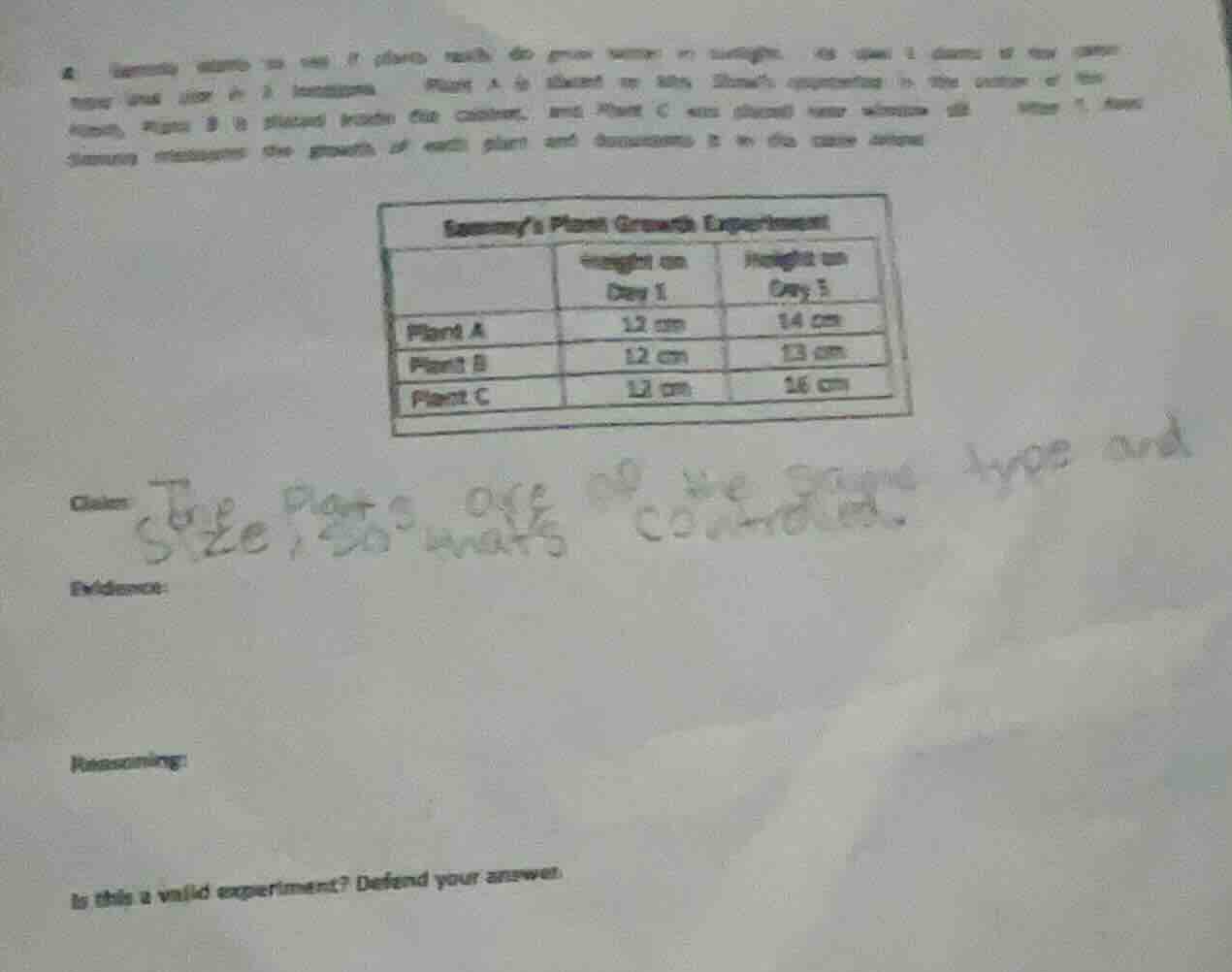
- sammy starts to see if plants each do grow better in sunlight. he uses 1 plant of the same type and size in 1 bedroom. plant a is placed in his mom’s apartment in the corner of the room, plant b is placed inside the cabinet, and plant c was placed near window sill. after 5, days sammy measures the growth of each plant and documents it in the table below. sammy’s plant growth experiment height on day 1 height on day 5 plant a 12 cm 14 cm plant b 12 cm 13 cm plant c 12 cm 16 cm claim: evidence: reasoning: is this a valid experiment? defend your answer.
To determine if the experiment is valid, we check the control variables. The plants are of the same type and initial size (Plant A and B: 12 cm on Day 1; Plant C: 11 cm, but the question's claim about same size might have a typo, but the key is if other factors like light, water (except the variable being tested) are controlled. However, the setup: Plant A in window (light), B in cabinet (no light), C near window (light? Wait, original setup: Plant A in window (sunlight), B in cabinet (dark), C near window (maybe different light? Wait, no—wait, the problem says "3 plants each do grow under in sunlight" (maybe typo, should be "3 plants, each to grow under different light?"). Wait, the table shows initial heights: A:12, B:12, C:11. The claim is "same type and size"—but C is 11, so maybe that's an error. But for a valid experiment, only one independent variable (e.g., light) should be changed, others (water, soil, plant type, initial size) controlled. If plants are same type, initial size (A and B:12, C:11—maybe a mistake, but if we take A and B: same initial height, different light (A in window, B in cabinet), C near window. Wait, the "Claim" says "same type and size, so it's controlled"—but evidence: from the table, Plant A (window) grew from 12 to 14 (2 cm), B (cabinet) from 12 to 13 (1 cm), C (near window) from 11 to 16 (5 cm). Wait, maybe the independent variable is light, but C's growth is different. But the key is: for a valid experiment, only one variable (e.g., light) should be manipulated, others (plant type, initial height, water, soil) constant. If A and B are same type, same initial height, different light (A: light, B: dark), then that's a controlled variable (type, size) for A and B. But C has different initial height (11 vs 12), so maybe that's a flaw. But the "Claim" says "same type and size", so if we assume that (maybe C's 11 is a typo, or it's a different plant). However, the standard for a valid experiment is that only the independent variable (e.g., light) is changed, and all other variables (plant type, initial size, water, soil, temperature) are controlled. If the plants are same type and initial size (ignoring C's 11, or it's a mistake), then by controlling type and size, and changing light (A: light, B: dark), it's a controlled experiment. The evidence is the initial heights (A and B: 12 cm) and same type, so other factors are controlled, making it valid (assuming C is a mistake or part of another variable, but the claim focuses on A and B maybe).

Snap & solve any problem in the app
Get step-by-step solutions on Sovi AI
Photo-based solutions with guided steps
Explore more problems and detailed explanations
The experiment can be considered valid (with possible minor errors in data like Plant C's initial height) because the plants (A and B) are of the same type and initial size (12 cm on Day 1), with only the light condition (independent variable) changed (A in sunlight, B in darkness), while other factors (water, soil, plant type) are controlled. The growth differences (A: +2 cm, B: +1 cm) support that light affects growth, indicating controlled variables.