QUESTION IMAGE
Question
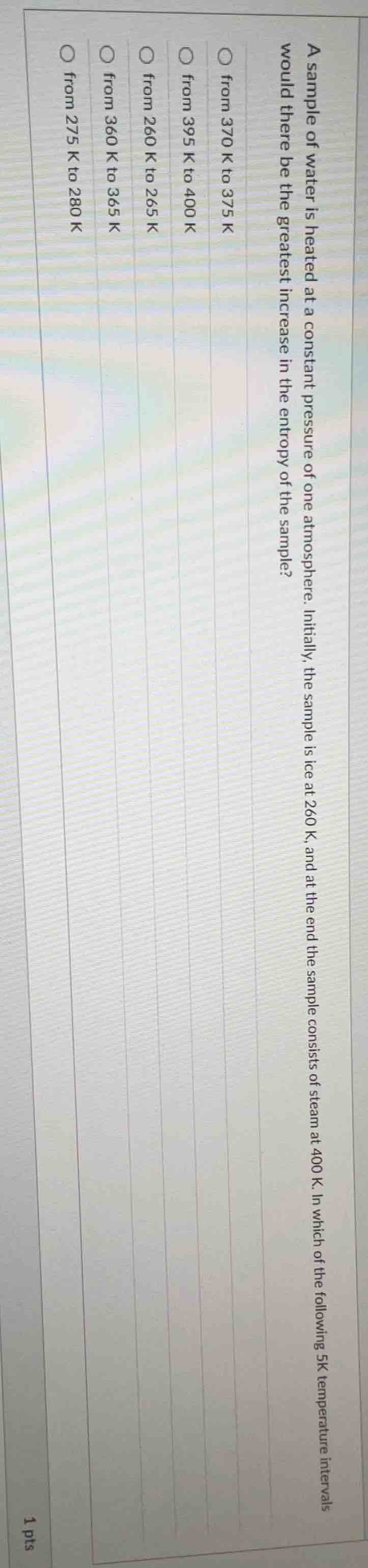
a sample of water is heated at a constant pressure of one atmosphere. initially, the sample is ice at 260 k, and at the end the sample consists of steam at 400 k. in which of the following 5k temperature intervals would there be the greatest increase in the entropy of the sample?
○ from 370 k to 375 k
○ from 395 k to 400 k
○ from 260 k to 265 k
○ from 360 k to 365 k
○ from 275 k to 280 k
Entropy change for a substance depends on phase changes and temperature. Phase changes (like ice to water, water to steam) involve larger entropy increases than temperature changes within a phase, but here we compare temperature intervals. The formula for entropy change at constant pressure is $\Delta S = nC_p\ln\frac{T_2}{T_1}$. For a given $n$ and $C_p$ (approx constant for a phase), the entropy change depends on $\ln\frac{T_2}{T_1}$. Let's calculate $\ln\frac{T_2}{T_1}$ for each interval:
- From 370 K to 375 K: $\ln\frac{375}{370} \approx \ln(1.0135) \approx 0.0134$
- From 395 K to 400 K: $\ln\frac{400}{395} \approx \ln(1.01266) \approx 0.01258$
- From 260 K to 265 K: $\ln\frac{265}{260} \approx \ln(1.01923) \approx 0.01905$
- From 360 K to 365 K: $\ln\frac{365}{360} \approx \ln(1.01389) \approx 0.01379$
- From 275 K to 280 K: $\ln\frac{280}{275} \approx \ln(1.01818) \approx 0.01803$
Wait, but wait—actually, the substance is ice at 260 K, then becomes steam at 400 K. So the phases: ice (solid) from 260 K, melts to water (liquid) around 273 K, then boils to steam (gas) around 373 K. The heat capacity $C_p$ is different for solid, liquid, gas. But the question is about 5K intervals. However, when the substance is in a phase where $C_p$ is lower (like solid ice), but wait no—actually, the key is that for a given temperature range, the relative change in temperature ($\frac{\Delta T}{T}$) is higher at lower temperatures. Wait, my earlier calculation was wrong. Let's re - express $\ln\frac{T + 5}{T}=\ln(1+\frac{5}{T})$. The derivative of $\ln(1 + x)$ with respect to $T$ (where $x=\frac{5}{T}$) is $\frac{-5}{T^2(1 + \frac{5}{T})}=-\frac{5}{T(T + 5)}$, which is more negative (so the function $\ln(1+\frac{5}{T})$ decreases as $T$ increases). So the value of $\ln(1+\frac{5}{T})$ is larger when $T$ is smaller. So for the smallest $T$ (260 K), $\ln\frac{265}{260}$ is the largest among the given intervals. Let's check the values again:
- At $T = 260$: $\ln(265/260)=\ln(1.01923)\approx0.01905$
- At $T = 275$: $\ln(280/275)=\ln(1.01818)\approx0.01803$
- At $T = 360$: $\ln(365/360)=\ln(1.01389)\approx0.01379$
- At $T = 370$: $\ln(375/370)=\ln(1.0135)\approx0.0134$
- At $T = 395$: $\ln(400/395)=\ln(1.01266)\approx0.01258$
So the largest value of $\ln\frac{T_2}{T_1}$ (and thus the largest entropy change, since $\Delta S\propto\ln\frac{T_2}{T_1}$ for constant $C_p$ and $n$) is for the interval from 260 K to 265 K.

Snap & solve any problem in the app
Get step-by-step solutions on Sovi AI
Photo-based solutions with guided steps
Explore more problems and detailed explanations
from 260 K to 265 K