QUESTION IMAGE
Question
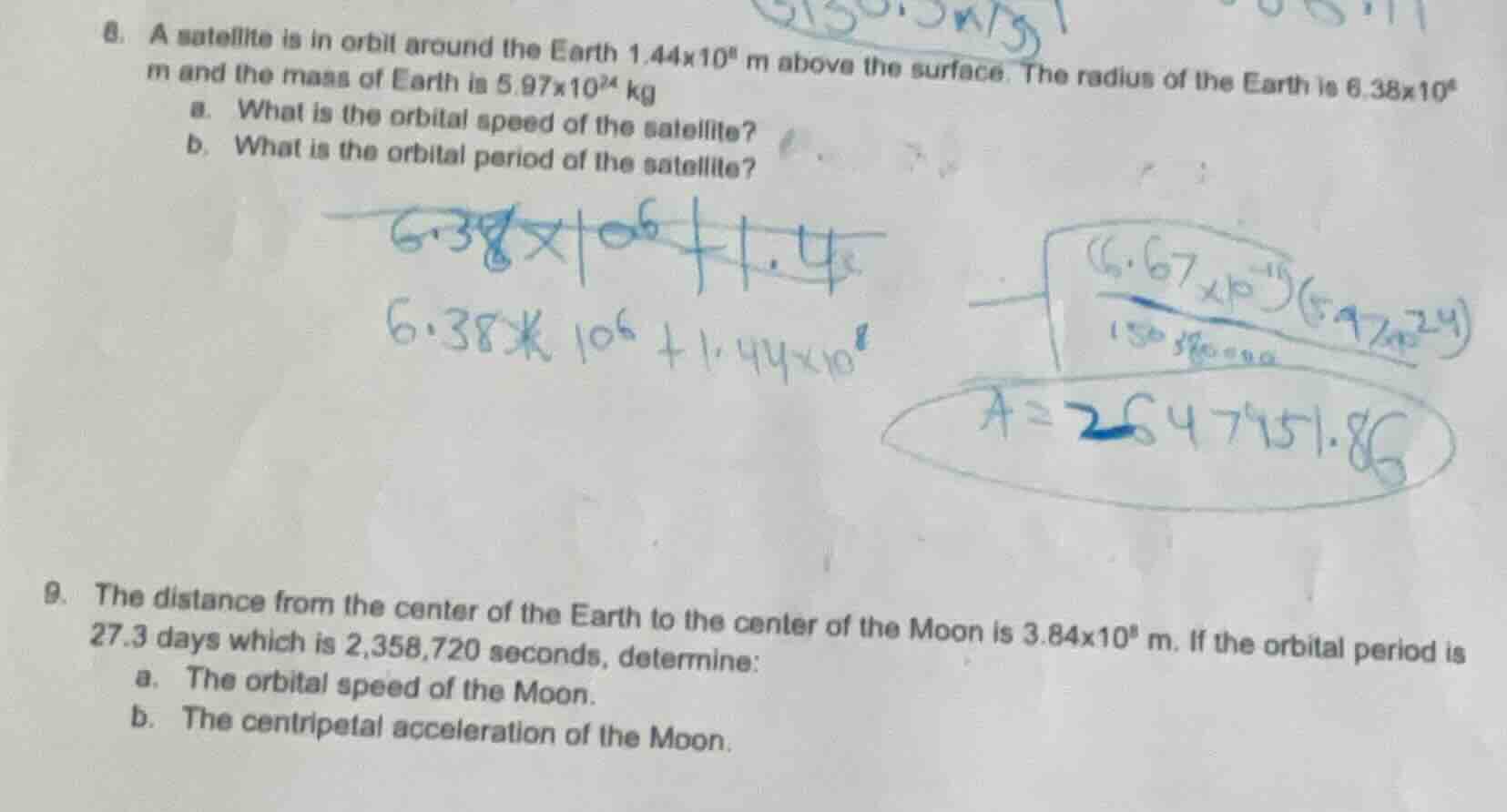
- a satellite is in orbit around the earth $1.44\times10^{8}$ m above the surface. the radius of the earth is $6.38\times10^{6}$ m and the mass of earth is $5.97\times10^{24}$ kg
a. what is the orbital speed of the satellite?
b. what is the orbital period of the satellite?
- the distance from the center of the earth to the center of the moon is $3.84\times10^{8}$ m. if the orbital period is 27.3 days which is 2,358,720 seconds, determine:
a. the orbital speed of the moon.
b. the centripetal acceleration of the moon.
Problem 8
Step1: Calculate orbital radius
Orbital radius \( r = \text{Earth radius} + \text{height above surface} \)
\( r = 6.38 \times 10^6\ \text{m} + 1.44 \times 10^6\ \text{m} = 7.82 \times 10^6\ \text{m} \)
Step2: Orbital speed formula setup
Use gravitational centripetal force equilibrium: \( v = \sqrt{\frac{GM}{r}} \), where \( G=6.67 \times 10^{-11}\ \text{N·m}^2/\text{kg}^2 \), \( M=5.97 \times 10^{24}\ \text{kg} \)
\( v = \sqrt{\frac{6.67 \times 10^{-11} \times 5.97 \times 10^{24}}{7.82 \times 10^6}} \)
Step3: Compute orbital speed
First calculate numerator: \( 6.67 \times 10^{-11} \times 5.97 \times 10^{24} \approx 3.98 \times 10^{14} \)
Then divide by \( r \): \( \frac{3.98 \times 10^{14}}{7.82 \times 10^6} \approx 5.09 \times 10^7 \)
Take square root: \( v = \sqrt{5.09 \times 10^7} \approx 7.13 \times 10^3\ \text{m/s} \)
Step4: Orbital period formula setup
Use \( T = \frac{2\pi r}{v} \)
\( T = \frac{2 \times \pi \times 7.82 \times 10^6}{7.13 \times 10^3} \)
Step5: Compute orbital period
First calculate numerator: \( 2 \times \pi \times 7.82 \times 10^6 \approx 4.91 \times 10^7 \)
Divide by \( v \): \( T \approx \frac{4.91 \times 10^7}{7.13 \times 10^3} \approx 6.89 \times 10^3\ \text{seconds} \)
(Convert to hours: \( \frac{6.89 \times 10^3}{3600} \approx 1.91\ \text{hours} \))
Step1: Orbital speed of Moon setup
Use \( v = \frac{2\pi r}{T} \), where \( r=3.84 \times 10^8\ \text{m} \), \( T=2358720\ \text{s} \)
\( v = \frac{2 \times \pi \times 3.84 \times 10^8}{2358720} \)
Step2: Compute orbital speed
Calculate numerator: \( 2 \times \pi \times 3.84 \times 10^8 \approx 2.41 \times 10^9 \)
Divide by \( T \): \( v \approx \frac{2.41 \times 10^9}{2358720} \approx 1.02 \times 10^3\ \text{m/s} \)
Step3: Centripetal acceleration setup
Use \( a_c = \frac{v^2}{r} \)
\( a_c = \frac{(1.02 \times 10^3)^2}{3.84 \times 10^8} \)
Step4: Compute centripetal acceleration
Calculate numerator: \( (1.02 \times 10^3)^2 = 1.04 \times 10^6 \)
Divide by \( r \): \( a_c \approx \frac{1.04 \times 10^6}{3.84 \times 10^8} \approx 2.71 \times 10^{-3}\ \text{m/s}^2 \)

Snap & solve any problem in the app
Get step-by-step solutions on Sovi AI
Photo-based solutions with guided steps
Explore more problems and detailed explanations
a. \( 7.13 \times 10^3\ \text{m/s} \)
b. \( 6.89 \times 10^3\ \text{seconds (or 1.91 hours)} \)
---