QUESTION IMAGE
Question
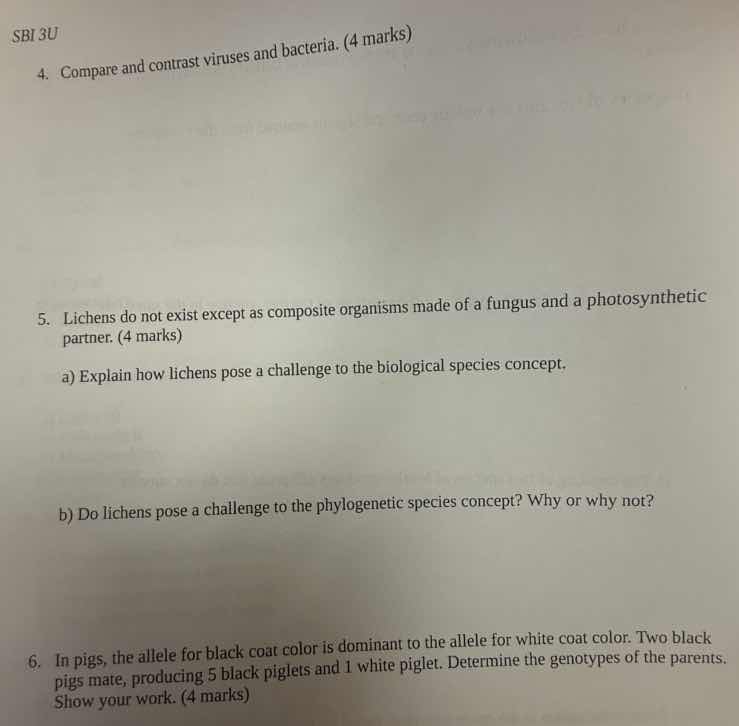
sbi 3u
- compare and contrast viruses and bacteria. (4 marks)
- lichens do not exist except as composite organisms made of a fungus and a photosynthetic partner. (4 marks)
a) explain how lichens pose a challenge to the biological species concept.
b) do lichens pose a challenge to the phylogenetic species concept? why or why not?
- in pigs, the allele for black coat color is dominant to the allele for white coat color. two black pigs mate, producing 5 black piglets and 1 white piglet. determine the genotypes of the parents. show your work. (4 marks)
Question 4: Compare and contrast viruses and bacteria.
- Structure: Bacteria are single - celled prokaryotes with a cell wall, cell membrane, cytoplasm, and genetic material (DNA in a nucleoid). Viruses are acellular, consisting of a protein coat (capsid) and genetic material (DNA or RNA), and some have an envelope.
- Reproduction: Bacteria reproduce asexually by binary fission. Viruses can only reproduce by hijacking a host cell's machinery and using it to make more virus particles (lytic or lysogenic cycles).
- Metabolism: Bacteria can be autotrophic (make their own food) or heterotrophic (obtain food from others) and have metabolic processes like respiration or fermentation. Viruses have no metabolic processes of their own.
- Response to Antibiotics: Bacterial infections can often be treated with antibiotics (which target bacterial cell processes or structures). Viral infections are not treated with antibiotics (antiviral drugs work differently, often targeting viral replication).
- Size: Bacteria are generally larger (e.g., E. coli is about 1 - 2 μm) than viruses (e.g., influenza virus is about 80 - 120 nm).
The biological species concept defines a species as a group of organisms that can interbreed and produce fertile offspring. Lichens are a symbiotic association between a fungus and a photosynthetic partner (usually a cyanobacterium or a green alga). The fungus and the photosynthetic partner are from different species (and often different kingdoms). Lichens do not "interbreed" in the way the biological species concept describes. Also, a single fungus can form a lichen with different photosynthetic partners, and a single photosynthetic partner can form a lichen with different fungi. This means that the lichen "entity" does not fit the definition of a species as a group that interbreeds, since it is a composite of two (or more) different species - level organisms that are in a symbiotic relationship, not a single interbreeding group.
The phylogenetic species concept (PSC) defines a species as the smallest monophyletic group (a group with a common ancestor and all its descendants) with a unique set of shared derived characters. Lichens are a symbiotic combination of a fungus and a photosynthetic partner. The fungus and the photosynthetic partner each have their own phylogenetic history (they belong to different lineages). A lichen does not represent a single monophyletic group because it is composed of organisms from different evolutionary lineages. So, lichens do pose a challenge to the PSC because the lichen "entity" is not a single monophyletic group, but rather a symbiotic association of two (or more) groups with their own phylogenetic histories.

Snap & solve any problem in the app
Get step-by-step solutions on Sovi AI
Photo-based solutions with guided steps
Explore more problems and detailed explanations
- Similarities: Both can cause diseases in living organisms. Both contain genetic material (DNA or RNA).
- Differences:
- Structure: Bacteria are prokaryotic cells; viruses are acellular.
- Reproduction: Bacteria reproduce by binary fission; viruses replicate using host cells.
- Metabolism: Bacteria have metabolic processes; viruses do not.
- Antibiotic Sensitivity: Bacteria are sensitive to antibiotics; viruses are not.
- Size: Bacteria are larger than viruses.