QUESTION IMAGE
Question
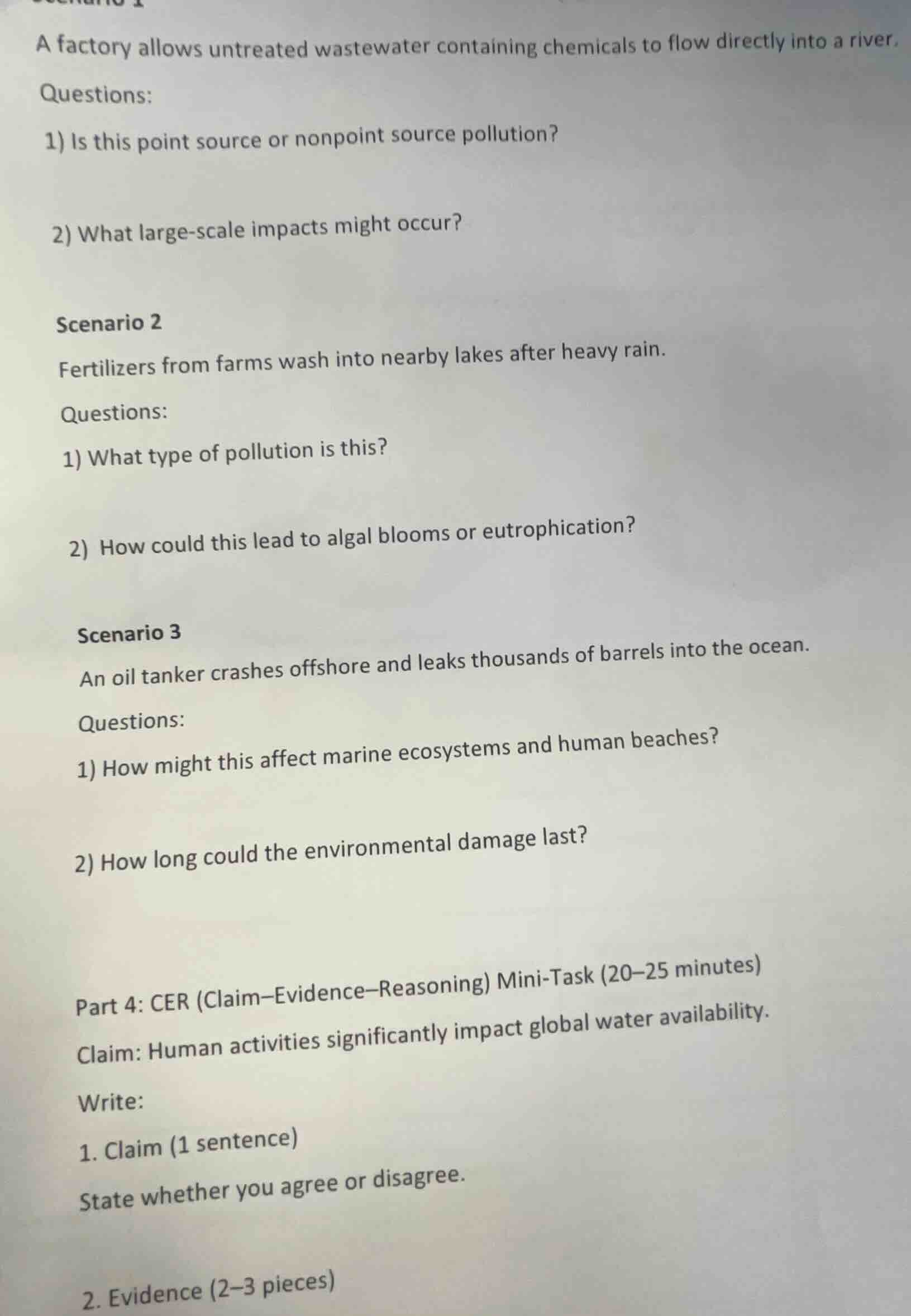
scenario 1
a factory allows untreated wastewater containing chemicals to flow directly into a river.
questions:
- is this point source or nonpoint source pollution?
- what large - scale impacts might occur?
scenario 2
fertilizers from farms wash into nearby lakes after heavy rain.
questions:
- what type of pollution is this?
- how could this lead to algal blooms or eutrophication?
scenario 3
an oil tanker crashes offshore and leaks thousands of barrels into the ocean.
questions:
- how might this affect marine ecosystems and human beaches?
- how long could the environmental damage last?
part 4: cer (claim - evidence - reasoning) mini - task (20 - 25 minutes)
claim: human activities significantly impact global water availability.
write:
- claim (1 sentence)
state whether you agree or disagree.
- evidence (2 - 3 pieces)
Brief Explanations
Scenario 1
- Point source pollution comes from a single, identifiable discharge point.
- Chemical wastewater disrupts aquatic life, contaminates drinking water, and degrades ecosystems.
Scenario 2
- Nonpoint source pollution comes from diffuse, unconfined sources.
- Fertilizers add nitrogen/phosphorus, fueling algal overgrowth that depletes oxygen.
Scenario 3
- Oil coats marine organisms, destroys habitats, and renders beaches unsafe for use.
- Oil persists in sediments and organisms for long periods, with some impacts lasting decades.
Part 4: CER Mini-Task
- The claim is validated by measurable human impacts on water systems.
- Evidence includes documented cases of pollution, over-extraction, and ecosystem disruption.
- Reasoning links human activities directly to reduced accessible clean water.

Snap & solve any problem in the app
Get step-by-step solutions on Sovi AI
Photo-based solutions with guided steps
Explore more problems and detailed explanations
Scenario 1
- Point source pollution
- - Destruction of aquatic plant and animal life due to toxic chemicals
- Contamination of drinking water supplies for human and animal populations downstream
- Long-term degradation of river ecosystem health and loss of biodiversity
Scenario 2
- Nonpoint source pollution
- The fertilizers contain high levels of nitrogen and phosphorus, which act as nutrients for algae. When these nutrients enter the lake, they cause rapid, uncontrolled growth of algae (an algal bloom). As the algae die, decomposing bacteria consume large amounts of dissolved oxygen in the water, leading to hypoxia (low oxygen levels) that kills fish and other aquatic life, a process called eutrophication.
Scenario 3
- - Marine ecosystems: Oil coats the feathers/fur of birds and marine mammals, impairing their ability to fly, swim, and regulate body temperature; it kills fish, invertebrates, and coral by damaging their gills, organs, and habitats; it disrupts food webs at all levels.
- Human beaches: Oil washes ashore, coating sand and rocks, making beaches unsafe and unfit for recreation; it contaminates shellfish and other seafood harvested from the area, posing health risks to humans.
- The environmental damage can last for decades. Some components of oil are persistent in marine sediments and can accumulate in the tissues of organisms, causing long-term reproductive and health issues for marine life. In some cases, oil residues can remain in the environment for 30+ years after a spill.
Part 4: CER Mini-Task
- Claim: I agree that human activities significantly impact global water availability.
- Evidence:
- Industrial and agricultural wastewater discharge (as in Scenario 1) contaminates freshwater sources, making them unfit for human use and reducing accessible clean water.
- Groundwater over-extraction for irrigation and urban use has caused aquifers in regions like the U.S. Ogallala Aquifer to decline by tens of meters, reducing long-term freshwater availability.
- Deforestation and urbanization reduce natural water infiltration, altering hydrological cycles and decreasing the amount of water that replenishes surface and groundwater sources.
- Reasoning: Human activities introduce contaminants that render water unsafe, deplete finite groundwater reserves faster than they can be replenished, and disrupt natural water cycles. These actions directly reduce the quantity and quality of water available for human, agricultural, and ecological use, proving that human activities have a significant negative impact on global water availability.