QUESTION IMAGE
Question
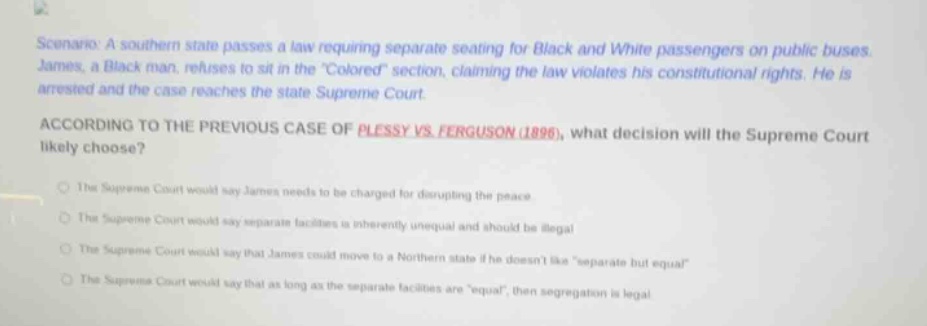
scenario: a southern state passes a law requiring separate seating for black and white passengers on public buses. james, a black man, refuses to sit in the \colored\ section, claiming the law violates his constitutional rights. he is arrested and the case reaches the state supreme court. according to the previous case of plessy vs. ferguson (1896), what decision will the supreme court likely choose? the supreme court would say james needs to be charged for disrupting the peace the supreme court would say separate facilities is inherently unequal and should be illegal the supreme court would say that james could move to a northern state if he doesnt like \separate but equal\ the supreme court would say that as long as the separate facilities are \equal\, then segregation is legal
Plessy v. Ferguson (1896) established the "separate but equal" legal doctrine, which held that racial segregation in public facilities was constitutional as long as the separate facilities were deemed equal in quality. This precedent would guide the court's decision in the described scenario.

Snap & solve any problem in the app
Get step-by-step solutions on Sovi AI
Photo-based solutions with guided steps
Explore more problems and detailed explanations
The Supreme Court would say that as long as the separate facilities are "equal", then segregation is legal.